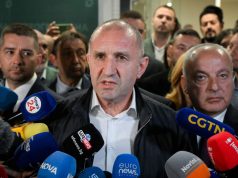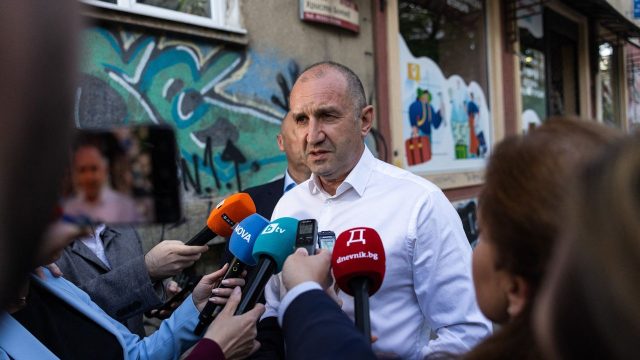
Former fighter pilot Rumen Radev led his party into Bulgaria’s parliamentary election promising to take on the “corrupt officials, conspirators and extremists” he claimed had run the country into the ground.
Voters responded on Sunday by handing his newly formed Progressive Bulgaria (PB) coalition the “single biggest vote haul in a generation”, which “paves the way for greater political stability after eight elections in five years”, said Reuters.
“This is a victory of hope over mistrust, a victory of freedom over fear,” the 62-year-old Radev said after his landslide victory. Bulgarians had “rejected the complacency and arrogance of the old parties and did not succumb to lies and manipulation”.
Corruption crusader
Radev rose through the ranks of the Bulgarian air force to become a major general and finally head of the service. A relative latecomer to politics, he was elected to the largely ceremonial role of president in 2016. He held the position for nine years, keeping himself above the chaos and corruption scandals that have dominated Bulgarian politics in recent years.
In January he resigned, forming his new PB movement to run in the election after massive anti-corruption protests brought down the previous government. On Sunday he won just under 45% of the vote, giving Bulgaria its first parliamentary majority in nearly 30 years.
The “main factors” driving Radev’s victory were “deep frustration over years of futile anti-corruption efforts, concern over rising prices… and a potent mix of pro-Russian sentiment”, said Atanas Rusev, from the Center for the Study of Democracy in Sofia. “Radev played astutely on all these anxieties.”
The result “raises expectations of an end to the country’s cycle of short-lived coalition governments”, said Deutsche Welle. Radev had pledged to “crack down on corruption, tackle inflation and pursue a more independent foreign policy within the EU – one that does not exclude dialogue with Russia”.
EU tightrope
A Radev-led government is “bad news for Ukraine and would represent a significant win for Russia”, said Jan Surotchak on the Atlantic Council think tank. In the short term, his victory will “likely mean an end to Bulgarian ammunition supplies to Ukraine, forcing Nato to seek other sources”. The US-backed northern corridor for energy supplies to Eastern Europe could also “lose out in favour of Turk Stream, the last major energy pipeline bringing Russian gas to Europe”.
Radev’s winning message has been a “cocktail of anti-corruption pledges, Euro-scepticism and pledges to rebuild ties with Moscow, spooking some EU and Nato diplomats”, said the Financial Times. But “while his outreach to Russia may be symbolically valuable to the Kremlin, it is likely to be far less consequential in practice” than the recently deposed Hungarian prime minister Viktor Orbán, who “routinely vetoed EU decisions in order to benefit Moscow”.
“Unlike in Hungary the political cleavage here between the anti-corruption platform and the anti-Russia platform is wide, so those two messages won’t reinforce each other in quite the same seismic way,” said Vessela Tcherneva, from the European Council on Foreign Relations.
“Maintaining a strategic ambiguity towards Russia and the EU” while focusing on his anti-corruption message helped Radev secure an absolute majority, winning votes from both the far-right and progressives, said The Guardian. This may bring the country “political stability” but “leave it walking a tightrope on EU issues”.
Newly elected PM Rumen Radev’s winning message was a ‘cocktail of anti-corruption pledges, Euro-scepticism and pledges to rebuild ties with Moscow’