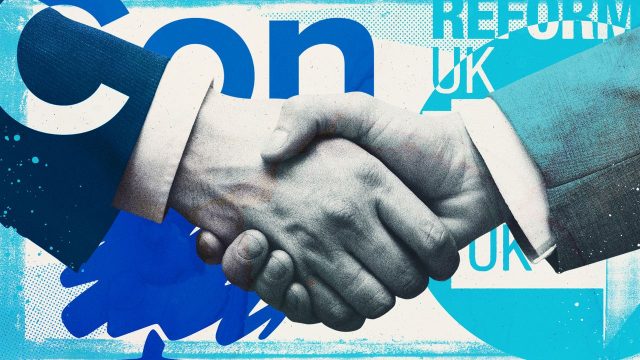
Nigel Farage reportedly expects an electoral pact or even a merger between Reform UK and the Conservatives before the next general election, a shift which would represent a historic realignment of the right.
A Reform donor said Farage told them that an agreement on cooperation between the two parties could help his party’s path to electoral success, according to the Financial Times. Another associate said that Farage described a pact or merger as “inevitable”, although the party leader said he “felt betrayed after the pact he made with the Tories at the 2019 election”.
“They will have to come together,” the donor said. “The Conservatives have been a successful political party forever because the left was always divided…If the right is divided, it can’t win.”
What did the commentators say?
I have long been sceptical of such a pact, said the newspaper’s Stephen Bush in his Inside Politics newsletter. Farage is a “polarising figure” who could unite the left and centre against him. Reform may be the “stronger party” in the polls, but the Tories have far more MPs – any deal would have to involve a lot of Tory losers, with many serving MPs “shunted out of plum seats”. But talk of a pact is “no longer far-fetched”. Kemi Badenoch’s lacklustre leadership has “made the Tory party such a marginal bit-part player that I am no longer so sure”.
Farage dismissed the accounts of his alleged remarks, telling the FT that “sometimes people hear what they want to”. After next May’s devolved elections and local polls, the Conservatives “will no longer be a national party”, he said. “I would never do a deal with a party that I don’t trust. No deals, just a reverse takeover. A deal with them as they are would cost us votes.”
But even if Reform does as well as current polls suggest, those numbers still wouldn’t give the party a Commons majority, said Sky News’ deputy political editor Sam Coates. Farage would need backing from Tory MPs to get into No. 10. While Badenoch has dismissed the idea, YouGov polling of members before conference season found that 64% supported an electoral pact, and 46% supported a full-blown merger. “The appetite’s there.”
Frankly, there is “already a slow merger going on”, said George Eaton in The New Statesman. Over the past year, 21 current or former Conservative MPs have “defected to Reform” – three this week. Reform’s ratings have also fallen in recent polls, and “waves of tactical voting” saw it lose the Hamilton and Caerphilly by-elections. Under a “more confident” Badenoch, the Tories’ standing is improving. “So is a deal inevitable?” One of Farage’s closest aides told the magazine: “Over my dead body.”
What next?
No pacts or deals will be considered while Badenoch is party leader, a Conservative spokesperson told Sky News. “Reform wants higher welfare spending and to cosy up to Putin.”
Anthony Wells, head of politics and elections at YouGov, told the FT that although Reform was “miles ahead in the polls”, tactical voting by left-leaning voters could block Farage from power. There are also a significant number of Conservative voters who wouldn’t back Farage even if the alternative was Keir Starmer’s Labour. “There are some Tories that really don’t like Reform,” said Wells, “so there will be some leakage from right to left.”
And therein lies “the key point to keep in mind: pact or no pact”, said Eaton. What really matters for the election is “whether the right is more divided than the left”. Labour and the Lib Dems have never needed a pact to “demolish” the Conservatives with progressive tactical voting, such as in 2024. Reform and the Tories don’t need a pact to “do the same to Starmer”.
Nigel Farage’s party is ahead in the polls but still falls well short of a Commons majority, while Conservatives are still losing MPs to Reform