
What happened
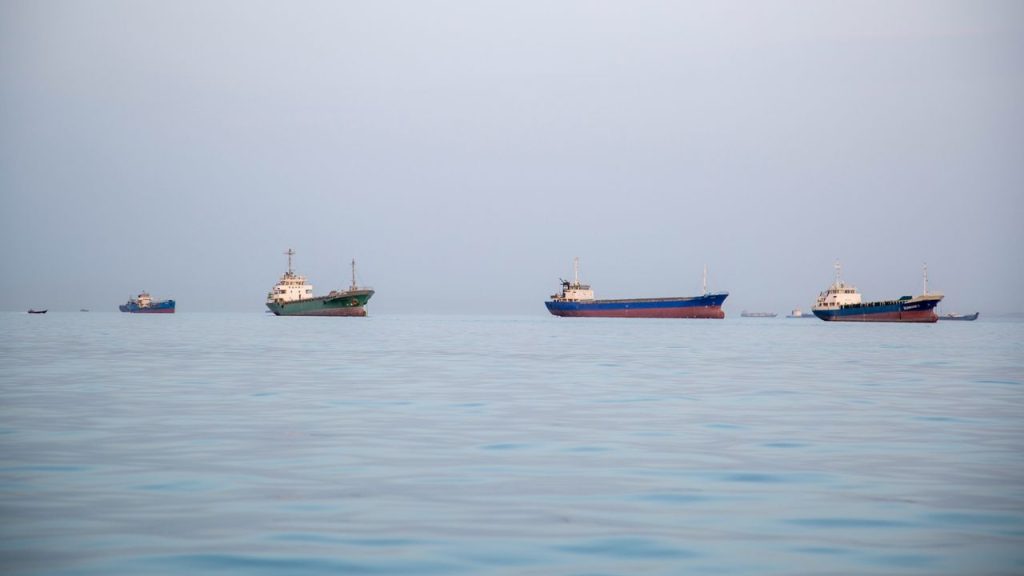
With peace talks between the U.S. and Iran at an impasse, the clash for control of the crucial Strait of Hormuz intensified last week as Iran seized at least two cargo ships in the trade corridor in retaliation for a U.S. naval blockade of its ports. The Navy has turned back some 30 ships trying to enter or exit Iranian ports since the blockade was imposed earlier this month, and in a bid to ramp up the economic pressure on Tehran, the U.S. last week boarded a tanker carrying Iranian oil in the Indian Ocean and seized an Iranian-flagged container ship that tried to run the blockade. The Iranian regime accused the U.S. of “piracy” and soon after seized two cargo ships—one flying a Panamanian flag, the other a Liberian flag—claiming the vessels had tried to navigate the contested strait without its approval. White House spokesperson Karoline Leavitt said Iran’s attacks on “international vessels” didn’t constitute a violation of the U.S.-Iran ceasefire.
A U.S. delegation led by Vice President JD Vance was set to travel to Pakistan for a second round of peace talks, but the trip was delayed after Iran refused to take part. A foreign ministry spokesman cited “contradictory messages” and “inconsistent behavior” from the Americans; other Iranian officials cited the blockade, which the regime called “an act of war.” Trump, who had warned that the “military is raring to go” for strikes on Iran if a deal wasn’t reached before the temporary ceasefire ended last week, extended the truce indefinitely, saying Iran’s leadership was “fractured” and needed time to “come up with a unified proposal.” Iranian officials accused Trump of trying to “buy time for a surprise strike.”
With traffic at a standstill in the strait, which carried some 20% of the world’s oil before the start of the war, U.S. Energy Secretary Chris Wright acknowledged that gas prices—now averaging about $4 a gallon—might not drop below $3 until next year. Trump said that’s “totally wrong” and that prices will plummet “as soon as this ends,” a claim experts called unrealistic. “Oil and gasoline rise very quickly, and they come down very slowly,” said economist Peter Earle. A new Quinnipiac poll found 65% of Americans blame Trump for the spike in gas prices, and more than half blame him “a lot.”
What the columnists said
As Trump’s approval numbers plunge to the mid-30s, associates say he “wants out of the increasingly unpopular war,” said Barak Ravid in Axios. His negotiators suspect a peace deal is within reach, but that “they may not have anyone in Tehran empowered to say yes.” Hard-line generals from the elite Revolutionary Guard now run the country, and they’re “openly at odds over strategy” with Iran’s civilian negotiators. The new supreme leader, Mojtaba Khamenei, could break the impasse. But he is rumored to have been badly wounded in the air strike that killed his father, former Supreme Leader Ali Khamenei, and is “barely communicating.”
There’s another major obstacle, said Alayna Treene and Kevin Liptak in CNN.com: The Iranians don’t trust Trump. The two sides seemed two weeks ago to be nearing an agreement. Then Trump went on a tear on social media and in interviews, falsely claiming Iran had agreed to “a host of provisions that hadn’t been finalized” and had accepted the most contentious U.S. demands, such as handing over its stockpile of enriched uranium. That tanked “the rising optimism for a deal,” and “it’s unclear where peace talks go from here.”
“Even Trump’s most basic claims about the Iran war can’t be trusted,” said Daniel Dale, also in CNN.com. He said last week that Vance was en route to Islamabad; in fact, the veep had never left the U.S. And he falsely claimed two weeks ago that Iran had agreed to never again close the Strait of Hormuz. Virtually nothing the president says can be taken at face value, a situation the world “has never had to contend with.” He’s confounded not just negotiators but ordinary Americans, said Peter Hamby in Puck. A new poll shows they “have no idea why this war is happening,” with answers ranging from keeping Iran from getting nukes (22%) to “taking oil” (20%) to “a show of power” (13%).
Control of the strait has become “the strategic fulcrum of the war,” said National Review in an editorial. Iran seems to think if it keeps the strait closed it will “exact so much economic pain” that Trump will end his blockade, or accept a deal that relents on his “red lines.” He needs to convince Tehran he’s “perfectly willing to start shooting again” and “take the strait back by force.”
Iran thinks it has the upper hand, said Erika Solomon in The New York Times. After a “high-stakes game of chicken,” it believes “Trump blinked first” when he extended the ceasefire with no concessions. That validates its view that Iran’s readiness to absorb the economic pain wrought by the war exceeds Trump’s. The regime sees this as an “existential battle,” and no matter how much suffering the blockade inflicts, experts say “it’s not going to blink.”
Both sides have powerful incentives to end this, so “in a world of logic” a settlement would be “a safe bet,” said Marc Champion in Bloomberg. But we’re in a realm where logic doesn’t seem to apply, stuck with leaders who lack “the personal and political courage needed for compromise.” In Tehran, fanatical hard-liners call the shots. In Washington, we have a president who “seems to live in his own movie, reinventing reality to follow a script in which he plays the triumphant hero.” It’s “an inherently unstable situation” with no obvious way out, and “a return to war looks all too possible.”
Retaliation includes the seizure of cargo ships