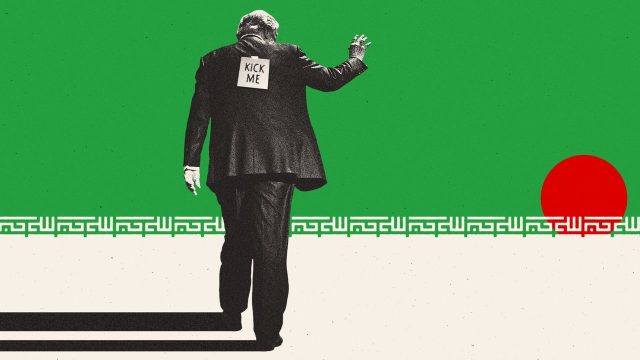
Donald Trump’s claim that the US and Iran are closing in on a peace deal has already been met with widespread criticism within his own Republican party.
The details haven’t been made public but Iran is said to have agreed to reopen the Strait of Hormuz, without charging tolls, and dispose of its stockpile of highly enriched uranium. In return, the US would cease hostilities, unfreeze billions of dollars of assets, and gradually remove economic sanctions.
But Republican Senator Ted Cruz said it would be a “disastrous mistake” to leave Iran “able to enrich uranium and develop nuclear weapons, and having effective control over the Strait of Hormuz”. And Senator Roger Wicker, chair of the Senate Armed Services Committee, warned that the emerging deal “would not be worth the paper it is written on”.
What did the commentators say?
The “grim reality” is that, by closing the Strait of Hormuz, Iran has “leverage” over peace talks, said the Financial Times’ chief foreign affairs columnist Gideon Rachman. And now the US seems poised to agree to a deal that “threatens to leave Iran in a stronger position than before the war began”. Trump likes to “deride” the nuclear non-proliferation agreement that Barack Obama negotiated with Iran in 2015, but this looks in many ways “worse”. Perhaps the US president “should have reread” his book, “The Art of the Deal”.
Eli Groner, a former director-general of Benjamin Netanyahu’s office, said Iran’s knowledge that it can now close the Strait of Hormuz at any point “is a victory far deeper and more strategic than any point-scoring military achievement”. His summary? “Disaster.”
The framework of the deal described by US officials would be “a series of compromises, well short of the capitulation that Trump sought”, said David Ignatius in The Washington Post. Iran hasn’t accepted his demand that its highly enriched uranium be delivered to the West, nor has it agreed to give up its “right to enrich” in the future. But Trump “doesn’t appear to have any better options” to escape what has become “a military morass and a strategic dead end”. Tehran “can claim victory simply by having survived” the US assault.
Some Republicans are arguing that “peace could bring a pay-off for voters” by lowering petrol prices and easing inflation as oil tankers start to move through the Strait of Hormuz again, said CNN’s Stephen Collinson. But recovery from the strait’s closure will take time and won’t “immediately improve global economic prospects or affordability in the US”. Trump “can’t win politically”: given that a majority of Americans oppose the war, he would face a huge “backlash if he ordered new strikes”.
There’s no way to spin this humiliating “catastrophe”, Middle East expert Danny Citrinowicz, a fellow at the Atlantic Council, told The New Yorker. Rather than toppling the Iranian regime, the US and Israel have “ended up strengthening” it. It’s hard to imagine Tehran will just “give up its nuclear material” – to Trump or anyone else – because “they’re so much in the driver’s seat” here. Iran is already rebuilding its missile capacity and still has most of its launchers. Now we have “a more radicalised regime that can rush into a nuclear bomb and still have a conventional missile capacity. It’s a shit show.”
What next?
We have “reached a conclusion on a large portion of the issues under discussion”, Iran’s foreign ministry spokesman Esmail Baqai told a news conference in Tehran yesterday. “But to say that this means the signing of an agreement is imminent – no one can make such a claim.” The two sides were not discussing Iran’s nuclear programme “at this stage”, he added.
This is “not a final settlement”, said the BBC; this “memorandum of understanding” seems simply to involve a 60-day extension of the ceasefire and a plan for further negotiations on “some of the thorniest issues”, including the nuclear one. That timeline seems “rather compressed, given the complexity of the issues”, said CNN’s Collinson. “History shows Iran would love to drag the United States into a prolonged period of inconclusive diplomacy that lasts months or years.”
Critics believe mooted ‘memorandum of understanding’ leaves ‘radicalised‘ Tehran in stronger position than before US assault