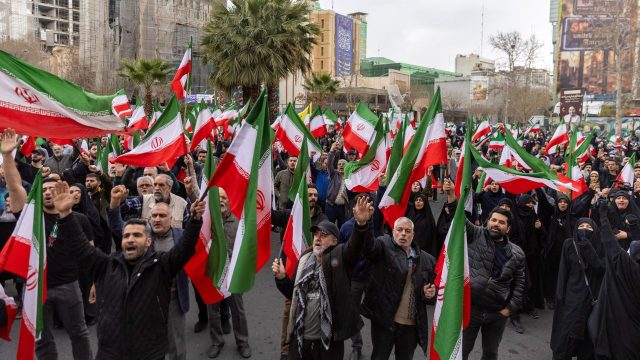
Long before the open warfare of recent months, the US and Iran have been locked into decades of low-level conflict. Since the revolution of 1979, the Islamic Republic of Iran has considered the US the “Great Satan” (Israel is dubbed the “Little Satan”). The leaders of the new Shia Muslim theocracy thought of America as an intruder in the Middle East, and an obstacle to the mullahs’ goal of spreading their Islamic revolution. For decades, their political speeches and sermons have ended with the chant, Marg bar Amrika, “Death to America”. The US, for its part, has seen Iran as a fanatical and implacable foe.
What are the roots of the animosity?
Iran’s antipathy towards the US is rooted in the events of 1953, when the CIA – together with Britain’s MI6 – orchestrated a coup against the democratically elected Iranian prime minister, Mohammad Mossadegh. Considered a hero by many Iranians, Mossadegh had nationalised the British-owned Anglo-Iranian Oil Company. The US, fearing communist expansion into Iran, joined the UK in funding regime opponents, ensuring that their ally the Shah, Mohammad Reza Pahlavi – previously a constitutional monarch – was installed as head of state. British and US access to oil was restored. But as a result, the Shah was considered a puppet of the West by many Iranians; he used an often brutal secret police force to keep Leftist and religious opposition groups in check.
How did the Iranian revolution come about?
The Shah’s regime was corrupt and dysfunctional. And amid a sharp economic contraction in the late 1970s, protests paralysed the country. The protesters included secular left-wingers and nationalists as well as Islamists, but Ayatollah Ruhollah Khomeini, a fundamentalist cleric at that time exiled in France, emerged as the movement’s undisputed figurehead.
The unrest forced the Shah to flee in January 1979; within weeks, Khomeini had returned. On 11 February, Khomeini assumed leadership and established the theocratic government that still rules. President Jimmy Carter gave the Shah permission to enter the US for cancer treatment, and resisted the new regime’s demands for his return to stand trial. On 4 November 1979, enraged Iranian students broke into the US embassy in Tehran, taking 52 diplomats hostage for 444 days.
How did the US react?
The hostage crisis set the tone for post-revolution relations. President Carter ordered a rescue mission, which went wrong, resulting in a mid-air crash in Iran that killed eight US servicemen. Carter severed diplomatic relations, and although the hostages were released in 1981, relations have remained frozen ever since.
In the 1980s, a series of proxy struggles began. During the Iran-Iraq War, the US actively supported Iraq as the lesser of two evils, fearing Iranian victory and hegemony in the Gulf. In 1983, after a US peacekeeping mission in Lebanon turned into an intervention backing the country’s Christian government, two truck bombs killed 241 American service personnel. A Shia militia mentored by Iran, Islamic Jihad, claimed responsibility, and the US designated Iran a “state sponsor of terror”. In 1988, the US navy mistakenly shot down an Iranian passenger jet in the Persian Gulf, killing all 290 people on board. It was during this period that Iran decided to develop nuclear weapons, which the US regarded as a grave threat to its main regional ally, Israel.
Have relations always been bad?
After 9/11, more moderate elements in Iran’s government tried to advance dialogue, hoping to make common cause against al-Qa’eda and the Taliban. But in early 2002, President George W. Bush labelled Iran as part of the “axis of evil”, and began plans for regime change in Iraq; Iran, US officials suggested, would be next. In response, Iran formed an alliance that it called the “axis of resistance”, comprising Syria’s government, the Shia militant group Hezbollah in Lebanon, and Hamas in the Palestinian Territories (which it had funded since the 1990s).
The US-led invasion of Iraq in 2003 initially alarmed Iran’s leaders, but as the occupation fell into disarray, it became clear that it was a great opportunity for them. Iranian-aligned Shia militias and politicians soon became a leading power in Iraq – their fighters killed hundreds of US soldiers with improvised bombs. When President Obama took office in 2009, he sought to calm tensions.
In 2015, US-led negotiators and Iran’s President Rouhani reached a deal to curtail Iran’s nuclear programme. Iran agreed to slash the number of its uranium centrifuges (which turn uranium into a form usable in nuclear bombs) and submit to inspections. In return, sanctions would be lifted and more than $50 billion in frozen Iranian assets held abroad would be released. The deal was designed to prevent Iran from enriching large amounts of uranium until at least 2031. But it was dumped in 2018 by President Trump, who complained that it only limited Iran’s nuclear activities until 2031 and didn’t address the country’s support for terrorism abroad. Instead, sanctions were tightened.
Why has the US attacked now?
The White House perceives Iran to be weak. US-led sanctions have helped to create the deepest economic crisis in its recent history. Major popular unrest flared up late last year and was put down with massive loss of life (perhaps as many as 30,000 killed). The 7 October 2023 attacks on Israel are also a crucial factor. Though Iran is not thought to have orchestrated them, its role as a patron of Hamas convinced many in the US and Israel of the need for military action; and the great damage done to Hamas and Hezbollah by Israel since has removed a deterrent to attacking Iran. The 12-day war on Iran in June last year, successfully prosecuted by Israel and the US, suggested that it could be attacked with relative impunity.
What about relations with Israel?
Before the 1979 revolution, Iran mostly maintained good relations with Israel. It was the second Muslim-majority country after Turkey to recognise the Jewish state, became its major oil supplier and cooperated on weapons programmes. Even so, anti-Zionist sentiment was widespread in Iran, stoked by its Shia clerics. And after the revolution, hostility to Israel became central to the ideology of the new Islamic Republic: Ayatollah Khomeini severed diplomatic ties, portrayed Israel as a Western colonial outpost and illegitimate occupier of Muslim land, and called for its elimination. (When Egypt made peace with Israel in 1979, Iran cut off diplomatic relations with Cairo.)
Ideological opposition turned to proxy confrontation through Iran’s support for Palestinian Islamic Jihad and Hamas, and for Hezbollah, which fought Israel during its long occupation of southern Lebanon. Israel, in turn, has opposed Western rapprochement with Iran and carried out covert operations against its nuclear programme, including assassinations of scientists. Although no evidence shows Iranian involvement in planning the 7 October attacks, its leadership praised Hamas’s fighters and confirmed Tehran’s support “until the liberation of Palestine and Jerusalem”.
The US and the Islamic Republic of Iran have been at each other’s throats for nearly half a century