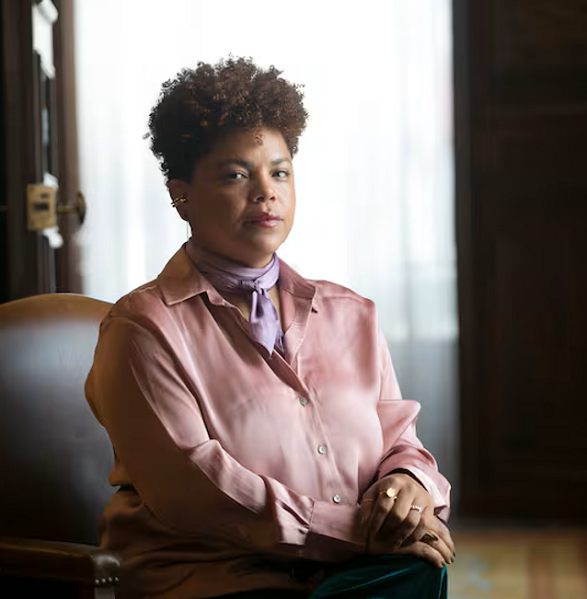
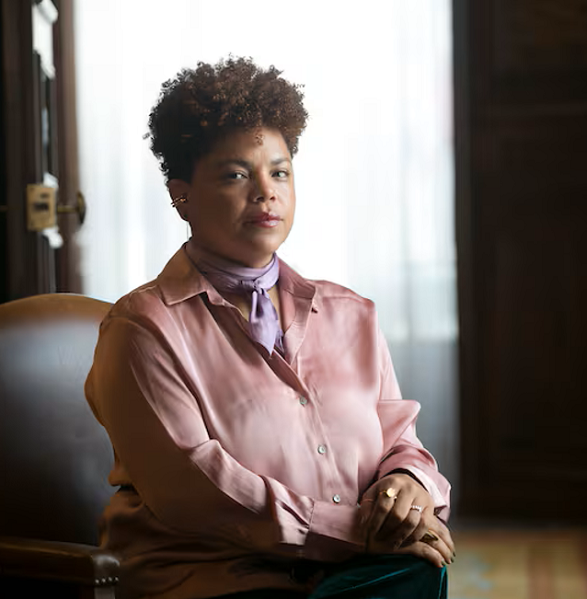
The full title of this article by María Fernanda Lattuada (El País, 3 April 2025) is “Johanné Gómez Terrero, directora dominicana: ‘Las voces de las personas esclavizadas no existen en nuestros archivos’” [Johanné Gómez Terrero, Dominican director: ‘The voices of enslaved people do not exist in our archives’]. Lattuada interviews Gómez Terrero, exploring the latter’s recent feature film, Sugar Island. She writes, “In Spain, the filmmaker presents her feature film Sugar Island, which highlights the migrant workforce, motherhood, and racial identity.”
See excerpts from the interview below. [Many thanks to Peter Jordens for bringing this item to our attention. See our previous post Film: Sugar Island.]
A train carrying a cargo of sugarcane. That was the image that director Johanné Gómez Terrero (Dominican Republic, 40) had of her childhood in San Pedro Macorís, in the east of the country, and wanted to capture in a documentary. But that image could only be filmed from a batey (a settlement of day laborers around sugarcane plantations), and the owners denied her permission. This refusal, however, was the impetus for a new project, Sugar Island, a feature-length fiction film that portrays the life of Makenya, a 16-year-old Dominican-Haitian girl forced to grow up prematurely due to an unwanted pregnancy, in a country where abortion is prohibited and where job opportunities are denied to her. This young woman lives in a batey where her grandfather —one of the thousands of Haitians hired in the 90s by the government for the Dominican sugar industry—fight for the for the pensions of these day laborers, while the mechanization of the sugarcane fields threatens her family with displacement.
The Spanish-Dominican co-production (Tinglado Films– Güasábara Cine) was recently presented in Spain on a tour to Málaga, Madrid, Barcelona, Valladolid, and Tenerife. As Gómez Terrero explains in an interview with EL PAÍS prior to the screening at Casa de América in Madrid, the film is like a river that is nourished by “many tributaries,” such as decoloniality, gender, motherhood, lineage and identity, and spirituality. [. . .]
Q. Makenya’s story is intertwined with gender, age, an unwanted pregnancy, the periphery, and Haitian descent. How does the film interweave all of this?
A. We are not isolated beings, and I wanted to think about it through a concept from the work of Ochy Curiel [Afro-Dominican anthropologist and philosopher], which is interweaving or intersectionality. I wanted to explore all those layers. If I work on teenage pregnancy, it’s not the same as a girl who lives in the city center and is middle class.
Q. Along with Makenya’s life, the film highlights sugarcane workers, like her grandfather. Why was it important for you to portray the lives of peasants [campesinos]?
A. I believe that the campesinos and those who have direct contact with the land sustain the lives of everyone. In the bateyes, during the privatization process, many sugarcane workers were left without pensions after having dedicated a large part of their lives to working in the sugarcane fields. To talk about the batey and sugarcane and to omit that situation would have been a huge omission. It’s a current issue. The sugarcane workers’ union exists and is still demanding pensions; it’s a much bigger problem than the film. For me, it was important to take charge and to observe everything I had to observe. You cannot be an artist and not be a witness. [. . .]
Q. In the Dominican Republic, since 2013, the Constitutional Court revoked the nationality of three generations of Dominicans of Haitian origin. The film addresses the situation of these people born in the country but without an identity card. Do you think the film is relevant at a time when far right [parties] and anti-immigrant rhetoric are gaining ground?
A. It’s extremely relevant because denationalization is present. The struggle of the sugarcane workers is present. I’d like to say the film is outdated, but it’s becoming more relevant. We have a wall, there’s a break in communication with Haiti, there are mass deportations… It’s a complex film to have conversations about in the Dominican Republic now; at the same time, I think [the situation] needs to be discussed because there is an exercise in violence. We have to understand that violence has many manifestations, and one of the many modes is telling someone who was born in a territory that they are committing a crime for walking on the land where they were born. [. . .]
Excerpts translated by Ivette Romero. For full interview, in Spanish, see https://elpais.com/planeta-futuro/2025-04-03/johanne-gomez-terrero-directora-dominicana-el-cine-permite-hacer-que-la-gente-mire-temas-que-no-esta-mirando.html
[Photo above: detail from photo by Santi Burgos, EL PAÍS.]
The full title of this article by María Fernanda Lattuada (El País, 3 April 2025) is “Johanné Gómez Terrero, directora dominicana: ‘Las voces de las personas esclavizadas no existen en nuestros archivos’” [Johanné Gómez Terrero, Dominican director: ‘The voices of enslaved people do not exist in our archives’]. Lattuada interviews Gómez Terrero, exploring the latter’s