
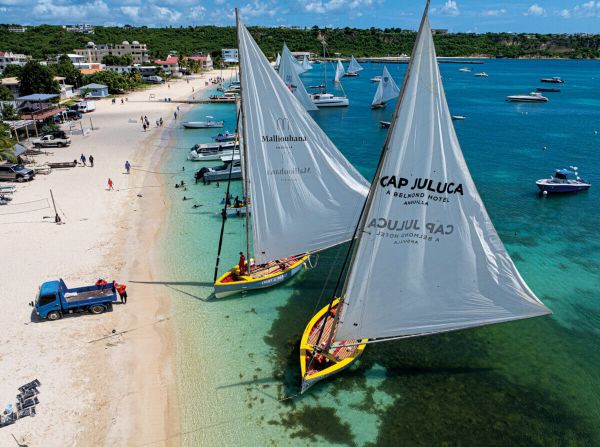
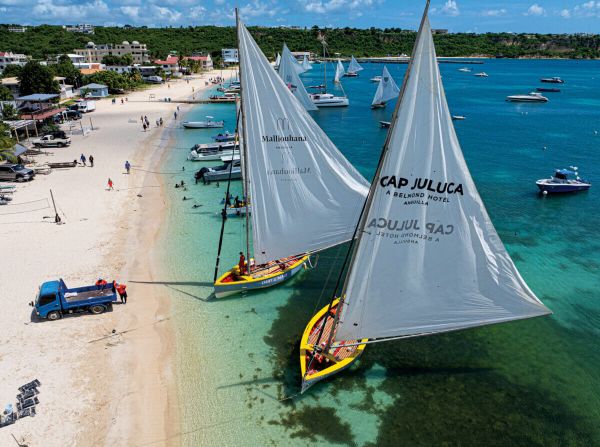
Carol Bareuther (All at Sea) examines the history of boat racing in Anguilla, which she calls a national sporting passion and pastime. She begins her article with this quote: “There are no yacht clubs in Anguilla, no commodores and flag officers in dress white trousers and blue blazers, no ensigns, no flags, no cedar paneled halls shelved with glittering trophies of past racing glories and broken records. Yet within this island, lapped by the crystal blue-green waters of the Caribbean, lurks a fever for boat racing.” — David Carty, author of the 1998-published Nuttin Bafflin and the 2011 documentary of the same name, which is available on YouTube. Here are excerpts from All at Sea.
Boat racing is the national sporting passion and pastime in Anguilla. In this case, boats are hand-built vessels crafted by family and friends in island backyards and neighborhoods, with 28-foot-long hulls, 54-foot-tall masts, and a 42-foot boom. These are Class A boats, with up to 20 to 22 crew. There’s also a Class B that’s 23-foot long.
Neither has a deck, a defining feature of an Anguillan race boat. There’s only a one-foot-wide rail for seating, rocks or sandbags for ballast, and huge wing-like sails. It’s a design that is centuries in the making and creates fast and agile craft in the wind and waves.
Sailing into the Present from the Past
Anguilla’s boat racing boats were born out of defense and vocational necessity rather than recreation. Three notable events set the scene for seafaring craft to become a vibrant part of Anguilla’s history and culture. First, in 1796, at the time of the Napoleonic Wars, French warships nearly destroyed Anguilla. The governor sent one fast sailing boat to St. Kitts to fetch a British naval frigate for help in what became the successful Battle for Anguilla, which the crew did despite having to tie ballast rock on the end of the boom to counterbalance a cracked mast from falling.
Secondly, during the mid-to-late 1800s, Nova Scotia and New England schooners started trade routes to Anguilla for salt and Sombrero Island, 34 miles north of Anguilla, for phosphate-rich seabird guano. A secondary technology transfer during this trade led Anguillans to construct their own sloops and schooners. A ship’s registry at the end of the 19th century showed a small fleet that ranged from 40 to 90 tons. Third, the turn of the 20th century saw the Dominican Republic grow rapidly with U.S. occupation and increased the need for laborers in the Spanish island’s sugar production. With a recruiting office nearby in Marigot, St. Martin, the Anguillan schooners started ferrying men west for a cane-cutting season.


“There’s a run off the wind directly from Marigot west to La Romana and San Pedro de Macoris,” says author David Carty, who also owns Rebel Marine Ltd., on North Hill, Anguilla. “The return trip is a beat straight back to the east where the schooners would have to tack because they’re coming back into the prevailing wind. On August Monday boat races each year, we still do it. We run off from Sandy Ground, go down a couple of miles, around a boat, back into sandy ground. That is a direct consequence of the Santa Domingo pattern of sailing.”
The 60- to 70-foot schooners’ return of 100 to 150 men home to their families in Anguilla was a joyous occasion. So much so that there were tremendous bragging rights for the first and fastest boat back. Thus, the seeds of racing were sown, with these farmers and cane cutters becoming skillfully adept at sailing. Going fast was also key for smaller boats, 18- to 24-foot ancestors of today’s racing boats, fished by day. At night, they plied the waters between Anguilla and St. Martin and St. Barth’s to smuggle in spirits and evade detection by Anguillan revenue officers ready to tax them to the tilt. Rum, gin, and brandy played a big role in ‘jollification,’ a tradition where neighbors helped each other plant subsistence crops and celebrated ‘payment’ in food and drink. [. . .]
For full article and fabulous photos, see https://www.allatsea.net/inside-anguillas-fierce-and-beautiful-tradition-of-boat-racing/5
[Photos above: courtesy of Clardio Design for All at Sea.]
Carol Bareuther (All at Sea) examines the history of boat racing in Anguilla, which she calls a national sporting passion and pastime. She begins her article with this quote: “There are no yacht clubs in Anguilla, no commodores and flag officers in dress white trousers and blue blazers, no ensigns, no flags, no cedar paneled