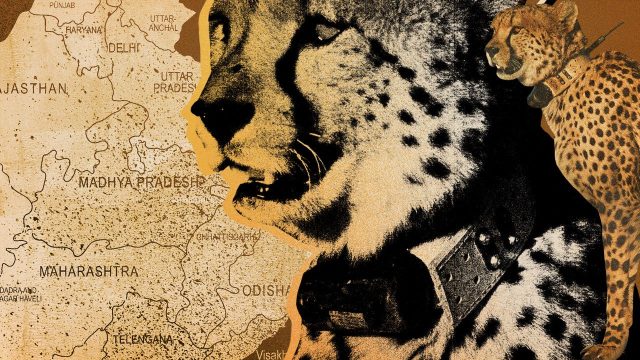
India’s programme to reintroduce cheetahs to the country is “flourishing”, but mounting opposition to “Project Cheetah” from local farmers has “teeth”, said The Times.
The big cats were declared extinct in India 70 years ago because of habitat loss, prey reduction and “rampant Raj-era poaching for luxury fashion”, but now they are back, and causing plenty of division.
Ambitious vision
India’s links with the “world’s fastest land animal date back centuries”, and the word cheetah itself comes from Sanskrit citra, meaning spotted. Royals “kept them as pets”, and in the 12th century they became a “popular hunting animal” and the Mughal emperor Akbar was believed to have collected some 9,000 of them.
Legend has it that the last three cheetahs in India were shot dead by the Maharajah of the historical state of Koriya, on a nighttime drive in 1947. Sightings were reported “intermittently” after that but the big cats were declared extinct in the country in 1952.
Then, in 2022, Prime Minister Narendra Modi, launched an ambitious scheme, with the aim of re-establishing the cheetah within its historical territory in the central state of Madhya Pradesh. The government claimed the project would aid global conservation and “improve livelihood options for local communities through ecotourism”, said The Hindu.
Re-establishing a cheetah population initially relied on importing cheetahs from countries like South Africa, Namibia and Botswana. Last month, “nine wild African cheetahs were tranquillised in Botswana’s savannah, quarantined for a few weeks in the country, and then taken on a 10-hour flight over the Indian Ocean by the Indian Air Force” before being delivered by helicopter to a national park in Madhya Pradesh.
The latest arrivals from Africa bring the total number of cheetahs in India to 53, 33 of which are native-born cubs. In December, the government said India was on course to have a self-sustaining population of cheetahs by 2032.
Land grab
But the project has had its “hiccups”, said The Times. Several cheetahs went into septic shock and died during a monsoon. Others perished from climate stress and parasitic infections as a result of their transition from Africa’s savannahs to India’s “scrub forest ecosystems”.
The new population of predatory carnivores is also proving a headache for local livestock farmers. One villager in Chak Kishanpur said she had lost her goats, worth 10,000 to 15,000 rupees (£90-£120) each, and is now forced to harvest wheat in a nearby field instead.
Some scientists are also opposed: conservationists have called for a ban on importing cheetahs, demanding that the most recent batch should be the last, citing an “abysmal lack of habitat and prey”, said The Hindu. The project is currently entirely based in the Kuno National Park, which will become more and more crowded if the free-ranging cheetah population continues to multiply.
This is a land grab in the name of conservation, Nitin Rai, a fellow at the Ashoka Trust for Research in Ecology and the Environment, told the outlet. Pointing to past conflict between state-led conservation efforts for tigers and the land rights of Indigenous communities, Rai said that “the cheetah, like the tiger, is being used as a proxy for territorial control of land and to move out forest dwellers.” The officials behind the cheetah scheme have “run roughshod over local opinions, understanding and histories of landscape change”.
Villagers and conservationists are up in arms over Narendra Modi’s Project Cheetah