
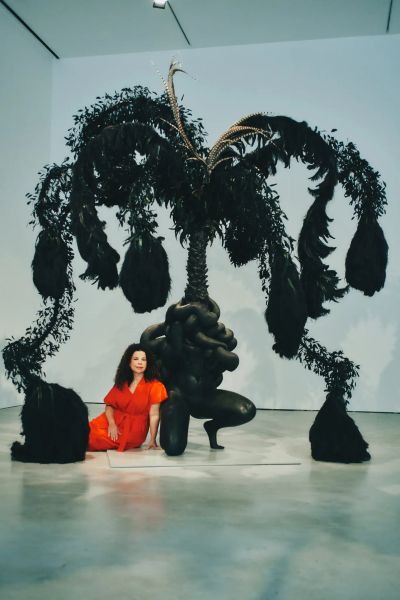
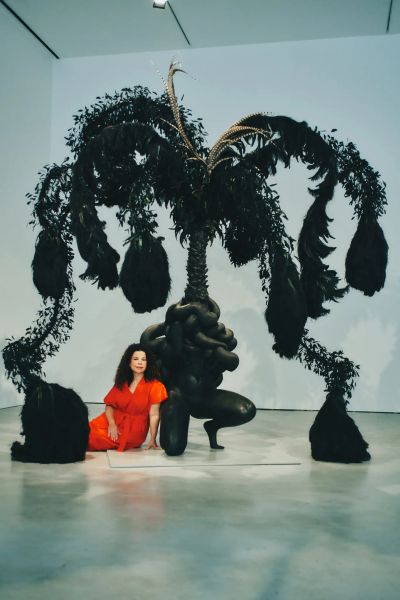
[Many thanks to Veerle Poupeye (Critical.Caribbean.Art) for bringing this item to our attention.] Written by J Wortham (and including excellent photos by Guarionex Rodríguez) for the NYT, this article explores Firelei Báez’s artistic cosmology and rootedness. Wortham writes, “Harnessing ‘trickster’ energy, the Dominican painter retooled graphics from the past to reimagine the future.” Firelei Báez’s exhibition “feet squelching on wet grass, nourished by uncertainty” is on view through July 31, 2026, at Hauser & Wirth (542 West 22nd Street, New York, New York). Here are excerpts; read full article in The New York Times.
Emma Willard was a feminist pioneer who pushed early for equality in education for white women and established herself as a reputable artist who combined her love of illustration with her love of pedagogy. She created inventive visualizations of historic events, which she described as “memory palaces.” In 1845, later in her life, Willard turned a drawing of a sprawling tree into a wall map depicting American history. It is perhaps her best-known illustration, which still appears as the cover of textbooks and is available, as a print.
Almost 200 years later, that map serves as a canvas for the artist Firelei Báez (pronounced FEER-eh-lay), who used the source material as inspiration for her own cosmology. Willard’s rambling tree reminded Báez of an underwater creature, so, for her solo show at Hauser & Wirth in Chelsea, she painted a large, milky white jellyfish whose lanky tentacles flop onto the tree’s bark, which is inscribed with the dates of “Columbus’ Discovery 1492,” “Pilgrims landing” and “Confederacy begins.”
In her own work, which Báez named “Not even unalterable limitations (or a transformational topology for remembering Willard’s Chronographer of American History),” a chaos of color erupts below the gelatinous creature, with protrusions of legs and feet, some comfortably blotting out the colonial past. Others use the base of the map for leverage, as if to flee the violence implicit in the timeline. The figure represents someone — or something — “coming into being, unruly, mid-formation,” Báez said.
Maps function as place makers and stand-ins for collective memory. But they have been manipulated endlessly to perpetuate notions and policies, often harmful, about global hierarchies and supremacies. Even today, on contemporary maps, Greenland often appears to be about the same size as Africa, even though Africa is roughly 14 times larger.
Báez, 45, has long collaborated with archives to unsettle the idea of a singular past, or a linear history — especially considering that Columbus’s “discovery” in 1492 was technically not what is currently called the United States. It was modern-day Dominican Republic, where she was born. Báez’s work remaps the stories of the world, creating possibilities to understand history anew, and by extension, humanity. [. . .]
For full article, go to https://www.nytimes.com/2026/05/28/arts/design/firelei-baez-hauser-wirth-exhibition.html1
For information from Hauser & Wirth (542 West 22nd Street) contact 212-790-3900 or hauserwirth.com.
[Many thanks to Veerle Poupeye (Critical.Caribbean.Art) for bringing this item to our attention.] Written by J Wortham (and including excellent photos by Guarionex Rodríguez) for the NYT, this article explores Firelei Báez’s artistic cosmology and rootedness. Wortham writes, “Harnessing ‘trickster’ energy, the Dominican painter retooled graphics from the past to reimagine the future.” Firelei Báez’s exhibition “feet