
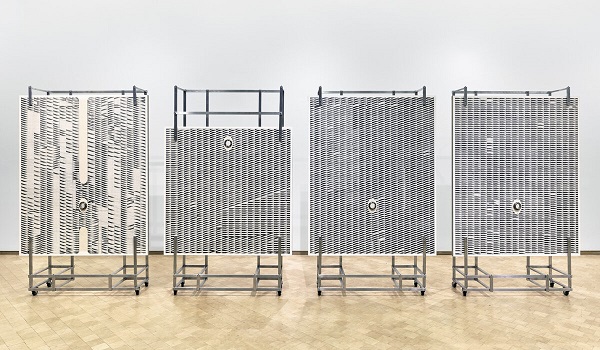

We missed this information on Flow States – LA TRIENAL 2024, but we’d love to share this outstanding review of Dominican artist Madeline Jiménez Santil’s work by Esteban Pérez (Contemporary& América Latina, 29 January 2025, translated by Jess Oliveira). [“Flow States” was on view at Museo del Barrio from October 10, 2024, to March 16, 2025.]
With an installation combining structures, drawings, vibrations, and sounds, artist Jiménez Santil creates a personal universe where she transforms an exclusionary system into spaces of freedom, crafting something entirely her own. This act of defiance, that she calls “contaminación” [contamination], stands as a declaration of autonomy and boundless creativity. [. . .]
A “glory hole” — a wall or partition with an opening facilitating anonymous sexual encounters —, takes on a striking new meaning in Flow States, LA TRIENAL at El Museo del Barrio in New York, curated by Rodrigo Moura, María Elena Ortiz, and Susanna V. Temkin.
In her piece My Dick Can Speak Your Language (2024), the Dominican artist based in Mexico City presents four panels set on mobile aluminum structures. The panels feature an immaculate black-and-white grid that looks as if it were machine-polished. However, the precise drawings and meticulously prepared supports are the result of the artist’s careful, handcrafted work.
Madeline Jiménez Santil’s creations blurs the boundaries between drawing, sculpture, and performative objects. The installation My Dick Can Speak Your Language functions as an interactive device, inviting viewers to activate the piece through “glory holes” that disrupt the immaculate grid of each panel. This disruption embodies tensions between Cartesian rationalism, which takes reason as the basis of knowledge, and dembow, a musical genre originating in the Dominican Republic with roots in reggae and Jamaican dancehall. From a young age, the artist excelled in mathematics, often studying to the rhythmic beats of dembow artists like La Insuperable. For her, music and mathematics were never separate or hierarchical. This connection is evident in her work, where the significance of dance and music creates a harmonious interplay, reflected in the titles of her pieces. Meanwhile, the grid on the panels evokes the duality of Cartesian binarism.
Jiménez Santil actively resists the colonial white gaze that prescribes how Black female bodies should behave, speak, move, and represent itself. She proposes a liberated body: free to imagine and desire and imagine without seeking to please anyone but herself. Thus, her pieces function as an alter ego, an avatar of her body, where dance becomes a meditative tool for self-knowledge and affirmation. [. . .]
Body and Multiplicity
From a young age, Madeline Jiménez Santil has been drawn to art and its history, even as its exclusivity marginalized non-hegemonic bodies and experiences. Rather than seeing this contradiction as a limitation, the artist perceives it as a space of great freedom to construct something new. Dancing within this contradiction is pleasurable for her. “Dancing makes me deeply aware of a geography and my body,” she explains, “it is a form of meditation.” Context, body language, and music are key elements in her work, as they act as generators of knowledge, which she then translates into groundbreaking artistic expressions.
Her work confronts norms and stereotypes of what a Black artist should be. This act of resistance comes at a cost—years of anonymity and an ongoing struggle to be seen in a world that overlooks and excludes those who refuse to conform to its expectations. [. . .]
Madeline Jiménez (Santo Domingo, 1986) is an artist living between Mexico City and Santo Domingo. In her practice, she imagines the transformation of objects and artistic conventions when in relation with a body that carries a different history.
Esteban Pérez (Quito, 1992) is an artist based in Berlin. His work explores alternative modes of attention for relating to the more-than-human world and landscape.
For full review and photos of her artwork, see https://amlatina.contemporaryand.com/editorial/imagining-perversely-with-madeline-jimenez-santils-art/
We missed this information on Flow States – LA TRIENAL 2024, but we’d love to share this outstanding review of Dominican artist Madeline Jiménez Santil’s work by Esteban Pérez (Contemporary& América Latina, 29 January 2025, translated by Jess Oliveira). [“Flow States” was on view at Museo del Barrio from October 10, 2024, to March 16,