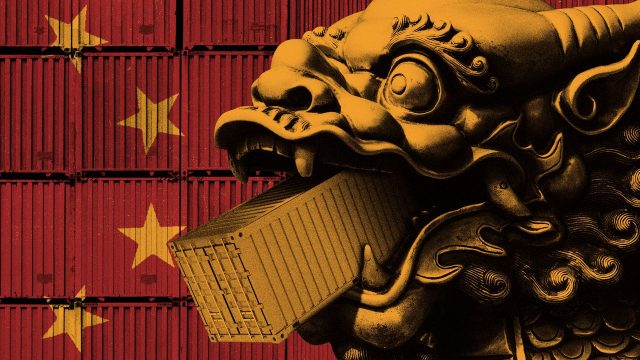
President Donald Trump’s tariff-driven trade war is not slowing down China’s export economy. Beijing this week reported a record $1 trillion trade surplus with the rest of the world in 2025, raising concerns about “growing imbalances” in the global economy.
The $1 trillion milestone puts China’s well-known “dominance” of world trade “into even starker relief,” said The Wall Street Journal. While Trump’s tariffs have limited the country’s exports to the United States this year — plunging nearly a third in November compared to last year — China’s exports to Africa, Southeast Asia and Latin America have “surged” significantly. The trend has “raised alarms around the world, especially in Europe,” whose automotive and luxury goods sectors find themselves threatened by “nimble Chinese competitors.”
That leaves Europe “squeezed between an ultra-competitive China and a protectionist America,” said Politico. China’s trade surplus “is untenable,” said French President Emmanuel Macron to the Les Echos financial newspaper. European companies were once big investors in China, he said, and now it is time for Chinese businesses to “create value and opportunities for Europe.” Europe could impose Trump-style tariffs on imports, Politico said, but Macron would prefer a “truce” with Beijing.
What did the commentators say?
China’s gigantic trade surplus reveals the difficulty that Trump and others will have “trying to rebalance global trade,” said Amy Hawkins at The Guardian. But it also demonstrates how much Beijing’s economic might is “still overwhelmingly reliant on foreign markets.” And it has raised fears that the country is now flooding non-American markets with “cheap goods that threaten local industry.” It is more likely, though, that those goods will “ultimately end up in the U.S.” after traveling through third countries to avoid Trump’s tariffs.
We could be looking at a “second China shock,” said Alexandra Stevenson at The New York Times. The first shock came two decades ago when American and European companies outsourced manufacturing to China while closing factories at home. The second will come now that China is “redirecting more of its exports to developing countries” that have “less control over how it unfolds.” There could be “profound” social consequences like unemployment and unrest in countries like Indonesia, Thailand and Malaysia as a result. “They’re going to need to brace for impact.”
What next?
The next developments may depend on whether the current trade “truce” between the U.S. and China can hold. Some observers believe the relative peace “may not last,” said CNBC. That failure — and a second effort by China to push its exports to other markets — “might compel Europe to impose more restrictive measures to protect its manufacturing sector,” said Jing Wang, a China economist at Nomura, to the outlet.
China’s economy will increasingly “ride on the strength of domestic demand,” said Bloomberg. For now, though, Beijing “faces a worsening economic picture” at home. There has been a slowdown in domestic consumption and investment is also falling. As a result, analysts believe that China will continue to rely on exports and take “only incremental steps” toward relying on its own people to be customers for the goods it makes.
Europe may impose its own tariffs