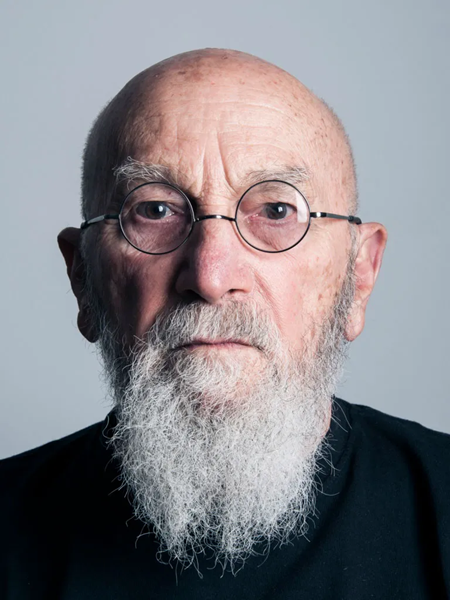
Barry Schwabsky, international editor at Artforum, remembers Rafael Ferrer (1933–2026), “whose scathing wit matched his exuberant inventiveness.” Read the full review and see photo gallery of Ferrer’s work at Artforum. Here are excerpts.
Rafi eventually seemed to fall out with almost everyone he knew. We had a falling-out too, but we kept the lines of communication open. It had something to do with my being too sanguine in the wake of the January 6, 2021, insurrection and the country falling apart; he couldn’t stomach my insufficient rage.
We’d met in passing sometime during the 1980s and renewed our acquaintance after I reviewed his 2010 retrospective at New York’s El Museo del Barrio for The Nation. [. . .] Unfortunately, our more sporadic recent emails about my coming out to see him again at his home in Greenport, Long Island, led to naught, as he died on September 27.
I think he must have been born a curmudgeon, though I always wondered what he had been like in his youth. By the time I met him, when he was in his fifties some forty years ago, he had already developed a scathing view of nearly everything. By the time he’d reached his nineties, he often sounded like he couldn’t wait to get out of a world that only seemed to keep getting stupider and stupider with every passing year.
Yet the truth is that he passionately loved being alive and being able to make art. The trenchant wit and formal inventiveness he cultivated inside the studio were his bulwark against this culturally bereft era—“the least hip time I have seen since I was fourteen. Social media is the kingdom of the squares,” he once told me. [. . .] If he became increasingly diffident about galleries and exhibitions in his later years, it was simply because getting other people involved seemed to put a damper on the fun he was having in his studio. He quoted fellow painter George McNeil: “If it weren’t for art, life would be a big zero.” [. . .]
That was the flavor of Rafi’s humor—the more scathing the better. [. . .] He also skewered the music world, which he had been involved with as an Afro-Cuban drummer as a young man. The one thing I don’t ever remember him being able to laugh about, no matter how bitterly, was the situation of his birthplace, Puerto Rico, under the colonial yoke of the United States.
His upbringing was unusually peripatetic. His parents sent him to a Virginia military school whose previous alumni included the future Republican presidential candidate Barry Goldwater, and from there he went on to Syracuse University. But he spent a lot of time with his much older half brother, actor José Ferrer, and José’s wife, singer Rosemary Clooney. He summarized what happened during this period in an email to me. [. . .]
Returning to the island after his time at Syracuse to study at the University of Puerto Rico, Ferrer came under the wing of the exiled Spanish Surrealist painter and writer Eugenio Granell (the probable source of the anecdote about the two poets). In another email from 2017, Rafi told me:
I was in his class for one year at the U of PR. I met him in Paris in 1954 and would go to Surrealist weekly meetings. Met Breton, his wife Elisa, and [Benjamin] Péret who spoke fluent Spanish. That summer went with Granell to [Wifredo] Lam’s studio. Granell was important for me as an example of a life dedicated totally to art with no compromise. His acerbic wit, ample knowledge of literature, Modernism, and extremism were the antithesis of the liberal art teachers I would meet later in the US. He was not really a significant painter; [he was] tied down by Breton and Surrealist dogma. The Spanish Civil War had galvanized his personality not only by seeing death up close but narrowly escaping it. Member of POUM [Partido Obrero de Unificación Marxista (The Workers’ Party of Marxist Unification)], probably the most radical faction of the Republican cause, he hated the Communists and saw Stalin’s secret service in action as they subverted the Republic by killing its leaders. One particular thing he said many times was prophetic: “Ferrer, in times of extreme upheaval the Liberals will always fail you.” He never saw Art as a liberal activity.
“When I moved to New York City in the ’50s” to be a musician, Rafi told me, “my very first ‘gig’ was a long winter at Grossinger’s”—the famous Borscht Belt resort in the Catskill Mountains of upstate New York [. . .]. No wonder visual art began to have a stronger appeal. Besides, he found the spectacle of older musicians having to—in his words—“prance around onstage” an unpleasant portent for the future. “I decided that my painting would never be the equivalent of that pseudo-Cuban music for nightclubs. I refused to paint cha-cha-cha. I wanted with all my heart to paint the drama of my country. [. . .]”
Yet the first works of his to draw wide attention were not pictures and had an undeniable performative dimension: He staged guerrilla interventions delivering bushels of leaves or gigantic, cakelike piles of ice to disperse or melt on gallery and museum floors. Pieces such as these got him into some of the most prominent shows of Conceptual and post-Minimal art between 1969 and 1970: “Live in Your Head: When Attitudes Become Form” at the Kunsthalle Bern, Switzerland; “Op Losse Schroeven (Square Pegs in Round Holes)” at the Stedelijk Museum, Amsterdam; “Anti-Illusion: Procedures/Materials” at the Whitney; and “Information” at New York’s Museum of Modern Art. And like many of his peers in the vanguard at the time, he was represented by Leo Castelli.
But sticking with what made for success was not in Rafi’s blood. In the early ’70s he started creating ramshackle boats and tents that seemed to evoke tribal ways of life in some distant Caribbean culture. [. . .]
Many of Rafi’s paintings of the ’80s depicted life in the Dominican Republic, where he was then spending much of his time. When Roberta Smith referred to these works as “faux primitivism,” Rafi subtly shifted the issue from how he was making them to whom he was painting: “They can call the people in the paintings natives or they can call them inhabitants of this place or the other, but I call them neighbors.” That was Rafi to a T. His art was intransigently and exuberantly eclectic, but it deeply involved the everyday and close-at-hand. Style was always about a way of life.
For full article, see https://www.artforum.com/columns/barry-schwabsky-on-the-life-of-rafael-ferrer-19332026-1234761177/
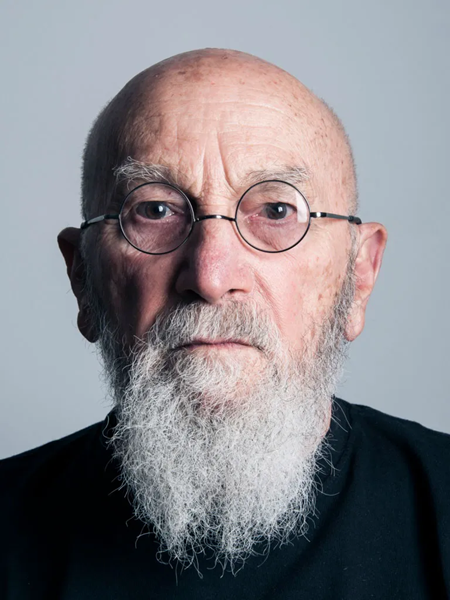
[Rafael Ferrer. Photo: Françoise Ferrer.]
Barry Schwabsky, international editor at Artforum, remembers Rafael Ferrer (1933–2026), “whose scathing wit matched his exuberant inventiveness.” Read the full review and see photo gallery of Ferrer’s work at Artforum. Here are excerpts. Rafi eventually seemed to fall out with almost everyone he knew. We had a falling-out too, but we kept the lines of