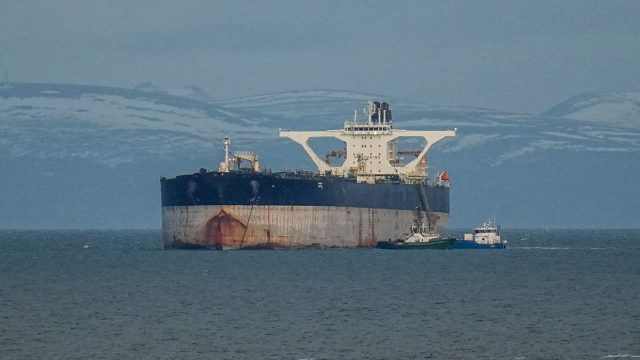
Today, an estimated 900 to 1,500 tankers – perhaps one in five in the world – are part of the global “shadow fleet”, defined by the International Maritime Organisation as “ships that are engaged in illegal operations for the purposes of circumventing sanctions, evading compliance with safety or environmental regulations, avoiding insurance costs or engaging in other illegal activities”.
While such ships have long been used to transport oil from sanction-hit nations such as Venezuela and Iran, their numbers expanded rapidly after Russia’s invasion of Ukraine, when Moscow built up a clandestine network of hundreds of vessels. About half of the world’s shadow fleet vessels transport Russian oil; about 20% carry Iranian oil; Venezuela is the next biggest market. The shadow fleet transported some 3.7 billion barrels of oil in 2025, accounting for 6% to 7% of annual global crude-oil flows, according to the trade intelligence analyst Kpler.
How did Russia build up its fleet?
US, G7 and EU restrictions on Russian oil exports were introduced in December 2022, notably in the form of a price cap on Russian crude (initially set at $60 per barrel) designed to hit Russia’s economy while ensuring that the sanctions wouldn’t raise global oil prices. This banned Western shipping services, insurance and brokerage for Russian oil exports sold at any price above that cap; until this point Russia was highly dependent on all three.
In their place, tankers approaching their end of life were purchased by Russia, or by intermediaries, often using shell companies in opaque jurisdictions. In a period of 12 months, Greek owners sold 127 vessels worth $4 billion. Shipping specialists based in London helped facilitate the sales. These ships have been used to move Russian oil to Asia, primarily China and India, while preventing Asian buyers from being hit with Western sanctions. The oil is usually sold at a price above the price cap (now $47.60 per barrel) but below the going market rate (roughly $58-$62).
How do ships evade detection?
Ownership is disguised. The vessels often change their names, and their registrations. They are usually registered under flags of convenience (in states such as Gabon, Cameroon, or the Cook Islands, which maintain open ship registries with minimal oversight) or under false flags. The ships frequently turn off their tracking systems to “go dark”, or they digitally manipulate their location data. Oil can be pumped between vessels in remote areas of open ocean far from typical trading routes. This makes it difficult for monitoring bodies to trace the cargo back to Russia. And because Western insurers are forbidden from insuring them, tankers often operate with dubious Russian insurance, or no insurance at all.
What dangers do the ships pose?
They provide an economic lifeline to Putin’s Russia, allowing it to continue selling oil at near-market prices and fund its war effort. It is estimated that some 70% of Russia’s seaborne crude exports use the shadow fleet. In addition, because most shadow tankers are old, cheaply maintained, inadequately insured, and sometimes turn off their tracking systems, they raise the risk of accidents and spills. The environmental impact could potentially be huge: many tankers carry at least a million barrels of crude. If one of these “floating rust buckets” causes a billion-dollar oil spill, says Michelle Wiese Bockmann – an intelligence analyst at Windward AI – “good luck with trying to find somebody responsible to pick up any cost”: the costs will fall on the affected coastal state. Furthermore, Russia seems to have “weaponised” parts of its shadow fleet.
How have they been weaponised?
Some tankers have been implicated in damage to key infrastructure – perhaps because of poor seamanship, but potentially owing to deliberate acts of sabotage. In late December, Finnish police detained a cargo vessel, the Fitburg, which was sailing from St Petersburg to Haifa in Israel, and was accused of damaging an undersea telecoms cable in the Baltic by dragging its anchor over it. The Boracay, a Russia-linked ship, is suspected of having launched the drones that overflew two airports in Denmark (Copenhagen and Aalborg) last September, closing both down.
What can be done?
The US, the UK and EU can impose sanctions on specific vessels and on companies that deal with them. These mean that the ships can’t be insured in these jurisdictions, and that service and port bans can be imposed. However, it’s a game of “whack-a-mole”: the ships are usually renamed and reflagged. Besides, it doesn’t stop them sailing. Freedom of navigation is a core principle of international law, and the appetite of coastal countries to intervene – risking Russia’s wrath – is limited. A Russian jet was sent to escort one tanker challenged by Estonian forces last May. However, recent developments are making it harder for the shadow fleet.
And what are those?
Since December, six Russian shadow vessels appear to have been attacked by the Ukrainians, using naval drones – mostly in the Black Sea, but in one case even in the Mediterranean, off Libya. The ships were all disabled but not sunk. The second development is that the US has shown a willingness to seize all shadow shipping moving to and from Venezuela. More than 40 shadow fleet vessels involved in trade with Venezuela have been reflagged to Russia in the past six months, in an apparent attempt to gain Kremlin protection from American seizure. The Marinera, previously sailing under a false Guyanese flag, changed both name and flag while fleeing Venezuela, but that failed to stop US forces from seizing it. Four other vessels, including the M/T Sophia, also reflagged as Russian, have been seized. The UK has hinted that it too might confiscate sanctioned vessels.
The seizure of a Russian tanker in the Atlantic last week has drawn attention to the country’s clandestine shipping network