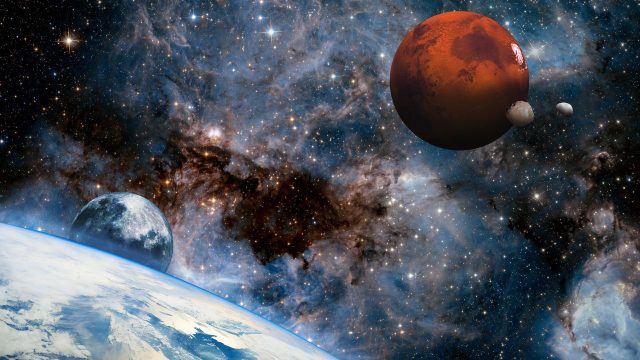
Small but mighty, the red planet — our celestial neighbor — has made Earth’s climate what it is today. Mars’ gravitational pull serves as a stabilizing force for our home’s orbit, tilt and position from the sun. Without it, life could potentially have been a lot different from what we know today.
How does Mars affect Earth’s climate?
Despite being approximately half the size of Earth and one-tenth its mass, Mars’ gravity has had a sizable effect on Earth’s climate, according to a study published in the journal Publications of the Astronomical Society of the Pacific. Specifically, the red planet is “quietly tugging on Earth’s orbit and shaping the cycles that drive long-term climate patterns here,” said a release about the study.
Earth’s climate is largely driven by Milankovitch cycles, which are “long-term variations in our planet’s orbit and tilt governed by the gravitational pull of other planets in the solar system,” said Space.com (a sister site of The Week). One cycle takes approximately 430,000 years and is largely affected by Venus and Jupiter. Mars has little to no effect on this cycle, originally leading scientists to believe that the planet did not have much pull on Earth’s climate. However, it turns out that Mars “punches above its weight,” said Stephen Kane, the study leader and a professor of planetary astrophysics at UC Riverside, in the release. Subtracting Mars from the equation significantly affected two other climate cycles, one of them 10,000 years long and the other 2.3 million years long. “When you remove Mars, those cycles vanish,” Kane said. “And if you increase the mass of Mars, they get shorter and shorter because Mars is having a bigger effect.”
These cycles “affect how circular or stretched Earth’s orbit is (its eccentricity), the timing of Earth’s closest approach to the Sun, and the tilt of its rotational axis (its obliquity),” said the release. This determines “how much sunlight different parts of the Earth receive, which in turn affects glacial cycles and long-term climate patterns,” including ice ages.
Mars’ positioning is what gives the lighter planet such a strong pull. “The closer it is to the sun, the more a planet becomes dominated by the sun’s gravity. Because Mars is further from the sun, it has a larger gravitational effect on Earth than it would if it was closer,” Kane said.
What are the implications?
Earth’s obliquity can “vary between 21.5 and 24.5 degrees every 41,000 years,” said Space.com. This is considered to be quite stable compared to other planets. It was thought that the moon was responsible for the stability in Earth’s tilt, but “simulations show that Mars’ gravity also stabilizes Earth’s tilt,” which “potentially removes the necessity for a large moon to keep an Earth-like planet from wobbling.” This pattern could exist elsewhere, too, on other habitable exoplanets with similar properties to Earth. “When I look at other planetary systems and find an Earth-sized planet in the habitable zone, the planets further out in the system could have an effect on that Earth-like planet’s climate,” Kane said.
Ice ages notably “changed Earth’s landscapes,” said Tech Explorist. They “shrank forests, spread grasslands and triggered major evolutionary changes, such as walking on two legs, making tools and working together.” It begs the question, said Kane: “What would humans and other animals even look like if Mars weren’t there?”
A pull in the right direction