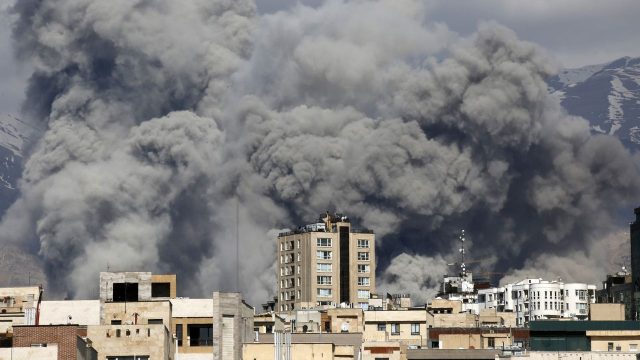
Donald Trump expects the conflict in Iran to continue for “four to five weeks” and says “it won’t be difficult” to maintain the US joint operation with Israel in the region.
But “what happens in Iran doesn’t stay in Iran”, said the Atlantic Council. The consequences of US and Israeli-led military campaigns “will radiate across the region and the world”.
What did the commentators say?
The lack of an obvious plan and failure of diplomatic talks could lead the US into a “long-lasting” and “open-ended” conflict, said Robert Tait in The Guardian. Trump has opened the door to more negotiations and said “I will be talking to them”, but Iranian representatives “waited too long” and “should have given what was very practical and easy to do sooner”. However, considering recent attacks and Iran’s “retaliation” across the Middle East, “that might not be easy” now, said the paper.
The president has offered several “contradictory visions” of a new regime and the means of achieving it, said Zolan Kanno-Youngs, David E. Sanger and Tyler Pager in the The New York Times. Despite warnings from his advisers that there are “vast differences in cultures and history” between the two nations, Trump “appears enamoured of using a Venezuela-like model in Iran”. He told the NYT that “what we did in Venezuela, I think, is the perfect, the perfect scenario”.
Attacking Iran – which has three times the population of Venezuela – is considered “far more complex and risky” than the kidnapping of Nicolás Maduro. Unlike Venezuela, “Iran has sustained an active nuclear programme”. Trump’s comments “reflect the degree to which his administration remains uncertain about how the next few weeks will unfold, both on the battlefield and in the creation of a replacement government in Tehran”.
The killing of Ayatollah Ali Khamenei has “left the regime reeling” in Iran, said Gideon Rachman in the Financial Times, but it “does not answer the question of what comes next”.
Trump believes it would be “folly” to put US soldiers on the ground, as happened in both Afghanistan and Iraq. So the US and Israel is seeking to bring about regime change by “air power alone”: a decision without “real precedent”. The hope is that by removing the Iranian regime’s leader, the nation will spark into “organic and spontaneous transition to a new political system”, without “further US intervention. But there is little reason to believe that will work.”
Iran’s response to the attacks “may expand beyond the ballistic missiles it has used in the past to retaliate”, said Nancy A. Youssef and Jonathan Lemire in The Atlantic. Its navy has demonstrated in recent operations in the Strait of Hormuz that it could “shock global markets”, and its drones could “try to damage nearby US warships”. How long the war lasts is “not up to just Trump or Israel”: it is “in the hands of both the regime and the people inside Iran”.
Though there may be doubts over Iran’s “missile-launching capability” after the 12-day war with Israel last year, it is “not the only side with limitations that could dictate the length of the latest conflict”, said Joe Barnes in The Telegraph. The retaliation from Tehran has “raised questions” over the “fragility” of US and allied air defences in the region. Trump’s reluctance to put boots on the ground could also be a “limiting factor” as aerial campaigns alone “rarely achieve successes” in terms of regime change.
The president’s main constraints may lie at home, however, with a “largely isolationist” Maga base that “hates the idea of becoming entangled in foreign wars”. But his vanity dictates that Trump “must also deliver a moment he can sell as a win back home”.
What next?
The Foreign Office has “mounted an unprecedented operation to support British citizens in the Middle East”, said Sky News. It is considering plans for “mass evacuation” working on potential routes to transport tens of thousands of Britons “should airspace in the Gulf remain off-limits”.
In the Gulf, countries face an “impossible choice”, said Urooba Jamal in Al Jazeera. Either they “strike back” against Iran “and risk being seen as fighting alongside Israel, or remain passive while their cities burn”.
Following the death of Ayatollah Ali Khamenei, and strikes on Cyprus, Lebanon and Qatar, the US is risking a ‘long-lasting’ and ‘open-ended’ conflict