
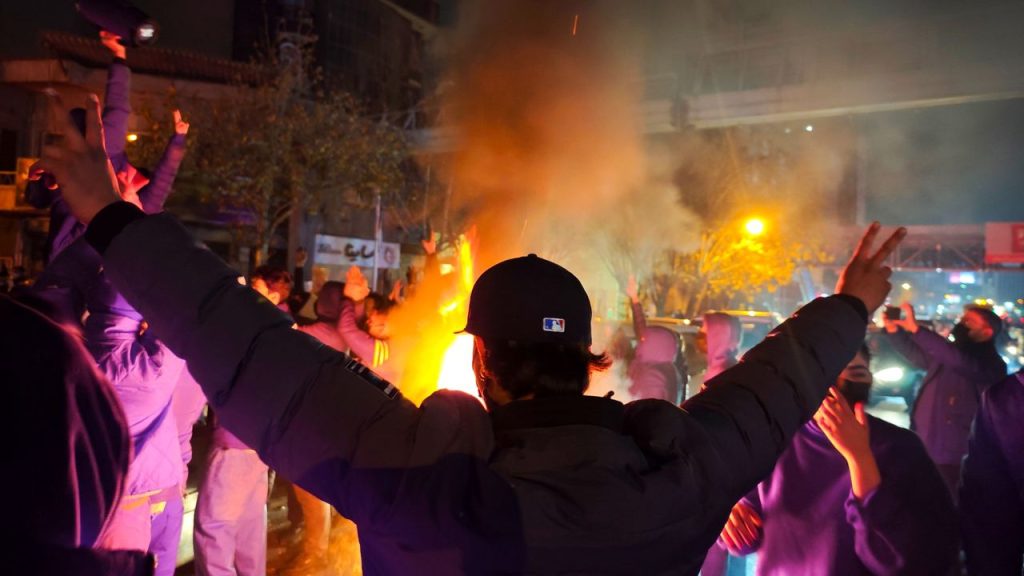
Iran’s supreme leader has blamed foreign actors for anti-government protests that rocked the regime and killed “several thousands” of people in recent weeks.
Ayatollah Ali Khamenei accused the US and Israel of direct involvement in the violence, following a brutal crackdown on protesters by the government.
While his remarks largely reaffirmed Iran’s longstanding position, “what stood out”, said Al Jazeera, “was the scale of the alleged death toll”.
‘Wide disparity in death estimates’
Estimates of how many have died since unrest broke out across Iran on 28 December have “varied”, said The Times, from several hundred to more than 20,000.
The communications blackout “not only halted public information flows but has also placed serious constraints on the independent verification processes of human rights organisations”, the Human Rights Activists News Agency (HRANA), an Iranian outlet based in Washington, told the newsaper.
Relying on reports from the ground and contacting mortuaries and hospitals, HRANA’s most recent estimates put the number of confirmed fatalities at over 4,000, with 9,000 further fatalities under review. A separate report compiled by doctors inside Iran suggest that the number of civilians killed could be as high as 20,000.
The “wide disparity in estimates” from rights groups and independent news agencies “mostly comes down to methodology”, said The Wall Street Journal. But if the figures emerging from the current violence are “roughly accurate”, they exceed those from previous crackdowns including the killing of demonstrators in Cairo following a military coup in 2013, and the Tiananmen Square massacre in China in 1989.
‘Purely psychological warfare’
As the protests spread, and with Donald Trump threatening to intervene militarily if the killing continued, the regime had an “incentive to under-report the toll and its opposition to exaggerate it”, said The Times.
There has been a noticeable shift in recent days as the immediate threat to the regime appears to have receded. On Sunday, an Iranian official in the region told Reuters that the authorities had verified that at least 5,000 people had been killed, including about 500 security personnel, blaming “terrorists and armed rioters” for the death of “innocent Iranians”.
Initially caught off guard, the regime at first sought to win over protesters by “acknowledging their demands and the hardships that they are facing,” Al Jazeera correspondent Resul Serdar Atas said, but authorities now argue the demonstrations were “hijacked by the violent protests who were receiving orders from the outside powers”.
At the same time, the regime’s propaganda machine has been “working to intimidate protesters and break their momentum”, reported ABC News. Among the few videos to have made it around the communications blackout and out of Iran are those showing long lines of body bags outside morgues in Tehran.
“This is purely psychological warfare to scare people”, said Saba Vasef, human rights journalist and scholar at the University of Sydney, “part of a systemic, deliberate, deterrence-based, state-sponsored terrorism”.
The reporting around the death toll in Iran has also revealed a double standard in the Western media, said Ahmad Ibsais, a first-generation Palestinian American, in an opinion piece for Al Jazeera. While estimates of those killed in Gaza were “repeatedly questioned” or caveated, those emerging from Iran, “in many cases based on estimates by diaspora organisations” such as the HRANA, “which have no ground access and no direct communication lines into the country, are being accepted as fact almost instantly”.
“This is not a failure of journalism alone, but a failure of moral consistency. Death is not measured by evidence, but by political utility.”
Regime blames killing of ‘several thousand’ people on foreign actors and uses videos of bodies as ‘psychological warfare’ to scare protesters