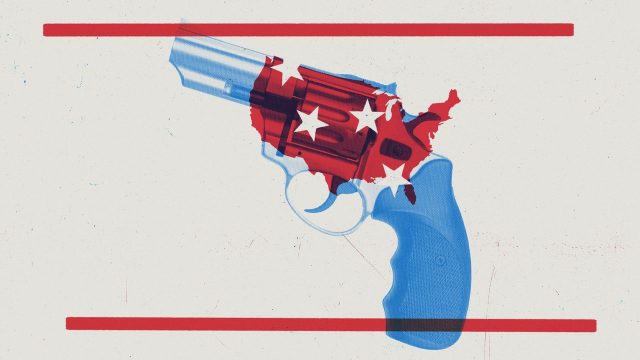
As polarisation increasingly divides America, violence is becoming embedded in its politics.
“We do believe it was administration officials,” said Acting US Attorney General Todd Blanche, when asked for the target of the shooting at the White House Correspondents’ Association dinner in Washington. “But as far as exacting threats that may have been communicated beforehand, we’re still actively investigating that evidence.”
For many Americans, Saturday night’s events were “at once shocking and familiar”, said Lisa Lerer in The New York Times. Politically motivated violence has become a “routine intruder” into our lives, bringing with it a “numbing narrative of assaults, bomb threats and assassination attempts”.
What did the commentators say?
“Instead of a speech stacked with heated barbs against the media, the event ended like many in the US do: with gun violence,” said Rachel Leingang in The Guardian.
The association’s initial decision to continue the event (it was later rescheduled) may have surprised some, but for many it “struck a chord about the regularity of gun violence in American life”. Trump said afterwards that the presidency is a “dangerous profession”, but the fact that violence in the political domain is a “feature”, rather than an “outlier, rang true on a night meant to celebrate the freedom of the press”.
Attacks like these are “convulsing” American politics from both sides of the partisan divide, said Guy Chazan in the Financial Times. The suspected gunman had barely been apprehended before “ranks of Maga influencers” were blaming Democrats, and left-leaning conspiracy theorists claimed it was a “staged” hoax to “advance Trump’s political agenda”.
So-called “conflict entrepreneurs” are “getting rich by making us angry at one another”, fuelled by a “loss of trust in democratic institutions that makes it easier to see illegal violence as a solution”, said William Braniff, from the American University. Modern assassination attempts are “backed by a growing public acceptance of the use of violence in the pursuit of political ends”, said Chazan. “Things could get even worse.”
Saturday’s events reveal how “dangerous” US politics has become over the last few years, said James Piazza, political science professor at Penn State, on The Conversation. Intense polarisation means opponents are “suspicious and hostile” towards each other, believing others to be “evil or immoral” instead of merely sharing a different view.
In turn, this has made violence more “normalised”, and because public backlash is “dampened” at each attempt, further violence becomes even “more likely”. Disinformation and social media have also accelerated this trend. Disinformed users are “hermetically sealed off” from alternative sources and this “facilitates radicalisation” for isolated communities.
Even with America’s “grim history of political violence”, Trump “certainly seems to attract a higher share than others of would-be assassins”, said Edward Luce in the Financial Times. He has now been the target of three assassination attempts: his “ear was grazed” by a bullet in Butler, Pennsylvania; there was the Mar-a-Lago golf course incident that was foiled by Secret Service agents; and then Saturday’s Washington dinner.
Nearly following in the footsteps of Abraham Lincoln, James Garfield, William McKinley and John F. Kennedy, Trump said that he was “honoured” by comparisons with the four assassinated presidents because he’s “done a lot”. Let’s not forget that eight children were killed in Louisiana last week, but it “only briefly made the headlines”: mass shootings are now “part of the texture of American life”, said Luce.
What next?
It is “absolutely critical” that both Democratic and Republican politicians “unite to condemn this attack and all political violence”, said Piazza on The Conversation.
Commentators should condemn any violence with political aims and political elites should “adopt rhetoric that does not normalise this sort of behaviour. If the message comes from across the political spectrum, it will be that much more effective at reducing the public attitudes that nurture political violence.”
Following the Pennsylvania assassination attempt the image of Trump with a bloodied face raising his fist “partly defined his campaign”, said Luce. This time around, “any sympathy wave is likely to be more limited”.
Before the incident at the Washington Hilton Hotel, Trump’s approval ratings hit a “personal low of below 40%” in some polls last week, and the “rising unpopularity” of the war in Iran is “driving his nadir”.
Though there is no doubt Trump will “try to make political hay” from the attempt on his life, “ironically” it has been his “early zeal for assassinating senior Iranians” that is “shaping his political future”.
The third assassination attempt on Donald Trump in two years shows attacks are becoming a ‘feature’ rather than an ‘outlier’