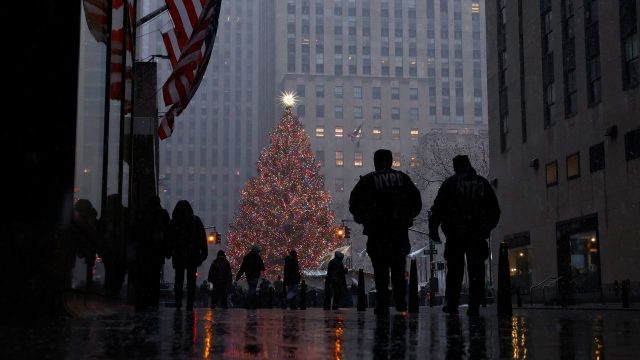
People may be dreaming of a white Christmas when they wake up on Dec. 25, but for many parts of the world climate change could make this a rare event. Snowfall is also not the only iconic part of the holiday that could be affected by extreme weather patterns, as everything from Christmas tree affordability to the prevalence of reindeer could be impacted.
How is Christmas weather being affected by climate change?
The two main Christmas Day associations that could be affected are winter weather and Christmas-themed goods. Climate change is “causing temperatures to rise across the country — and it’s impacting precipitation patterns,” said Time. In the last 75 years, temperatures in December have “warmed three to five degrees” nationwide, David Robinson, a New Jersey climatologist and Rutgers University professor, said to Time.
This small change in the global temperature “could mean the difference between snow and rain” on Christmas Day, said Time. And this pattern has already been seen for years. From 2003 to 2024, the “average Christmas morning snow cover blanketed just 36% of the contiguous U.S. states,” according to National Oceanic and Atmospheric Administration data cited by Time, though this also factors in areas of the country like southern California where it rarely snows.
A person’s memory of Christmastime may also play into this phenomenon — whether this frosty recollection is accurate or not. People “tend to remember that one snowy Christmas, and they forget that it was surrounded by five Christmases that weren’t,” Robinson said to Time.
What other Christmas traditions are being affected?
While the drive to the store for Christmas gifts may not be covered in snow, once shoppers arrive they may be disappointed. Many of the “most lucrative Christmas commodities are grown” in areas that are being affected by climate change, said Mother Jones. In African countries the past few years, plummeting cacao yields affected the production of cocoa, which goes into “all sorts of holiday classics — from yule log cakes to marshmallow-topped cocoa.” This “points to a new normal in a climate-driven shift,” said Harvard University’s Salata Institute for Climate and Sustainability.
People’s Christmas trees may look different in future years too, as “modern-day circumstances are slowly transforming the tree-farming industry,” said CBC News. Beyond the weather shifting growing conditions for trees, the “high cost of land is also having an impact on the industry,” Kelsey Leonard, founder and director of the Christmas Tree Lab at Canada’s University of Waterloo, told CBC News. People may think plastic trees are the solution, but their environmental repercussions are troublesome. Many “artificial trees are some type of plastic by-product, which is a product of fossil fuel consumption,” said Leonard.
Not even classic Christmas characters like Rudolph will be able to avoid the changing climate; global warming could cause a 50% decline in the global reindeer population by the end of the 21st century, according to a study in the journal Science. Population decline could be particularly bad in North America, where “projected losses are expected to exceed 80%.” This could be catastrophic for the only species of deer “adapted to year-round occupancy of the Arctic.”
There may be a slim chance of future white Christmases