
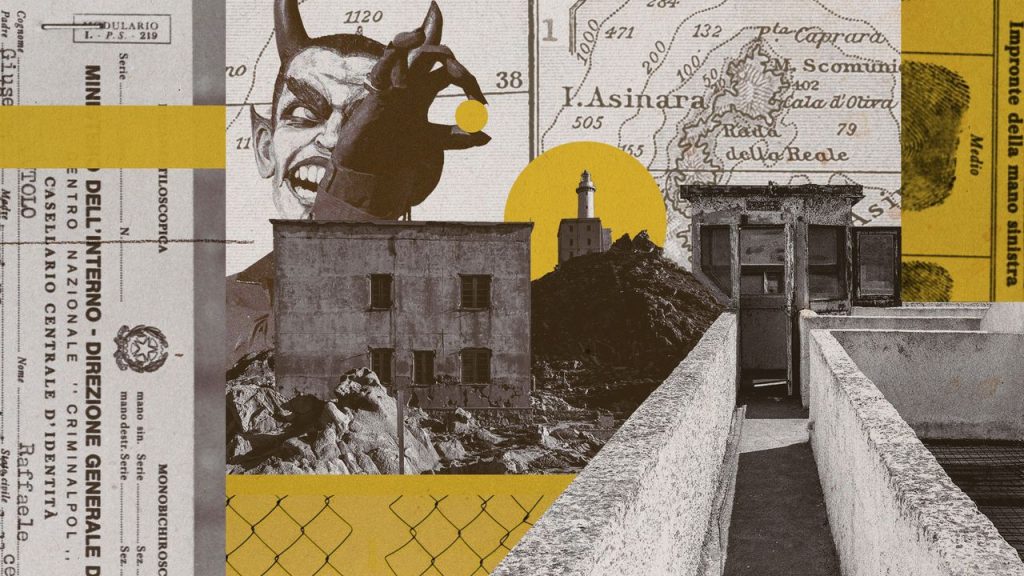
The Italian government has “moved in a unilateral and arrogant way, treating Sardinia like the Cayenne of Italy”, said Alessandra Todde, governor of Sardinia.
The official, referring to the former penal colony off the coast of French Guiana, nicknamed “Devil’s Island”, has accused the government of ignoring her objections, and not permitting her to be “involved in decisions that directly affect” Sardinia, said Il Sole 24 Ore.
Last weekend, 88 high-security prisoners arrived on the island, said The Times. They are among the “746 inmates held under Italy’s toughest solitary confinement rules”, taking Sardinia’s total to 183, a quarter of the national total.
Starting with protest flashpoints in February, Sardinians continue to oppose the prisoners’ relocation to the island, but one prison official told the newspaper: “we can’t send them to Sicily because many of them come from there in the first place”.
‘Alcatraz of Italy’
This is not the first time the island has been perceived by the central government as a favourable location for prisons, said The Times. In the 1990s, Sardinia “endured an influx of mobster prisoners” after a government crackdown on Cosa Nostra, the Sicilian mafia. Many were locked up on Asinara, a small island off the Sardinian coast, including Raffaele Cutolo, a crime boss from Naples, and Salvatore “Toto” Riina, the head of Cosa Nostra. Asinara was nicknamed the “Alcatraz of Italy”, and only one prisoner escaped during its 112 years as a prison before it closed in 1997.
Implementing this process is the “first concrete result of the government’s plan to concentrate harsh imprisonment in seven Italian facilities, three of which are located in Sardinia”, said L’Independiente. Transferring the prisoners to the island also required significant logistical planning. Transporting the 88 prisoners required two finance police aircraft plus “10 military flights, 65 vehicles, eight ground convoys, seven ambulances, two drones and 207 officers”.
The prisoners will continue to be detained under the “hardline” “41 bis” programme, which promotes near-complete isolation, said The Italian Times. Introduced in 1992 following the assassinations by the mafia of prosecutors Giovanni Falcone and Paolo Borsellino, the regime is designed to “sever” contact with criminal networks outside jail.
The government has framed this “Sardinia expansion” as part of a “multi-region overhaul” of this system, concentrating the most high-risk criminals in regional posts. But the 41 bis regime has come under fire, being repeatedly challenged by the European Court of Human Rights. The initial stages of this rollout are a “test of how far Rome can concentrate its highest-security prisoners without triggering a fresh rights dispute at home and abroad.”
Movement of mafia clans
With its “silky, white beaches, turquoise bays and terracotta villages, Sardinia has worked hard” to forget its past and to “position itself as one of Europe’s most popular holiday destinations”, said The Telegraph. Asinara, which once hosted a maximum-security prison, became a national park in 1997. Now, it is “famed for its unique population of albino donkeys”. Local businesses are concerned this appealing image will be “tarnished” by the government’s plans to “dump hundreds of maximum-security prisoners in its jails”.
Locals fear that the island’s culture, once linked to “notorious mobsters and convicted terrorists” incarcerated away from the mainland, could re-emerge, said The Independent. As more high-security prisoners arrive, mafia clans could “move from mainland Italy to be near jailed relatives”. The risk would no longer be of violence, but of “white-collar crime”, with authorities concerned that the “precarious working conditions and low salaries provide an ideal environment for the clans”. There would be clear opportunities to “launder illicit money and infiltrate business, particularly in less developed areas”.
Sardinia already faces one of the country’s highest prisoner-to-inhabitant ratios, and increasing that could strain services. Like much of southern Italy, Sardinia has a “fragile healthcare system and an ageing population”. Additionally, islanders face “higher inmate healthcare costs than in other parts of the country.” If a “mobster” in prison were to require hospital treatment, they would require an escort of “dozens of prison guards”, and in order to accommodate them, and protect the public, authorities could be forced to “shut entire wards”.
The Italian government’s decision to relocate ‘hardline’ inmates to the island stokes local fears of diminishing tourism and strain on services