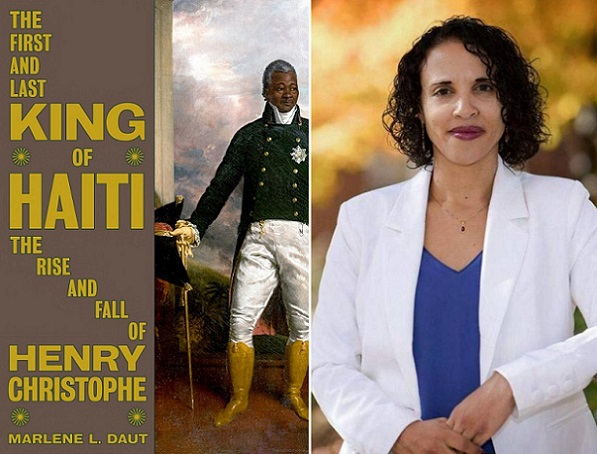

Marlene Daut recently delivered the Stanford Lecture “Henry Christophe: King in a World of Kings,” at the Richter Library at the University of Miami (Coral Gables, Florida). For the Miami Herald, Jacqueline Charles writes about the public lecture and Daut’s fourth book, The First and Last King of Haiti: The Rise and Fall of Henry Christophe (Penguin Random House, 2025). Charles underlines, “He was the first and only king of Haiti. What the life of Christophe says about its history…”
Marlene Daut, a historian and expert on the Haitian Revolution, is the author of “The First and Last King of Haiti: The Rise and Fall of Henry Christophe.” Marlene Daut’s deep dive into Haiti’s first — and only — king reads like a historical novel of a bygone era with Black princes and knights, an elaborate dress code and a palace, Sans-Souci, to match. But Daut’s “The First and Last King of Haiti: The Rise and Fall of Henry Christophe” (Penguin Random House, $40), isn’t a novel— even if at times its fascinating prose about the self-proclaimed king and veteran of the Haitian Revolution and the betrayal and geopolitical clashes that shaped his 13-year reign over the Kingdom of Haiti at times seems like fiction. While Christophe ruled in the north, Alexandre Sabès Pétion, another hero of the revolution and later his rival, governed in the south as president of the Republic of Haiti. “There’s not a lot of attention paid necessarily to this period,” Daut said. “Of course, there should be tons and tons of studies of the Haitian Revolution, but I think that we also need to study and pay more attention to the lives of the people who lived during the revolution, outside of Toussaint.” Toussaint is Toussaint Louverture, the former slave-turned-general, considered one of the foremost leaders of the Haitian Revolution, the only successful slave revolt leading to the founding of a Black nation and the abolition of slavery. But while Toussaint is traditionally depicted in literature as a hero, historians and artists have tended to portray Christophe as an “irredeemable monster.” That, said Daut, a renown expert on Haiti’s history and revolution who will be giving a public lecture at 5 p.m. Thursday at the Richter Library at the University of Miami, is what drove her to finally tackle a biography on the king. “I was fascinated by the fact that the Christophe portrayals lasted for so long into the 20th Century, into the middle of the 20th Century, in comic books, and yet there still is not like a big Hollywood movie,” said Daut, a professor of French and African Diaspora Studies at Yale University. “I just really wanted to find out more about his life.”
Born in Grenada to an enslaved mother and fluent in English, Christophe is perhaps best known as the architect of the famous Citadelle Henry, the mountaintop fortress completed in 1813 to guard against another French occupation. Located on the outskirts of Cap-Haïtien in the city of Milot, it stands today as a UNESCO World Heritage site, along with the remnants of his Sans-Souci Palace, largely destroyed in an 1842 earthquake. He is also known as the controversial and brash leader who despised idleness and, after creating a monarchy in Haiti in 1811, eventually suffered a tragic end. In 1820, after a stroke and with his enemies close, Christophe took a gun and shot himself in the heart, ending a 13-year reign during which he had built a prosperous Black kingdom after defeating what at the time was the world’s most powerful army. In between those bookends, however, much about Christophe’s life and contributions have been debated, exaggerated and even misrepresented against a backdrop of an isolated Haiti. He remains, Daut writes, “as misunderstood now as in the past,” despite having been one of the most written about revolutionary figures in literature. [. . .]
For full article, see https://www.miamiherald.com/news/nation-world/world/americas/haiti/article302338774.html#storylink=cpy
Marlene Daut recently delivered the Stanford Lecture “Henry Christophe: King in a World of Kings,” at the Richter Library at the University of Miami (Coral Gables, Florida). For the Miami Herald, Jacqueline Charles writes about the public lecture and Daut’s fourth book, The First and Last King of Haiti: The Rise and Fall of Henry