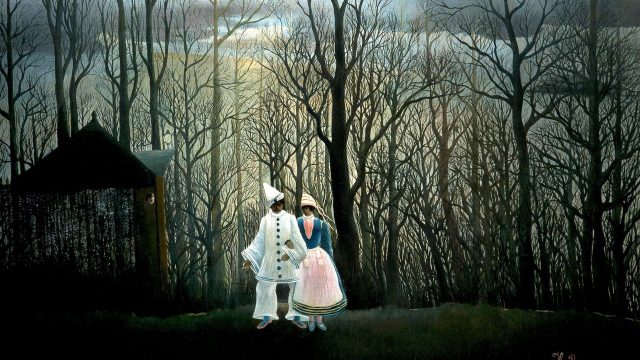
“‘A Painter’s Secrets’ is that rare, magical exhibition that casts a storybook spell,” said Lance Esplund in The Wall Street Journal. It brings together 55 of the paintings of Henri Rousseau, a self-taught and widely misunderstood French artist whose popularity blossomed shortly after his death in 1910. The show “aims to dispel myths about Rousseau,” casting him as alert to the potential commercial advantages of being seen as naive. But the appeal is largely in the work and the “beautifully abundant” make-believe world it conjures. In Rousseau’s paintings, evocations of folk art and pre-Renaissance Christian religious painting merge with “magical thinking and the candid spontaneity of children’s art.” From the first gallery, we’re enchanted. Rousseau’s “early enigmatic masterpiece,” 1886’s Carnival Evening, depicts two small, costumed figures walking arm in arm out of dusky woods. The image is “a harbinger of surrealism,” and it’s both “eerie and romantic.
“What Rousseau did best was recast elements from his cultural milieu in his own personal idiom,” said Kelly Presutti in Art in America. To achieve his storybook-like images, he flattened the pictorial space, played with scale, and gave his human figures “an almost caricatural stiffness.” In 1908, when France performed well in a rugby match with England, Rousseau created an image in which four players seem to be dancing on a field framed by two rows of trees, the men “appearing both of the moment and suspended entirely outside of it.” Rousseau, a former customs agent, struggled to support himself as an artist after turning fully to the field when he was nearly 50. But he was most successful in selling his jungle scenes, which he devised not by traveling but by visiting zoos and botanical gardens and perusing magazine photos. Though some of the resulting images are clichéd, they’re imbued with “a luminosity and strangeness that still fascinates.”
“While his work may seem simple at first glance,” said Elisa Carollo in The Observer, “walking through the exhibition reveals the astute social commentary woven into his paintings.” Those jungle images are “deeply allegorical works that critique modernity and colonialism,” and Rousseau is “equally insightful” when his subjects are war or bourgeois life. The Barnes exhibition “culminates with some of Rousseau’s most elusively mystical works”—The Sleeping Gypsy (1897), Unpleasant Surprise (1899–1901), and The Snake Charmer (1907). The three paintings “blend fantasy with fear, inviting viewers to consider the deeper mysteries of human experience at its most primordial essence.” Rousseau’s insights into human nature and modern society were “ahead of his time,” as was his method.
Barnes Foundation, Philadelphia, through Feb. 22