
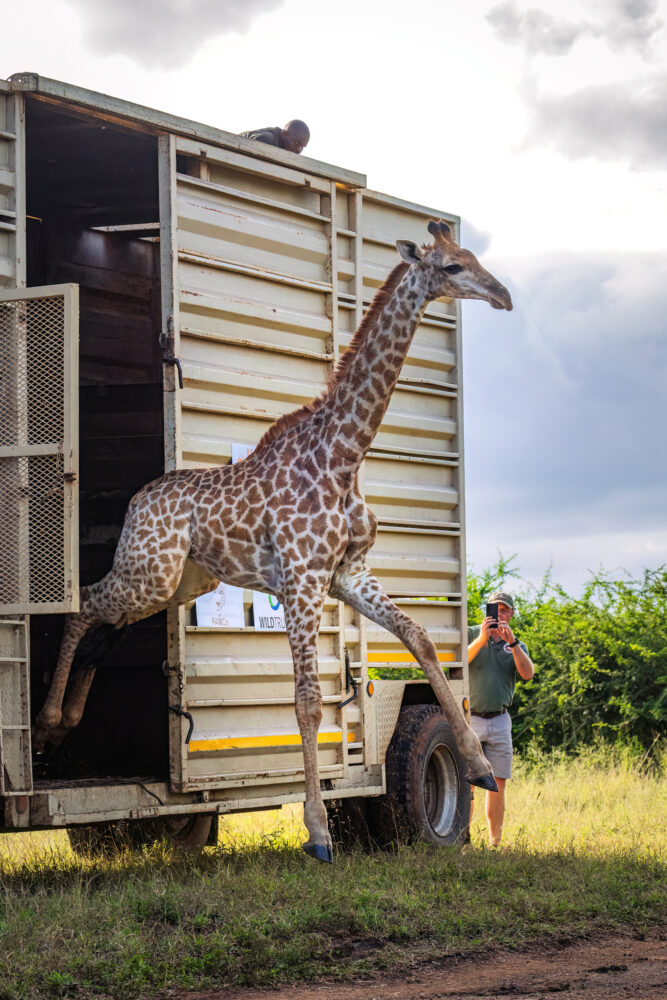
Catching giraffes to move them safely from one reserve to another is no easy task, says conservationist Dereck Milburn.
The director of the Wildlife Emergency Fund (WEF) was reflecting on the recent translocation of eight giraffes from Pongola Game Reserve to the Somkhanda Community Game Reserve in northern KwaZulu-Natal.
In a project carried out in partnership with WildTrust, WEF, Albus Environmental and the Somkhanda Wildlife Foundation, the giraffes were introduced into Somkhanda’s predominantly male herd to strengthen genetic diversity and ensure the long-term resilience of the population.
“It’s taken a lot of people collaborating to make this project possible,” he said. “We’ve partnered with WildTrust and Grant Tracy — his incredible team caught the giraffes — we couldn’t do it without them, to be honest. It’s a very special project.
Catching giraffes is not clear-cut, he said. “It’s one of the most technical captures in the industry. On the day of the translocation, we selected several bulls and six breeding cows, because Somkhanda specifically asked for that.”
Somkhanda, a 12 000 hectare Big Five reserve, is community-owned and managed by The Protected Area Management Company (PAMCo). Established in 2005 through a landmark land restitution process, it is held by the Emvokweni Community Trust on behalf of the Gumbi community.
Meiring Prinsloo, the manager of the Somkhanda Game Reserve, said the operation was carried out by an experienced team, including a wildlife veterinarian, a specialised helicopter pilot and licensed capture professionals.
“All procedures followed best-practice guidelines, with a strong focus on animal welfare, careful sedation, monitoring and safe transport. While there are always inherent risks, these were significantly reduced through experience and adherence to proven standards.”
The new arrivals represent a significant step for the reserve.
“It’s a wonderful opportunity to see another group of giraffes arriving,” he said. “We received eight giraffes — five females and three males. They will be introduced into our current herd, which needs new genetics. This is a very valuable contribution.”


He said the translocation improved breeding success, enhanced population viability and would be monitored through integration, calf recruitment and overall herd performance.
Prinsloo also noted the broader benefits for the Gumbi community. “Giraffe are an iconic species that strengthen Somkhanda’s tourism offering, contributing to revenue generation and the long-term sustainability of the reserve as a community asset.
“These kinds of interventions form part of a broader conservation-based land-use model that supports ongoing employment and local economic activity.”
Dr Roelie Kloppers, the chief executive of WildTrust, highlighted the collaborative nature of the project. “We believe in working collaboratively with individuals and organisations who value both people and planet and who share our vision of driving meaningful environmental change.
“This translocation will significantly enhance the tourism and economic potential of Somkhanda and we are grateful for the continued support from WEF and Albus Environmental for this unique community-owned reserve.”
Across Africa, giraffes face mounting threats, with only 117 000 to 140 000 individuals remaining. Populations have declined nearly 30% over the past three decades, a trend the Giraffe Conservation Foundation described as a “silent extinction”.
Habitat loss, fragmentation, disease and illegal hunting continue to challenge conservation efforts.
Prinsloo reflected on the broader role of translocations in South Africa’s conservation history, noting that wildlife translocation has been a cornerstone of conservation, notably in the recovery of species like white rhino through early, historic efforts led by Dr Ian Player.
It remained a critical tool for managing wildlife in fragmented and fenced landscapes, supporting genetic diversity, balancing populations and enabling species restoration, he said. “It reflects a proactive, science-based approach to conservation rather than a response to crisis.”
As the country’s reserves were fenced, populations needed to be carefully managed, added Milburn. “This is relevant in terms of number of animals, sex ratio and genetics. It is essential for any reserve that is fenced to supplement the existing populations of animals with new genetics from time to time.
“This has now been done for Somkhanda as the management partner, PAMCo, identified this as a conservation need for the property. This intervention aims to mitigate the impacts associated with inbreeding and ensure the integrity of the wildlife stock owned by the community.”
He said it was up to reserve managers/owners to manage their populations by moving animals from their reserves if they had reached capacity or bringing animals onto their reserve “to achieve appropriate population numbers and balances/genetics”.
“Many historic movement routes/corridors of wildlife have been impacted on or fragmented due to human development. It is now up to conservation managers to intervene and artificially move animals between areas to simulate animal movements.”
On why the Pongola giraffes were chosen, Milburn explained that the Pongola Game Reserve had exceeded its carrying capacity as determined by their ecological planning.
“Therefore, the number of giraffe on the reserve needed to be reduced. Instead of hunting the giraffe, the translocation of the giraffe meant that their lives would be secured and that they would contribute meaningfully to the giraffe population at Somkhanda.”
The Pongola Game Reserve, he added, was in proximity to Somkhanda Game Reserve, which meant that the transport time for the giraffe would be limited and the climate and habitat type would be similar for the giraffe at Somkhanda. “This would contribute to them settling in well.”
Eight giraffes have been safely relocated from Pongola Game Reserve to the Somkhanda Community Game Reserve in KwaZulu-Natal to improve genetic diversity and support community conservation efforts