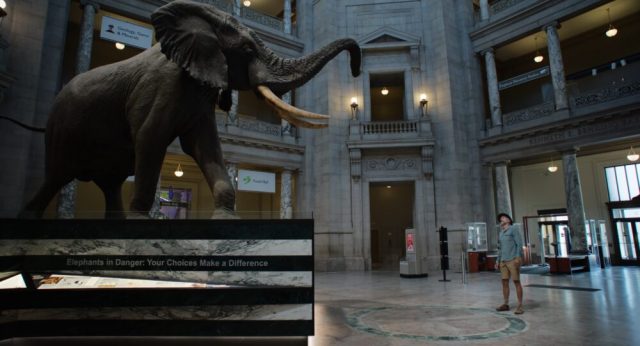
Sometimes the only way forward is to go back. That was my biggest takeaway from Ghost Elephants, a National Geographic documentary by acclaimed filmmaker Werner Herzog. True to Herzog’s reflective style, the film moves beyond the simple idea of a wildlife expedition and becomes something deeper, a meditation on knowledge, memory and humanity’s relationship with the natural world.
The documentary follows South African conservation biologist and National Geographic explorer Steve Boyes, who has spent years studying and protecting the fragile ecosystems connected to the Okavango Basin. This time, Boyes travels into the mist-covered highlands of Angola in search of a mysterious animal many believe exists somewhere between myth and reality: the ghost elephants of Lisima.
The elephants are believed to be unusually large and incredibly elusive. Stories about them have circulated for years, suggesting they could be descendants of some of the largest elephants recorded. Whether legend or scientific possibility, their existence has intrigued explorers, researchers and communities alike. For Boyes, the mystery is compelling enough to embark on another demanding journey into one of Africa’s most remote landscapes.

But Ghost Elephants quickly reveals that this is not just a story about searching for a rare animal. Instead, the film becomes an exploration of how we search and who holds the knowledge needed to find what we are looking for.
Despite years of exploration and access to modern technology, Boyes recognises that tracking the animals requires a return to something more fundamental. Enter Xui, Xui Dawid and Kobus, three KhoiSan master trackers whose skills transform the expedition. Their presence shifts the narrative from a conventional scientific quest into something far more fascinating.
Tracking, as the film demonstrates, is far more complex than simply following footprints. It is a practice that draws on all the senses. The trackers observe the smallest details in the environment such as a bent blade of grass, a disturbed patch of soil or the faint scent carried by the wind. Even the behaviour of birds and other animals becomes part of the story they read in the landscape.
What makes their work remarkable is the way they interpret the signs. Through observation, intuition and experience passed down through generations, they reconstruct the movements of animals across vast terrain. At times, they physically mimic how an animal might have walked or turned, using their bodies to imagine where it might have gone next. Watching them work feels almost spiritual, though they describe it simply as knowledge inherited from their ancestors.
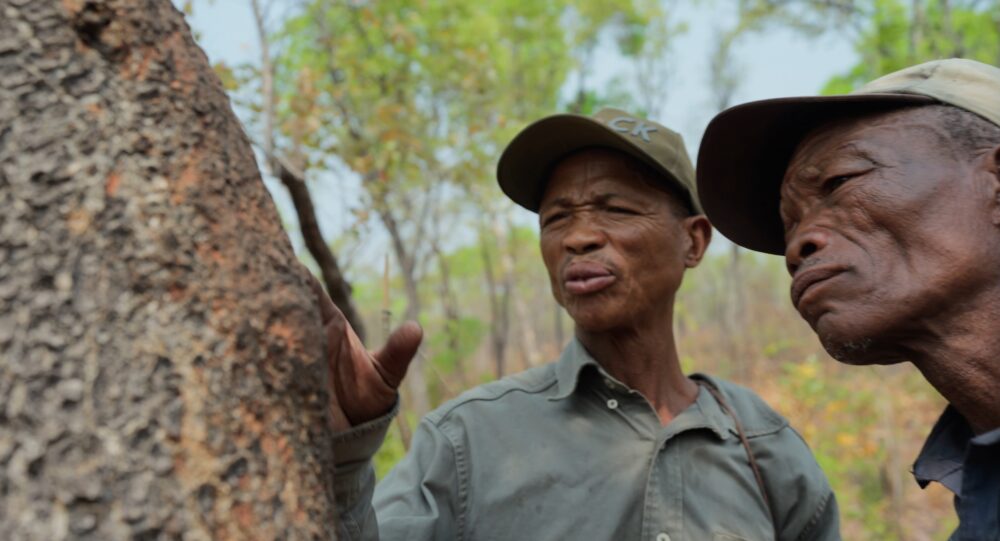
This is where the film finds its emotional centre. Herzog frames the trackers’ skills as a powerful reminder that some of humanity’s most sophisticated knowledge systems are not written in textbooks or stored in databases. Instead, they live within communities and traditions that have existed for centuries.
Visually, the documentary captures the haunting beauty of Angola’s highlands. Dense forests, winding rivers and mist-covered hills create an atmosphere that feels both mysterious and untouched. For decades, much of the region remained inaccessible due to war and political instability, which has allowed parts of the ecosystem to remain remarkably intact. The cinematography embraces the sense of isolation, showing landscapes that seem to guard their secrets carefully.
Yet beneath the beauty lies a quiet urgency. The film subtly raises questions about what happens when traditional knowledge systems disappear. The skills of trackers like Xui, Xui Dawid and Kobus are not easily documented or digitised. They are learnt through years of practice and close relationships with the land.
As modern life continues to reshape rural communities, there is a risk that the knowledge could fade with time. In that sense, the title Ghost Elephants carries a deeper meaning. It does not only refer to a mysterious animal hidden somewhere in Angola’s wilderness, but also to cultural wisdom that risks becoming invisible in the modern world.
Ultimately, Ghost Elephants is less concerned with delivering a dramatic discovery than it is with reflecting on the process of searching. By bringing together science, storytelling and indigenous knowledge, the film reminds us that progress does not always come from moving forward at full speed.
Sometimes, it begins by remembering what we have left behind.
GHOST ELEPHANTS premieres on National Geographic Wild, DStv 182 on Wednesday 11 March at 6pm (CAT) and is streaming on Disney+ in South Africa.
A haunting journey into Angola’s wild highlands, ‘Ghost Elephants’ follows Steve Boyes and KhoiSan master trackers as they search for a mythical elephant