
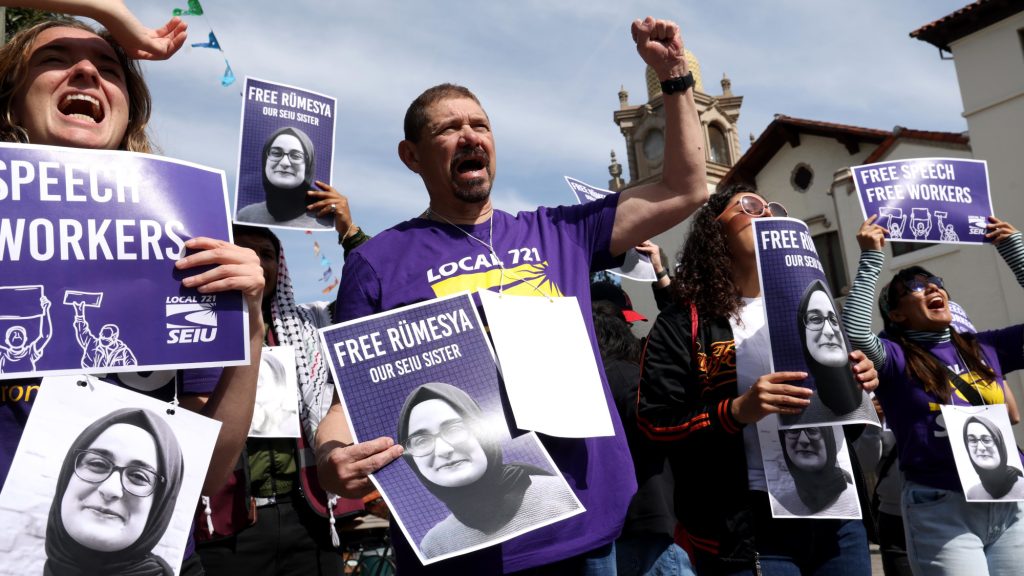
Welcome to “Trump’s America,” said Jonah Valdez in The Intercept, where “you can be disappeared for writing an op-ed.” If you haven’t yet seen the chilling surveillance camera footage, Rumeysa Ozturk, 30, a Turkish Fulbright scholar at Tufts University, was walking to meet friends last week when masked federal agents seized her on a street in Somerville, Mass., and whisked her away in an unmarked SUV. For nearly a day, no one knew where Ozturk was, until she surfaced at an Immigration and Customs Enforcement facility in Louisiana. She is now awaiting deportation for “activities in support of Hamas,” according to the Department of Homeland Security, or as Secretary of State Marco Rubio told reporters, for “creating a ruckus.”
Both allegations sound like references to last year’s campus protests against Israel’s war in Gaza, said Zack Beauchamp in Vox. Rubio says he’s revoked the visas of “more than 300” students so far. But unlike, say, Mahmoud Khalil, the green-card-holding Columbia protest organizer arrested last month, the extent of Ozturk’s “ruckus” appears to be an op-ed she co-authored in the Tufts Daily that calls on the university to divest from Israel. It says nothing “that even approximates support for Hamas.” State agents, in other words, abducted a legal migrant for expressing a political opinion, an “attack on civil liberties that we would not hesitate to label as authoritarian in another country.”
Ozturk wasn’t “kidnapped” or “disappeared,” said Rich Lowry in National Review. She was simply “arrested.” Yes, the ICE officers wore masks—a prudent measure given the “doxxing” habits of the online left. But the agents treated Ozturk with respect and even kindness, one of them telling her, “I understand it’s scary,” and no doubt it was. Some unpleasantness is “inherent to any arrest,” and unlike those grabbed off the streets of banana republics, Ozturk now gets a formal court hearing, with “ample legal representation,” and nothing to lose but her student visa. When the worst-case scenario is being free “to go home to live your life however you please,” these “lurid” comparisons to Third World torture regimes are grotesque and unfair.
Her punishment isn’t the issue, said Jeffrey Blehar, also in National Review. Yes, the secretary of state has broad discretion to remove non-citizens from the U.S. But using that power to capriciously expel someone for expressing an unpopular opinion is “utterly abhorrent” and should be to all conservatives who claim to revere “free speech.” It sounds like there could be more evidence against Ozturk, said The Free Press in an editorial. Speaking to reporters, Rubio seemed to dismiss the idea that he’d revoke someone’s visa “just because you want to write op-eds.” But if Ozturk did more than that, what was it? This administration’s emerging pattern of detaining people for alleged crimes, but not providing evidence, risks eroding “public trust in the rule of law.”
What if that’s the goal? said Aymann Ismail in Slate. Week after week, arrest after arrest, the Trump administration is “pushing the limits of the law,” and widening the circle of people with reason to fear persecution by the state for unspecified acts of speech or disloyalty. With the “brazen state abduction” of Ozturk, that circle now includes all foreign nationals, especially Muslims. Before long, it could be any of us. “No one is safe,” said Will Bunch in The Philadelphia Inquirer. “Stunning and unprecedented” things are happening in Trump’s America, “in broad daylight, on our formerly free sidewalks.” The only consolation in Ozturk’s shocking arrest is that we can finally “stop talking about ‘the threat of creeping authoritarianism,’ because tyranny is already here.”
The Turkish student was confronted by masked federal agents and transported in an unmarked vehicle