
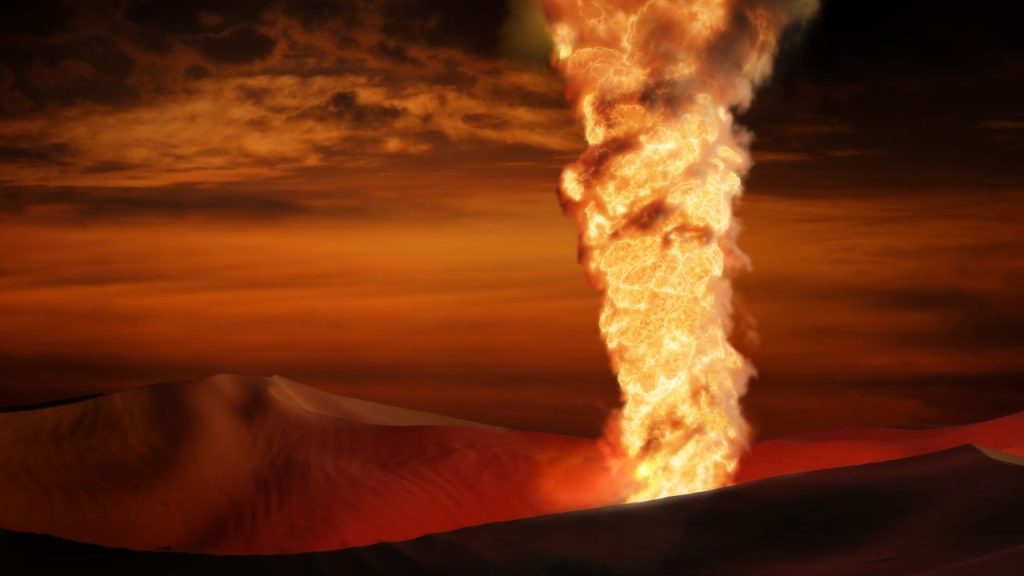
Oil spills have a new whirlwind solution. Disasters like Exxon Valdez in 1989 and Deepwater Horizon in 2010 are difficult to clean up after and can cause catastrophic ecological damage — and there are thousands of them each year. The options to deal with the crude oil are either burn it and produce high levels of smoke and pollution in the process, or leave it to destroy habitats and kill wildlife. Now, scientists may have found a new way to burn the oil without releasing excessive emissions: by creating raging fire tornadoes.
A blazing idea
The most common method of removing oil from bodies of water is through on-site burning. This technique can “rapidly remove up to 95% of spilled oil from the water surface, reducing the risk of oil penetrating sediments or drifting to contaminate adjacent habitats,” said a study published in the journal Fuel. However, it also “produces a visible smoke plume containing soot and other combustion products, raising concerns about air pollution and potential health risks.” It also tends to leave a layer of black sludge on the surface of the water.
Fire tornadoes or fire whirls offer the “potential for cleaner, more efficient burns with reduced emissions in environmental applications like oil spill remediation,” said the study. These flames spread upward rather than outward, acting like a “natural turbocharger, sucking in oxygen and creating a flame that burns hotter, faster and far more efficiently than fire pools,” said a release about the study. The blazing tornado can also produce 40% less soot and consume up to 95% of the fuel.
Scientists tested this method in a controlled experiment during which they “built 316-foot walls and a rough triangle and generated a controlled fire whirl that reached 17 feet high,” said Vice. The tornado burned through the oil 40% faster than the on-site method and was able to “destroy the particles that form thick smoke plumes,” reducing the amount of emissions, said the release. This can cut the “environmental cost of emergency burning while vaporizing nearly all the oil before it can become a toxic tar mat on the ocean’s surface.”
Not so slick
As promising as fire tornadoes are, these “inferno giants are sensitive,” said the release. “Too much wind, and the column can collapse or destabilize. Too little control over airflow, and it behaves like a fire pool.” The thickness of the oil layer can also affect the whirl’s efficiency. However, “this is the first time anyone has conceived using fire whirls for oil spill remediation, and it’s really just the beginning,” said Elaine Oran, a professor of aerospace engineering at Texas A&M who led the study, in the release. “Our goal is to harness the chaotic nature of fire whirls as a powerful, precise restoration tool, to protect coastlines, marine ecosystems and the environment as a whole.”
There is still a lot of work to be done before widespread use becomes possible. For now, the method to create the whirls using three walls is “not directly applicable to open ocean environments where large oil spills typically occur,” said the study. More research should be done to “explore applicable methods for inducing fire whirls in open water conditions,” like using “mobile or deployable structures” or “leveraging natural atmospheric conditions.”
This research could also be applied to other uses, like to “help engineers design high-efficiency combustion systems” or to “better predict and control wildfire behavior on land,” said Earth.com. “By understanding the physical laws that govern fire whirls, we can harness their power beyond oil spill remediation,” said Oran.
The whirling flame could be faster and cleaner