
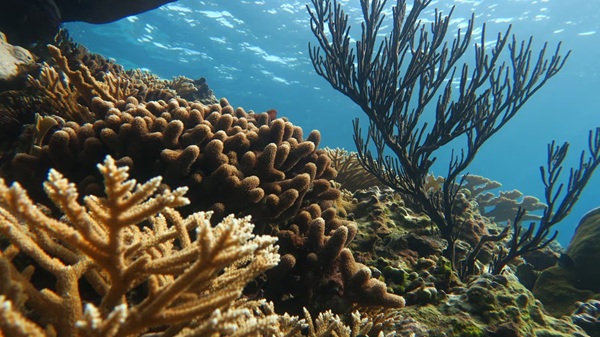

The conditions of local coral reefs in most of the Caribbean region is bleak. As Sea Grant Puerto Rico points out, the Global Coral Reef Monitoring Network has reported that the Caribbean region lost nearly half of its coral reefs between 1980 and 2024, according to the recent report “Status and Trends of Caribbean Coral Reefs: 1970–2024.”
Sea Grant PR recently posted about an educational documentary film— Un pueblo de coral [A Coral Village]— screened by ISER Caribe, an environmental organization, to help raise consciousness about the situation. As Metro Puerto Rico indicates in the article “Organización ambiental ISER Caribe presenta su documental “Un pueblo de coral,” the documentary focuses on marine restoration and the human connection to coral reefs. [Read translated excerpts below. To volunteer or to help with funding, visit ISERCARIBE/CIROM.]
The production explores the scientific, community, and socio-environmental efforts behind reef restoration in Puerto Rico and the Caribbean, and it will compete in its first film festival in March.
[…] “Un pueblo de coral is an eco-centric exploration of the archipelago’s future, intertwined with its underwater jungles created by animals, a call for its inhabitants to do their part as caretakers of the coral reefs,” commented Dr. Braulio Quintero, co-founder and executive director of ISER Caribe.
Founded in 2012 and headquartered in Cabo Rojo, ISER Caribe is the first organization in Puerto Rico to develop and manage land nurseries of marine organisms for ecological restoration. Through its Center for Research and Restoration of Marine Organisms [Centro de Investigación y Restauración de Organismos Marinos (CIROM)], with facilities in La Parguera and Ceiba, it leads pioneering conservation projects that include the restoration of marine and coastal habitats and promotes the monitoring of the health of corals and key species such as the black sea urchin.
“Reefs are our first line of defense against erosion and the impacts of climate change. Un pueblo de coral demonstrates what is possible when we join science, community, and a long-term vision,” said Dr. Stacey Williams, co-founder and chief scientist of the organization. [. . .]
Excerpts translated by Ivette Romero. For full arti cle, in Spanish, see https://www.metro.pr/entretenimiento/2025/12/17/organizacion-ambiental-iser-caribe-presenta-su-documental-pueblo-de-coral/
For more information, see ISER Caribe; to volunteer or to help with funding, visit ISERCARIBE/CIROM.
[Photo by Mariane Aimar-Godoc | IGREC Mer: Coral reefs.]
The conditions of local coral reefs in most of the Caribbean region is bleak. As Sea Grant Puerto Rico points out, the Global Coral Reef Monitoring Network has reported that the Caribbean region lost nearly half of its coral reefs between 1980 and 2024, according to the recent report “Status and Trends of Caribbean Coral