‘The Testament of Ann Lee’
Directed by Mona Fastvold (R)
★★★
The “singular, astonishing, otherworldly” new biographical musical about the founder of the Shakers “may not be to everyone’s taste,” said Alissa
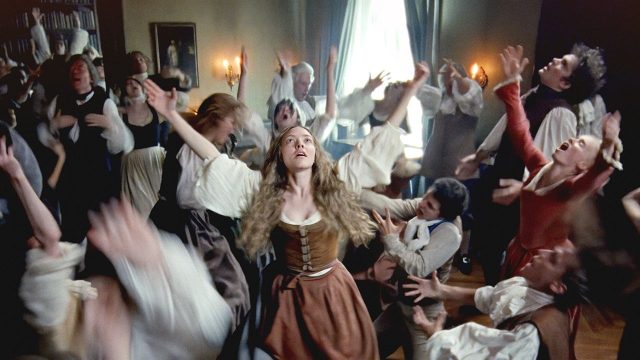
Wilkinson in The New York Times. But who cares? “When an artist takes a swing this colossal and stays true to their vision in every way, the resulting work deserves respect, and is always worth seeing.” With a “spectacular” Amanda Seyfried as her star, director Mona Fastvold has found a way to pull viewers inside the life of Ann Lee as the 18th-century mystic experienced it, particularly when engaged in the ecstatic form of group song and dance that was central to the sect’s form of worship. “Rationalists in the audience might be tempted to ask, ‘Well, what is the testament of Ann Lee, exactly?’” said Peter Bradshaw in The Guardian.
We learn that after she had four children die in infancy, Lee declared sex the root of all evil and demanded her followers renounce it, then somehow persuaded several devotees to leave England for America, where the movement’s celibate flock peaked at about 6,000. But while the shaking and shivering and speaking in tongues looks, to a modern audience, “like collective hysteria,” this “genuinely strange” film refuses to say so, “because it wants us to take Lee seriously at some level.” Sure, the movie is “unlike anything you’ve seen,” said Monica Hesse in The Washington Post. But Fastvold, who with partner Brady Corbet co-wrote both this film and 2024’s The Brutalist, is assured enough in her approach to convince you “there was no other way to tell this story.” It’s the story of one woman who was ravenous to be closer to God, and following that journey proves “richly satisfying.”
’28 Years Later: The Bone Temple’
Directed by Nia DaCosta (R)
★★★
“Squeamish, beware,” said Johnny Oleksinski in the New York Post. The latest 28 Years Later movie, the second in a trilogy, “doubles the savagery” of its June 2025 predecessor, adding a “twisted” and “more
freakishly funny” chapter to a zombie franchise that debuted with 2002’s 28 Days Later. The story picks up where the last ended, as 12-year-old Spike is forcibly conscripted into joining a small band of murderous adolescents in blond wigs. But “two tales are told here,” the second focusing on a lone doctor, played by a “magnificent” Ralph Fiennes, who has a monument to the dead in human bones and is seeking a cure for the zombie virus.
Fiennes “elevates the movie whenever he’s onscreen,” said David Rooney in The Hollywood Reporter. His character is “half lunatic, half visionary,” and he forges a poignant connection with one of the infected as he tries to determine if anything human remains in the flesh-eating creature. Alas, we spend more time with the cultish young killers and their leader, played by Jack O’Connell. They skin their victims alive, pushing the film into torture porn, all of it “more repugnant than scary.” But this is a movie about “the weird ways that belief and spirituality can evolve under the harshest conditions,” said David Sims in The Atlantic, and director Nia DaCosta, taking over Danny Boyle’s chair for this installment, “creates a gorgeous and moody atmosphere” that suits the story’s themes. It also prepares the way for “an outstanding climactic set piece” that should give viewers “a reason to be hopeful, rather than fearful, for postapocalyptic humanity.”
‘Young Mothers’
Directed by Jean-Pierre and Luc Dardenne (Not rated)
★★★
“Understated, graceful, and moving,” this Belgian drama from the celebrated Dardenne brothers is, to me, “the first great film of 2026,” said Nick Schager in The Daily Beast. Winner of Best Screenplay at Cannes, Young Mothers ushers viewers into a shelter for single young mothers to portray four of its teenage residents. Each faces challenging circumstances, and the Dardennes’ naturalistic touch and deep empathy for people on the margins are once again “on full display” in a movie that’s “of a piece with their prior masterworks,” including Rosetta, The Kid With a Bike, and Two Days, One Night.
Because the Dardennes have four protagonists here instead of one, said Justin Chang in The New Yorker, “they lean more on exposition, which doesn’t play to their cinematic strengths.” But as we follow Jessica, Perla,
Julie, and Ariane, learning of the obstacles presented by their home life, their partners, and, in one case, addiction, the movie does hold us—“not
with the urgency, perhaps, of its predecessors but with an emotional pull as lovely and irresistible as the sudden dawning of a smile on a baby’s face.” It helps that all of the young actors “have a quietly moving guilelessness,” said Stephanie Zacharek in Time. “Young Mothers is fiction, but it has the feel of documentary,” and “you recognize that these women’s feelings, and their fears, are playing out somewhere in your own city or town.”
A full-immersion portrait of the Shakers’ founder, a zombie virus brings out the best and worst in the human survivors, and pregnancy tests the resolve of four Belgian teenagers