
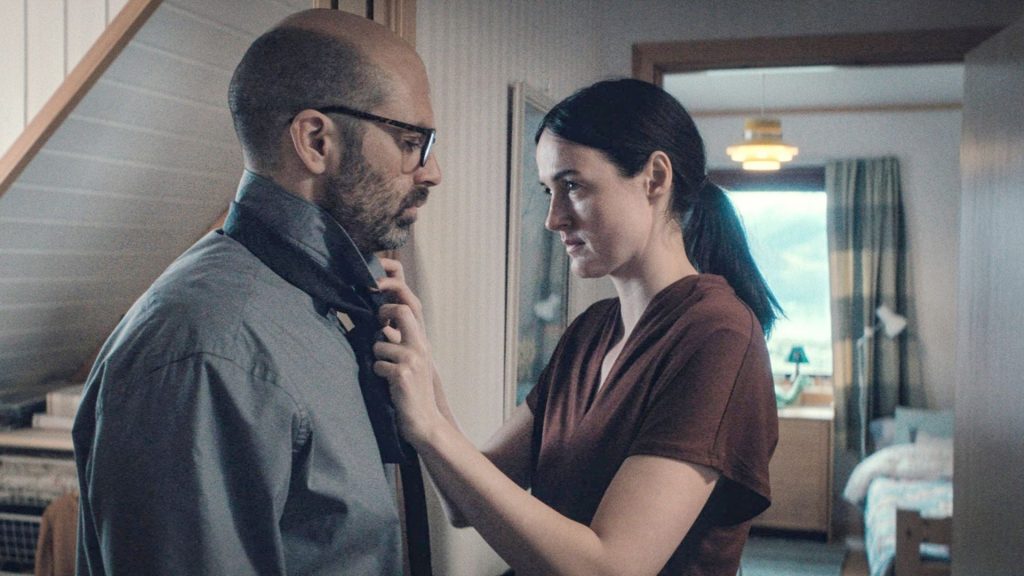
Fjord
Directed by Cristian Mungiu (R)
★★★★
The film that won the Palme d’Or at Cannes this year is “a car crash occurring in what feels like real time,” said Nick Schager in The Daily Beast. “One of the year’s undisputed highlights,” the newly released drama follows a family that’s torn apart soon after they move from Bucharest to a Norwegian village and their fundamentalist Christian beliefs generate suspicion. When the parents, Mihai and Lisbet, are accused of child abuse based on slim evidence, all five of the couple’s kids, including two teenagers and a breastfeeding infant, are taken away by child services. With co-stars Sebastian Stan and Renate Reinsve delivering performances that give little away, the movie “poses prickly questions it astutely refuses to answer.” Romanian director Cristian Mungiu, who previously won the Palme d’Or for 2007’s 4 Months, 3 Weeks, and 2 Days, never reveals whether Mihai and Lisbet are guilty of serious mistreatment or not, said Monica Castillo in The A.V. Club. But while his latest award winner is “expertly crafted,” it belies his disdain for Norway’s progressive liberalism and the government overreach he thinks the mindset spawns. Fjord also “loses its focus” once a fed-up Mihai summons fellow religious conservatives to stand with him and his wife during their trial. “Excellent” work from Reinsve and Stan help save the movie from tipping into didacticism, said Brian Tallerico in RogerEbert.com. But Mungiu also hasn’t fully made his mind up about Mihai and Lisbet and the values they espouse. “One of the things that makes Fjord so rewarding is the sense that he’s exploring how he feels about these people and these issues along with us as their story unfolds.”
‘La Bola Negra’
Directed by Los Javis (R)
★★★★
Arriving in U.S. theaters after wowing festival audiences, this Oscar contender from Spain “has the sweep and audacity of a great modernist novel,” said Dana Stevens in Slate. “An at times exhausting but ultimately nourishing feast,” La Bola Negra toggles between three gay protagonists separated by nearly a century of time as it highlights the links between fascism and homophobia. “Not every one of its interweaving stories lands with equal power,” and some passages feel rushed, but “too much movie is better than not enough.” Each tale, “at first oddly, works in a slightly different register,” said Alissa Wilkinson in The New York Times. In 1937, Sebastián, a musician forced to fight for the fascists in the Spanish Civil War, falls for a wounded prisoner named Rafael, initiating a love story that turns wrenching. By then, we’ve also met Carlos, who, in an “almost fairy-tale-like” 1932 setting, is barred from an elite club because of his sexuality. And we’ve watched Alberto, a grad student from our own era, begin investigating his grandfather’s past. It takes a while to see the stories’ links, but once you do, “the structure feels cleverly satisfying” despite the movie’s “unnecessarily overwrought” third act. Still, co-directors Javier Calvo and Javier Ambrossi—aka Los Javis—“execute this mighty vision with thrilling technical bravado,” said Richard Lawson in The Hollywood Reporter. It is “high time” we had a gay war epic of this much “scope and soulfulness and invention.”
‘Klara and the Sun’
Directed by Taika Waititi (PG-13)
★★★★
“Adapting a complex, questioning novel as a cockeyed child’s-eye comedy worked once before for Taika Waititi,” said Guy Lodge in Variety. But even fans of 2019’s Jojo Rabbit are unlikely to be moved by Waititi’s “twee, pulseless” adaptation of Kazuo Ishiguro’s 2021 novel about an android purchased to be the companion of a sickly 14-year-old. In this disastrous misfire, “the filmmaker’s kooky affectations fight the stoic sadness of Ishiguro’s storytelling at every turn.” Jenna Ortega stars as Klara, the tale’s “Artificial Friend,” playing the robot as “a ditsy, cutesy innocent,” said Peter Bradshaw in The Guardian. Being solar-powered, Klara worships the sun as a god. But whereas Ishiguro made something of such fable-like story elements, Waititi’s “unbearably mannered” film “winds up saying nothing substantial or meaningful (or funny) about artificial intelligence, love, or grief.” And when we reach the twist ending, it’s “as unsatisfying and contrived as everything that has gone before.” The two leads do what they can, said Ben Gibbons in Screen Rant. Ortega has a tough assignment, and “her ability to imbue her character with emotion while still feeling robotic is impressive.” Mia Tharia, meanwhile, plays 14-year-old Josie “with enormous confidence, magnetism, and charm.” Alas, the actresses’ work is wasted on an adaptation that turns out to be “a ham-fisted sci-fi comedy with a hollow message.” Clearly, Waititi was “not the right choice for this story.”
A gripping international family drama and a sci-fi comedy