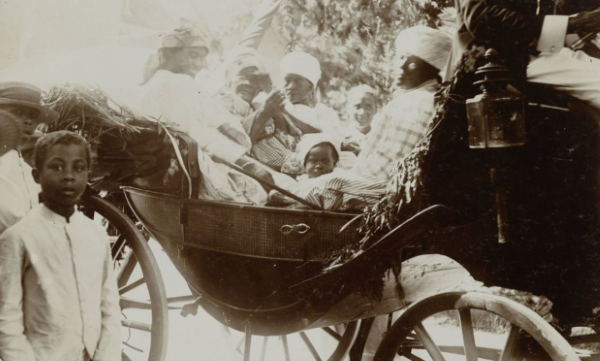

Surinamese-born, Dutch journalist, writer, and documentary filmmaker Ida Does has completed a new documentary film: Affiba, the oldest woman of Paramaribo. Following her recent success— an award for Best Film on Matters Relating to the Black Experience / Marginalized People for her film Uma Memória Emplumada, by Black International Cinema Berlin— Does’s new production centers on the family research of descendant Joan Windzak and her great-grandmother Affiba Maria Magdalena Dompig (1792-1896). Her search for her ancestors in Suriname brings a 19th-century photograph from the collection of the Rijksmuseum in Amsterdam back to life and sheds light on hidden women’s histories. Shown here, “Affiba Dompig, ‘de oudste vrouw van Paramaribo’, met haar nageslacht in een koets op weg naar de gouverneur van Suriname” [Affiba Dompig, ‘the oldest woman of Paramaribo’, with her descendants in a carriage on their way to the Governor of Suriname.]
The director says, “After more than one and a half years of [exploring] puzzles, recordings, archives, and traveling, editing, and discussions, it’s time: my new documentary AFFIBA THE OLDEST WOMAN OF PARAMARIBO is ready!
The film follows Joan Windzak in her search for her family history. During her research, she discovered a special nineteenth-century photograph depicting her great-grandmother Affiba, a woman born into slavery, gained her freedom and became at least 105 years old.
With Affiba, the oldest woman of Paramaribo, I, together with Joan, want to make visible lives that have been left out of the picture for a long time.”
The Rijksmuseum describes the photo: “On August 31, 1896, Affiba Maria Magdalena Dompig (1792-1896) rode in a carriage through Paramaribo with two of her children, a grandchild, and a great-grandchild on their way to a reception with the Governor of Suriname at the Government Palace on the occasion of Queen Wilhelmina’s birthday. Affiba looks at the photographer and appears to be waving at him as well. With her left hand, she shields her face from the sun. To her left sits her daughter Lijsje Christina (1820-1906), and to her right her granddaughter Elisa (1856-1901). Opposite Elisa sits her aunt Sophia Albertina (1836-1908), with Josephine Henriétte Magdalena Dompig (1894-1978), Affiba’s great-grandchild. At that time, Affiba was the oldest woman in Paramaribo. Photographer Van Lelyveld noted with the photo that she was 104 years old. Upon her death in December 1896, it was written in the Koloniaal Nieuws- en Advertentieblad that she had reached the age of at least 105. Because she had come to Suriname from Africa, her age could, according to the journalist, only be determined approximately.”
For more information, see https://www.facebook.com/ida.does and https://www.srherald.com/entertainment/2026/03/03/ida-does-wint-filmprijs-in-berlijn-met-uma-memoria-emplumada/
Photo of Affiba Dompig and description from https://www.rijksmuseum.nl/nl/collectie/object/Affiba+Dompig,+’de+oudste+vrouw+van+Paramaribo’,+met+haar+nageslacht+in+een+koets+op+weg+naar+de+gouverneur+van+Suriname–5a21ecc4c2e1514c112b7c99c56f1735
Surinamese-born, Dutch journalist, writer, and documentary filmmaker Ida Does has completed a new documentary film: Affiba, the oldest woman of Paramaribo. Following her recent success— an award for Best Film on Matters Relating to the Black Experience / Marginalized People for her film Uma Memória Emplumada, by Black International Cinema Berlin— Does’s new production centers