Gisela Colón’s “La montaña, el monolito” [The Mountain, The Monolith], curated by Abdiel D. Segarra Ríos and Alexandra Méndez, brings together a group of works that represent 30 years of the artist’s trajectory. It opened on March 14, and will remain on view until July 12, 2026, at the Museum of Contemporary Art [Museo de Arte Contemporáneo (MAC)] in San Juan, Puerto Rico. The exhibition examines the relationship between geology, memory, and vital energy.
Description (MAC): Coining the term “organic minimalism” to describe her process, Gisela Colón develops a body of work that explores the interconnectedness of the forces that— at different scales— compose and sustain the universe. Through sculptures, paintings, installations, video, and her emblematic monoliths, the artist invites us to consider astronomical, geological, and metaphysical movements as manifestations of the same vital energy.
La Montaña, El Monolito, presented in Puerto Rico— the artist’s homeland— reveals the profound ways in which the archipelago’s geography, geology, and primordial matter have shaped both her personal history and her artistic practice. The mountain ranges that traverse the archipelago’s mountainous topography remain a constant presence in her imaginary, accompanying her throughout her life’s journeys—from her years in the diaspora in Los Angeles to her travels through remote territories around the world. These mountainous forms decisively inform the verticality, mass, and spiritual resonance of her monoliths, grounding her global practice in the memory of place.
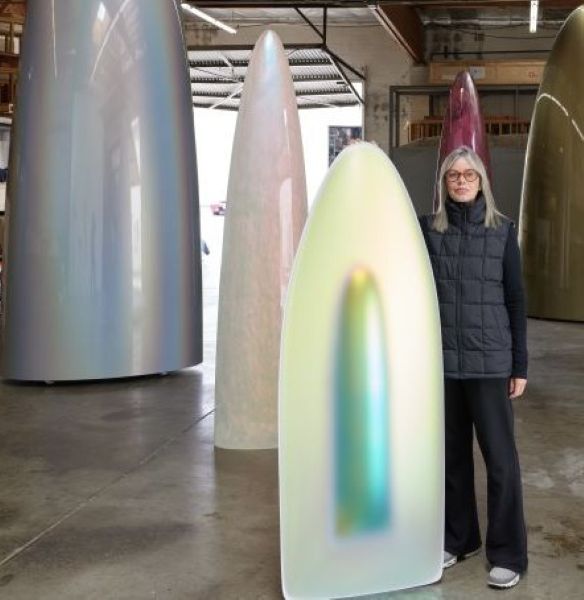
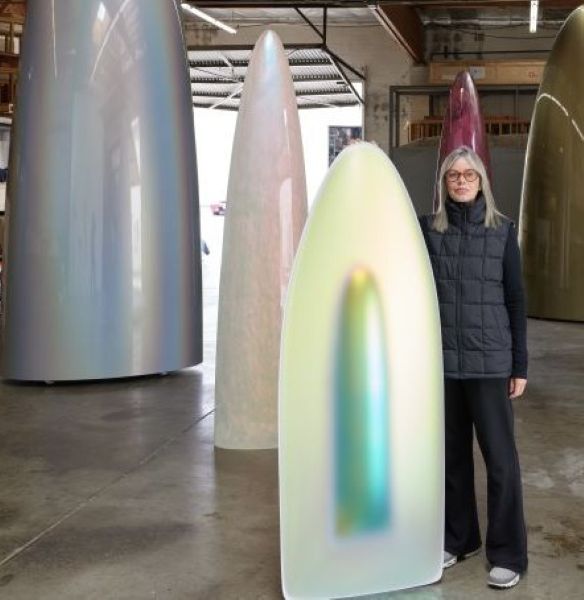
Puerto Rico as context adds several additional layers of meaning to her work. Without conditioning its place of enunciation or obscuring its discursive possibilities, the emergence of this work in the archipelago is inevitably linked to conversations about the right to territory and the hegemonic view of nature. The constitutive materiality of the works and the iridescence of the pigments —their ability to capture light and transform it— conceptually bring it closer to a corporeal experience that provokes a reflection on light and what it illuminates.
This exhibition adds Colón’s research to the legacy of artists and aesthetic benchmarks that, from the Caribbean and their respective diasporas, point to a rethinking of landscape as a subject that defines our cultural imagination. In this sense, place— whether we call it territory, homeland, context, or circumstance— serves as a platform and vehicle through which the artist’s experiences of rootedness are linked to the poetics of the materials activated through her creative process. Colón, in a spirit similar to that of artists and sculptors working in clay, dedicated to designing direct interventions in nature, offers a declaration of purpose that invites us to reimagine our connection to the land in a temporality that transcends human chronologies. [. . .]
Gisela Colón (b. 1966) is a Puerto Rican–American artist whose multidisciplinary practice investigates how matter carries geological, ancestral, and cosmic memory across human, planetary, and cosmic scales. Working within a framework she describes as organic minimalism, her work spans sculpture, painting, land interventions, video, and photography. Her work brings together ancient symbolic forms and advanced technologies to examine the relationship between matter, perception, and deep time.
Over the course of her career, Colón’s work has been situated in dialogue with the legacies of Minimalism, Light and Space, and Land Art, extending the perceptual and geological concerns of these movements into a broader investigation of cosmic matter and planetary time. Her practice evolved from early investigations in painting—beginning with childhood landscape experiments in Puerto Rico in the 1970s and continuing through the earthen abstract paintings she produced from the 1990s through the 2010s. This sustained engagement with color and perception led her to explore the phenomenon of structural color, a natural process in which prismatic color emerges through the interaction of light and material structure rather than pigment. In 2012 Colón expanded this investigation into sculpture with the development of her Pods series (2012–present), biomorphic forms that suggest cellular or embryonic structures. Referencing natural phenomena such as the bioluminescent waters of Puerto Rico’s coastal bays, the iridescent surfaces of Caribbean nacreous shells, and the shimmering feathers of tropical hummingbirds, the works generate shifting fields of color that change with environmental light and the movement of the viewer.
Colón’s practice is profoundly shaped by the landscapes of Puerto Rico and the American West. As a child growing up in Puerto Rico, the regenerative power of the natural world— particularly the rainforest mountain of El Yunque— became a source of strength and survival. Early encounters with nature revealed the living world’s capacity for renewal: she recalls peeling the bark of eucalyptus trees to reveal vibrant layers of color beneath, observing how the tree continually healed and renewed its surface. These experiences instilled an early understanding of nature’s cycles of transformation and resilience, and of how matter reveals itself through successive layers of time—from living systems and geological formations to the cosmic materials from which planets and life emerge. In her work, this understanding emerges through a central metamorphosis in which personal history becomes landscape—biography becoming geography, and ultimately geology.
This transformation finds its most direct expression in Colón’s monumental Monoliths (2015–present), luminous sculptural forms fabricated from aerospace-engineered carbon fiber, optical acrylics, and ancient minerals such as onyx, marble, and granite. These vertically oriented structures echo archetypal forms found across ancient cultures—including totems, obelisks, amulets, and Taíno cemíes—while simultaneously referencing geological formations and cosmic orientation. Emerging from forms that initially recall bullets or projectiles, the works transform instruments of violence into monumental structures that evoke mountains and geological permanence. In Colón’s work, the monolith becomes a mountain: violence transformed into a structure of endurance and personal memory expanded into a universal language of form.
[. . .] Rooted in both biospheric ecologies and spiritual traditions, Colón’s approach positions raw matter not merely as medium but as witness—an active participant in the unfolding history of life on Earth and beyond.
Colón’s practice moves between rainforest, desert, and cosmos, tracing a continuum between living systems, geological time, and stellar matter. Across these bodies of work, Colón investigates how matter carries memory across human, geological, and cosmic timescales, revealing processes of formation and transformation that connect human experience with the deep time of the Earth and the wider universe. Her work reflects a form of cosmic ecology, tracing a continuum from stellar matter to human perception and revealing how the materials that compose our bodies and our planet originate in cosmic processes—reminding us that the substance of life itself is born from the same cosmic matter that forms stars and worlds.
Colón’s work has been presented internationally through large-scale installations and exhibitions that often engage historically and environmentally significant sites, including three UNESCO World Heritage sites. Her projects have activated landscapes and cultural monuments across Europe, the Middle East, and the Americas, including installations at the Pyramids of Giza, Desert X AlUla in Saudi Arabia, the Oude Warande Forest in the Netherlands, and the Wadi Hanifa river valley in Riyadh. In Brazil, her survey exhibition Máteria Prima at the Museu Nacional da República in Brasília (2024) featured the large-scale environmental installation Plasmático: El Cuarto Estado de Materia, which later traveled to the Instituto Artium da Cultura in São Paulo. Her work was also featured in the XV Havana Biennial (2024) at the Museo Nacional de Bellas Artes, Cuba.
In 2026 Colón’s work is the subject of two institutional solo exhibitions: Radiant Earth at the Bruce Museum in Greenwich, Connecticut, and La Montaña, El Monolito at the Museo de Arte Contemporáneo de Puerto Rico in San Juan.
She is the recipient of a Warhol Foundation Grant supporting a major institutional exhibition scheduled for 2027 at the USF Contemporary Art Museum in Tampa, Florida, alongside a concurrent solo exhibition at the Museum of Fine Arts St. Petersburg. [. . .]
For more on the artist, visit https://www.giselacolon.com/
For more information, see https://www.museomac.org/arte/exhibiciones/la-montana-el-monolito-gisela-colon
Also see https://www.puertoricoartnews.com/2026/03/exhibicion-la-montana-el-monolito-de-la.html, https://www.surfacemag.com/articles/gisela-colon-la-montana-el-monolito/ and https://www.artealdia.com/News/BIOGRAPHICAL-GEOLOGY-GISELA-COLON-PRESENTS-HER-FIRST-RETROSPECTIVE-IN-PUERTO-RICO
Gisela Colón’s “La montaña, el monolito” [The Mountain, The Monolith], curated by Abdiel D. Segarra Ríos and Alexandra Méndez, brings together a group of works that represent 30 years of the artist’s trajectory. It opened on March 14, and will remain on view until July 12, 2026, at the Museum of Contemporary Art [Museo de