

Featuring approximately fifty contemporary and vibrant artworks connecting the histories of a not-so-imaginary archipelago, “Imagining an Archipelago: Art from Cuba, Guam, the Philippines, Puerto Rico, and Their Diasporas” opened yesterday (July 11, 2026) at the Colby College Museum of Art in Waterville, Maine. Curated by Jessamine Batario, Linde Family Foundation Curator of Academic Engagement, the exhibition will be on view until June 6, 2027.
This exhibition will then travel to Museo de Arte Contemporáneo de Puerto Rico, in San Juan, Puerto Rico; the Yerba Buena Center for the Arts, in San Francisco, California; and the Newark Museum of Art, in Newark, New Jersey. The exhibition is accompanied by a fully illustrated catalogue. [See full list of artists at the end of the post.]
Description: Connecting generations across oceans, Imagining an Archipelago: Art from Cuba, Guam, the Philippines, Puerto Rico, and Their Diasporas presents approximately fifty contemporary artworks by more than forty artists. The physically and visually immersive presentation brings together paintings, sculptures, videos, prints, photographs, and multimedia installations— including several newly commissioned, site-specific works— that explore artists’ relationships to the histories and communities of their lands and seas. Uniting the works are themes of cultural and political self-determination, indigeneity and migration, and climate crisis and resilience.
The exhibition is organized geographically, showcasing each island’s uniqueness, and thematically— Land, Sea and Sky; Religion and Spirituality; Food; and Military Occupations— offering visitors multiple ways to engage with ideas of history, culture, and identity. At its heart, Imagining an Archipelago provides a platform for solidarity and connection among artists and island communities, both at home and in diaspora, in poignant, healing, and joyful ways.
Through painting, photography, installation, sculpture, weaving, assemblage, and film, the artists convey the layered realities of life shaped by US expansion. Together, the artworks form a vivid archipelago of stories that underscore the enduring impact of these histories on contemporary American life and invite visitors to reconsider how we carry the past— and what it means to be American.
The exhibition’s historical focus begins in the late nineteenth century, a period when movements toward independence gained momentum across Cuba, the Philippines, and Puerto Rico and the 1898 Treaty of Paris shifted control from Spain to the United States.
Imagining an Archipelago is the first major exhibition to use contemporary art to examine the impact of extending Manifest Destiny beyond North America, challenging the perception of the US as a purely continental nation and centering islands that were—and, in the cases of Puerto Rico and Guam, still are—under US control. The exhibition opens a window into living history, offering a new and vital lens through which to see connections between the past and a present moment marked by global and domestic events that test the viability of democracy.
The exhibition’s premise guides the forging of creative connections across islands in different oceans, separated by thousands of miles. The metaphor of the archipelago—a chain of islands—emphasizes the artists’ different yet interconnected strategies of critique, defiance, and navigation in response to circumstances shaped by empire. Juxtapositions suggest nuanced affinities and contrasts, underscoring a diversity of perspectives within complex networks. Rather than presenting a singular response to a monolithic interpretation of imperial legacies, Imagining an Archipelago visualizes solidarity strengthened by difference. [. . .]
The exhibition is accompanied by a fully illustrated catalogue published in association with DelMonico Books. Contributors include Jessamine Batario, Lian Ladia, Alexandra Méndez, Craig Santos Perez, Stephanie Syjuco, Jacqueline Terrassa, Marina Tyquiengco with Fran Nededog Lujan, Adriana Zavala, and Phoebe Zipper.
Artists (listed in order of birth year)
Zilia Sánchez
Carlos Villa
Pacita Abad
Ana Mendieta
Imelda Cajipe Endaya
Judith R. Escalona
Daniel Lind-Ramos
Juan Sánchez
Felix Gonzalez-Torres
María Magdalena Campos-Pons
Juana Valdés
Lilian Garcia-Roig
Teresita Fernández
Edra Soto
Miguel Luciano
Beatriz Santiago Muñoz
Rogelio Báez Vega
Stephanie Syjuco
Amber Robles-Gordon
Gamaliel Rodríguez
Sarah Sudhoff
Maia Cruz Palileo
Martha Atienza
Roldy Aguero Ablao
Guma’ Gela’
Mariquita “Micki” Davis
Sherwin Rivera Tibayan
Thea Canlas
Reynier Leyva Novo
Jerome Reyes
Sara Jimenez
Enzo Camacho and Ami Lien
Celia-Yunior
Sofía Gallisá Muriente
Isa Gagarin
Camille Hoffman
Bhen Alan
Gisela McDaniel
Mariana Ramos Ortiz
Roquin-Jon Quichocho Siongco
Gi Matan Guma’
For more information, see https://museum.colby.edu/exhibitions/imagining-an-archipelago
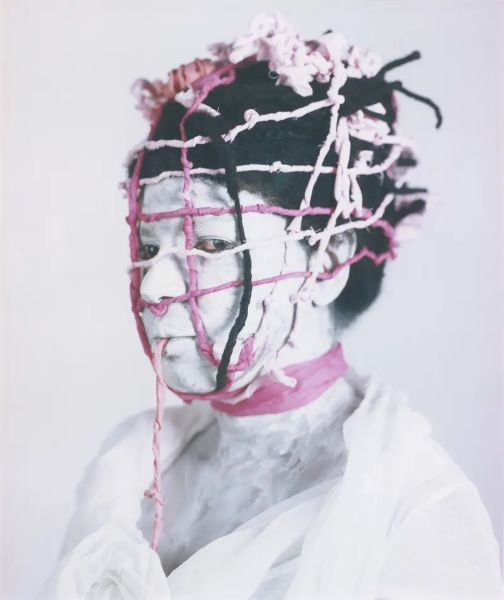
[Shown above: María Magdalena Campos-Pons, “Freedom Trap,” 2013. Polaroid Polacolor Pro. 24 × 20 in. (61.0 × 50.8 cm). Museum purchase from the Jere Abbott Acquisitions Fund, 2024.044.]
Featuring approximately fifty contemporary and vibrant artworks connecting the histories of a not-so-imaginary archipelago, “Imagining an Archipelago: Art from Cuba, Guam, the Philippines, Puerto Rico, and Their Diasporas” opened yesterday (July 11, 2026) at the Colby College Museum of Art in Waterville, Maine. Curated by Jessamine Batario, Linde Family Foundation Curator of Academic Engagement, the exhibition will be on view until June 6, 2027.