
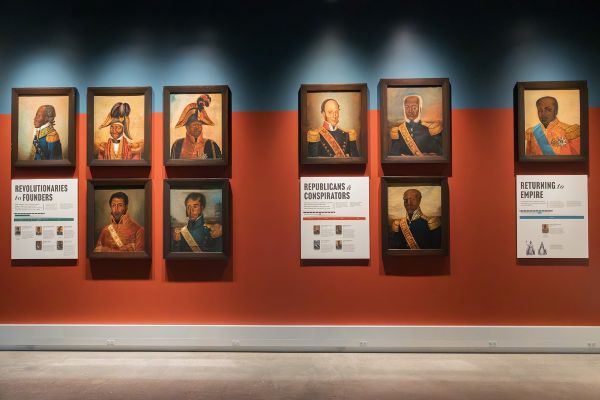
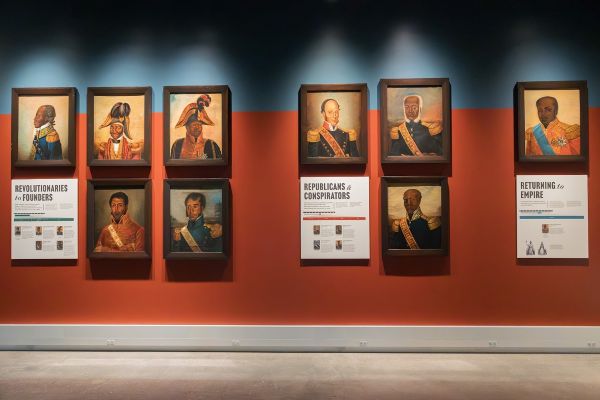
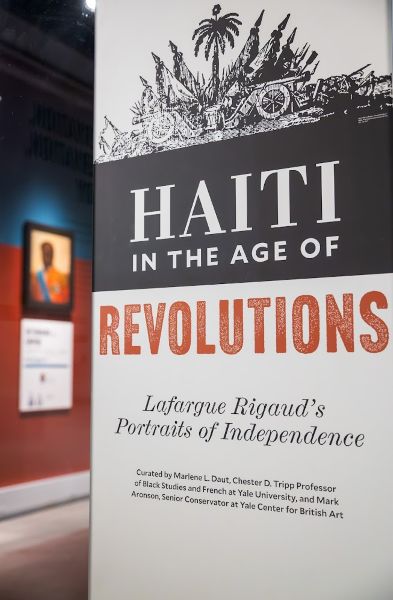
“Haiti in the Age of Revolutions: Larfargue Rigaud’s Portraits of Independence”—co-curated by Marlene L. Daut (Yale University, Departments of French and Black Studies) and Mark Aronson (Yale Center for British Art)— opened on November 9, 2026, and will remain on view until March 30, 2027, at the Yale Peabody Museum. The museum is located at 170 Whitney Avenue, New Haven, Connecticut. Here we share excerpts from a description by Steven Scarpa and a selection of photos from the exhibition.
Description (Steven Scarpa):The military portraits by the nineteenth-century Haitian artist Faustin Lafargue Rigaud are stately. Rigaud presents these dashing uniformed men with epaulets glittering on their shoulders, sashes and medals adorning their chests. They are Haitian revolutionaries and statesmen, who won freedom from France in the only successful revolution by enslaved people in modern history, forming the second independent state in the Americas and eventually the first Black republic. And now this set of paintings, not seen in public since the World’s Industrial and Cotton Centennial in New Orleans from 1884-85, will be on display at the Yale Peabody Museum. [. . .]

Rigaud’s portraits show the artistic and political ambition of 19th century Haiti. “Viewers are [. . .] Marlene L. Daut, an intellectual historian of the Caribbean and professor in Yale’s French and Black Studies department. “Haiti had a history of governmental experimentation since the Revolution,” she explained, referencing the nation’s oscillation between monarchical and republican rule.
The paintings of Faustin Lafargue Rigaud, created between 1877 and 1881, depict key figures of the Haitian Revolution and early statehood – governor-general François-Dominique Toussaint Louverture, emperor Jean-Jacques Dessalines, and king Henry Christophe, among others. “These leaders are instantaneously recognized in Haiti. Their images are understood the way we understand images of Washington and Lincoln,” said co-curator Mark Aronson, senior conservator at the Yale Center for British Art.
Rigaud painted Haitian presidents and heads of state, some of them many decades after their time in power. The paintings were a valuable tool for statecraft, Daut said. “Portraiture was about respectability. It was about projecting an image of strength and sovereignty. That’s why it was so important for Haitians to have portraits of their leaders. They were often given as gifts to other nations,” she said.
Diplomacy wasn’t the only reason for Rigaud’s work. Haiti won its independence in 1804 while slavery was still rampant throughout the world. Despite Haiti’s emergence as a slavery-free regional economic power, other countries refused to recognize the nation’s independence, Daut said. Depicting the revolutionary generation’s leaders was a way to reassert the nation’s autonomy and show that Haiti was a symbol of freedom in a world of slavery.

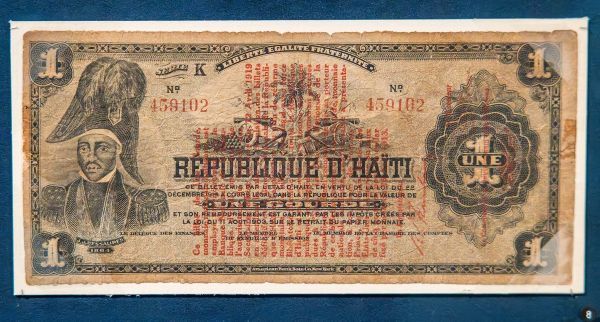
“These portraits show that Haiti was a sovereign nation and these were its leaders, not Napoleon or French kings or the French government,” Daut said.
The paintings had their own journey to the light of day.
After Rigaud’s work appeared at the 1884-85 Cotton Centennial, shipping them back to Haiti would’ve been cost-prohibitive, so they are believed to have been given as a gift to the Smithsonian Institution. They sat in storage for the better part of a century, deemed by Smithsonian curators as having “no ethnological or artistic value.” In 1963, the paintings were sent to Yale for study, added to the Peabody’s collection in 1972, and ended up on display until the late 1980s in the homes of two Yale professors.
Once the artworks were returned to the Peabody, they remained unseen. “There is something quite miraculous about the survival of this set of paintings given the history of fire, floods, earthquakes, and coups d’état in Haiti, and inattention to them once in the United States,” Daut said.
The 2010 earthquake that destroyed much of Haiti, including its cultural infrastructure, became a moment of opportunity to reclaim this piece of cultural patrimony. “The images most people today have of Haiti are drawn from the media showing poverty, violence, and the aftermath of the 2010 earthquake,” Aronson said.
To tell a different story, Yale University’s Institute for the Preservation of Cultural Heritage and the Smithsonian’s Haiti Cultural Recovery Project worked with Haitian conservators and trainees to restore the artwork at Yale’s West Campus. Aronson initiated the conservation efforts, a crucial step toward the Peabody’s new exhibition. Erica Moiah James, an assistant professor at the University of Miami, worked on the original conservation project, providing art historical support and contributing insights into the history of the paintings.
The portraits reveal complex stories worth remembering – true revolutionaries who fought for freedom, an artist committed to showing his country’s history, and those who collaborated with contemporary Haitians to preserve a stricken nation’s culture.
“Haiti in the Age of Revolutions” asks – and answers – questions that shed light on a nation whose struggle for freedom has been overlooked. “We hope people will get a more complete and nuanced picture of Haiti,” Daut said.
For more information, see https://peabody.yale.edu/news/haitian-paintings
Also see our previous post https://repeatingislands.com/2026/10/24/conference-haiti-in-the-age-of-revolutions-lafargue-rigauds-portraits-of-independence/
[Photo credit: Andy Melien / Yale Peabody Museum.]
“Haiti in the Age of Revolutions: Larfargue Rigaud’s Portraits of Independence”—co-curated by Marlene L. Daut (Yale University, Departments of French and Black Studies) and Mark Aronson (Yale Center for British Art)— opened on November 9, 2026, and will remain on view until March 30, 2027, at the Yale Peabody Museum. The museum is located at