
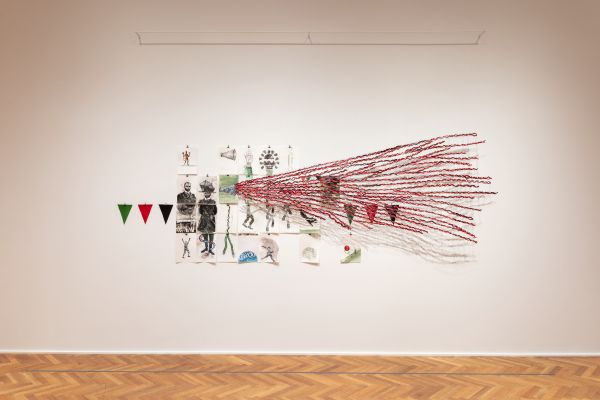
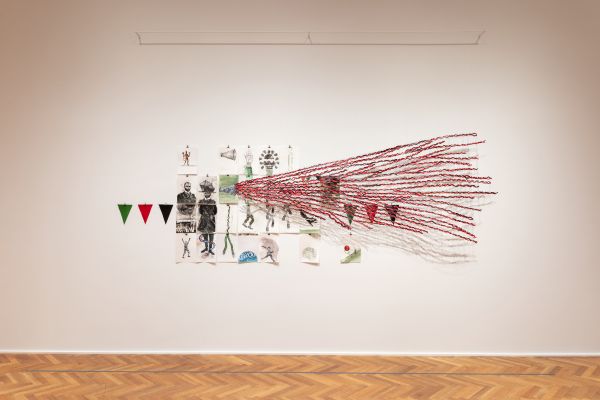
Galerie Françoise Heitsch / Françoise Heitsch Gallery for contemporary art presents Christopher Cozier & Shannon Alonzo in “Errant Helices,” which opened this evening, November 19, 2026, and will remain on view through January 23, 2027. The gallery is located at Amalienstrasse 19, Munich, Germany. [Read more information below and excerpts from an essay by Gerard Aching.]
Description (Gerard Aching, coauthored with Antawan I. Byrd): Helix (plural, Helices). Anything of a spiral or coiled form, whether in one plane (like a watch-spring), or advancing around an axis (like a corkscrew), but more usually applied to the latter; a coil, a spiral, as an electromagnetic coil of wire, the thread of a screw, a tendril, etc. (Oxford English Dictionary) The helix form contains opposing forces. On the one hand, what provides stasis to the form is its readily recognized and therefore classifiable coiled or spiraling structure; on the other, the structure conveys dynamism, a spiraling movement away and outward, almost as if it could extend itself indefinitely. While engineered uses of the helix, such as in coils or screws, purposefully limit the extension of its form to accomplish proposed functions, the form in the natural world, such as in a tendril, organically sustains and augments the form’s outward growth. At its most rudimentary in nature, the twisted ladder form of DNA’s double helix—the genetic foundation of what makes us, us at a molecular level—holds identifiable, inherited properties and transmits them reassembled to forthcoming generations through reproduction. In its stasis and dynamism, the helix possesses both diachronic and synchronic properties. It is a form that reveals how it materializes in a particular moment and over time.
Titled Errant Helices, this exhibit displays selected works by the Trinidad and Tobago-based artists, Christopher Cozier and Shannon Alonzo. Helices in the art on display depict entangled relations between humans and the natural or surrounding world at precise moments and through time. These relations do not oppose “man” to “nature,” as Romantic antecedents strategically did to give rise to reflections on the inescapable embeddedness of “man” in “nature.” Rather, the helical forms in this art foreground the twisting, inextricable entanglements of humans and the surrounding world as preconditions for creating art. As a point of departure, this entanglement is familiar to artists and intellectuals in places where colonial histories have long documented the efforts of imperial projects to subdue natural and precolonial human environments. Hence, each artwork not only provides a statement about this entanglement of humans and the surrounding world at a given moment but each also employs specific citations and objects to substantiate its intervention and situate it contextually.
Cozier’s central piece, Stepping, foregrounds the explosive, centrifugal emission of red and black helices from a megaphone to convey the artist’s introduction to, engagement with, and celebration of Pan-Africanist thought through popular music. Modes of stepping—back and forth, processional, celebratory, or combative movements—respond to this music. [. . .]
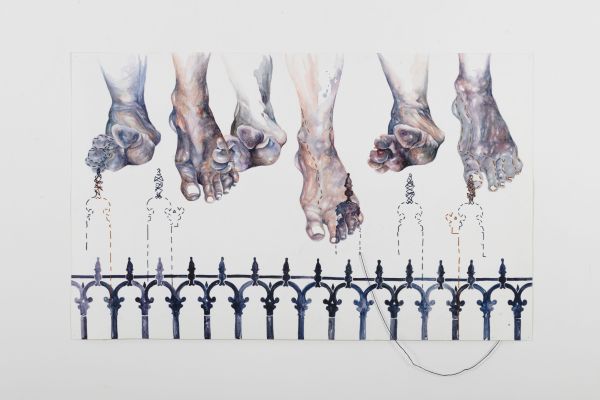
In Alonzo’s works, the simultaneous presence of mangrove (Lat. Rhizophora mangle) roots and human feet provides various renderings of always evolving, borderless entanglements between two temporalities of progressive movement: the organic, ahistorical advance of mangrove roots that create, expand, and protect coastal lands and the human occupation of space over time, ranging from walking or dancing to proprietary or anthropocentric claims. In works like Point of Contact, these temporalities are competitive and produce ruins or remnants in the wake of their ongoing entanglements. In other works, like Grounding , the outgrowth of feet from mangrove roots fuses natural and human temporalities into forms that are aspirational, mythical, or monstrous in their amalgamation of DNA properties.
***
As an exhibit, Errant Helices is neither programmatic nor interested in offering a manifesto. So teleological or didactic an endeavor runs counter to its artists’ conceptions of the works they’ve created. Rather, the artworks that Cozier and Alonzo display here demonstrate a range of complementary and contextualized creative statements in which inextricable entanglements and errancy do not constitute unsurmountable, poststructuralist challenges to artistic creativity but condition their possibilities. Visitors are invited to contemplate the works of the artists errantly: that is to say, wandering, meandering, and ambling from work to work in the exhibit.
For more information on the exhibition, see https://www.francoiseheitsch.de/exhibitions/errant-heliceschristopher-cozie-shannon-alonzo and https://invitation-christopher-cozier-shannon-alonzo-errant-helices?e=17765ebb37
Contact the gallery by phone at +49 (0)170 5339532, or the following:
WWW.FACEBOOK.DE/GALERIEFRANCOISEHEITSCH
INSTAGRAM: @GALERIEFRANCOISEHEITSCH
[Shown above: 1) Christopher Cozier, “stepping,” 2024, Installation view, Art Institute of Chicago, Project a Black Planet: The Art and Culture of Panafrica, MACBA Museum d’Art Contemporary de Barcelona 2025, Barbican Center London 2026, courtesy: Art Institute of Chicago. 2) Shannon Alonzo, “point of contact,” 2026, mixed media, watercolour, watercolour pencil, ink, vellum, and embroidery thread on watercolour paper.]
Galerie Françoise Heitsch / Françoise Heitsch Gallery for contemporary art presents Christopher Cozier & Shannon Alonzo in “Errant Helices,” which opened this evening, November 19, 2026, and will remain on view through January 23, 2027. The gallery is located at Amalienstrasse 19, Munich, Germany. [Read more information below and excerpts from an essay by Gerard