
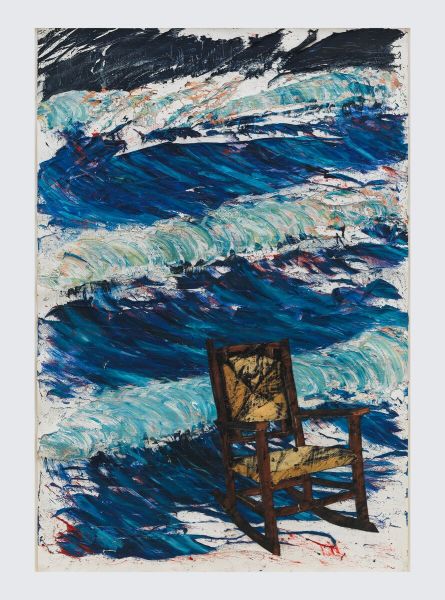
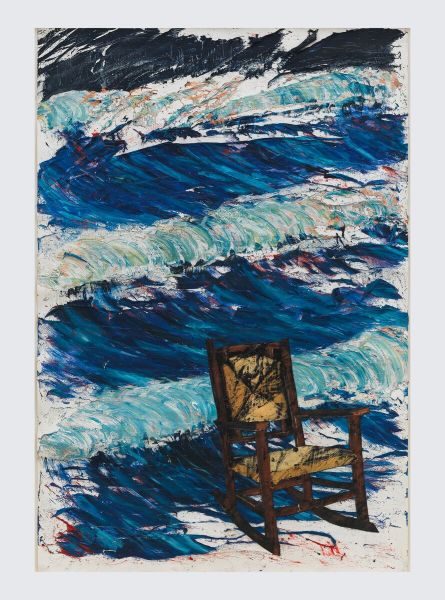
I am deeply moved by this statement by Puerto Rican artist Ángel Otero: “Each corner of this house holds a negative space. It is not emptiness, but the shape of an absence. Of something missing. A rocking chair leaves its mark on the floor long after it is gone.” Otero’s solo exhibition “Agua salada” [Salt Water] is now on view at Hauser & Wirth Somerset (located at Durslade Farm, Dropping Lane, Bruton, United Kingdom) until October 18, 2026.
Description (Hauser & Wirth): Angel Otero makes his United Kingdom debut this spring, featuring a deeply personal body of work completed during an artist residency at Hauser & Wirth Somerset.
Known for his physically immersive approach to paint as material, Otero transforms the medium itself—scraping, layering and peeling dried oil paint to create richly textured compositions that hover between abstraction and figuration. Moving his studio practice from Brooklyn NY and Puerto Rico temporarily to Somerset, the residency provides Otero with the opportunity to continue his exploration of memory, place and meaning in the context of a new environment.
‘I have come to understand place as a living presence within the work—not merely a backdrop, but a condition that shapes perception. Every environment holds a quiet residue of light, architecture, weather, and history. When I shift my surroundings, it stirs fragments of memory that surface through process rather than depiction. The work becomes a meeting point between where I am and where I have been. The studio becomes porous, and what lies beyond inevitably seeps into the painting.’—Angel Otero
The exhibition unfolds across the galleries in Somerset, with outdoor sculpture extending into the inner cloister courtyard. Paintings range from monumental compositions, including Otero’s largest figurative painting to date, that envelop the viewer in a fully immersive sensory experience to intimate encounters with smaller studies and works on paper, rarely presented outside the studio.
The exhibition title ‘Agua Salada’ (Salt Water) operates on several simultaneous registers. First, it is the ocean: a horizon of origin, migration, and return. Second, it is chemistry: salt dissolving into water, a visible and invisible transformation that both erases and preserves. Third, it is affect: salt as sting and as salve. Salt Water in this body of work is never a single metaphor, it is a process, a material, and a conceptual stance. The series asks viewers to reckon with how place and family leave mineral traces on us, how grievance can calcify into identity, and how nostalgia can be both balm and burden. The work does not resolve these tensions; it lets them crystallize, shimmer, and slowly dissolve.
Otero’s signature mode of storytelling evokes the ways in which household objects become personified through the lens of memory. These objects, seemingly quotidian at first glance, take on the role of surrogates for family members and moments from the artist’s past. Expansive landscape works feature familiar motifs of doors, bedframes, pianos and clocks that operate as portals. Each work becomes an accumulation of intimate fragments, a composite self-assembled from elements that are never singular or fixed.
Early explorations in portraiture include a painting depicting Otero as a small child with his grandmother. The figures tenderly hold on to one another whilst merging and colliding with a wave, serving as an emotional anchor for the exhibition. The sea is a subject the artist frequently returns to, embodying both beauty and terror, its unpredictability and vastness reflecting the instability of memory itself. Photograph-sized family portraits appear collaged within the works, hovering at the edge of recognition, pointing to the tie we have with photographs as tangible objects and powerful emotional bridges to our past.
The outdoor work, ‘Dreams and Salt’ (2026), was first shown in Puerto Rico as part of La Gran Bienal Tropical in 2025, highlighting a feeling of distance and longing to return to the island. A new film conceived in Puerto Rico brings elements investigated within the paintings into moving image for the first time. The non-linear narrative includes footage shot within Otero’s late grandmother’s home, sealed since her passing and preserved as a container of the family’s shared history. An unmediated record of life that simultaneously speaks to the stories we hold close and how we understand ourselves in relation to a person and the resonance of a space.
Angel Otero was born in 1981 in Santurce, Puerto Rico, where he resided until moving to Chicago in 2004. He currently splits his time between New York and Puerto Rico. [. . .]
Otero’s practice is known for employing highly innovative techniques that challenge the parameters of his materials, revealing the intrinsic qualities of paint. His works are rooted in abstract image making and engage with ideas of memory through addressing art history, as well as his own lived experience. Otero is best known for the Oil Skin works he began in 2010, an ongoing series that demonstrates the inherently transformative nature of the artist’s practice as well as his dedication to expanding the visual field of abstract expressionism. Using oil paint layered onto glass and peeled off at a partially dried state, Otero recomposes his ‘skins’ onto canvas to make entirely new images and patterns.
In 2017, Otero debuted a series of large-scale sculptural oil paintings that resemble tapestry. Hanging freely, these works incorporate salvaged materials from his studio, off-cuts of previous paintings, and found objects that are significant to his native Puerto Rico. The many fragments that make up his compositions become powerful meditations on past and present.
The artist’s early childhood memories are brought to the forefront in his most recent series of paintings which see a return to figuration combined with his hallmark style of abstraction. Otero paints and collages dreamlike scenes upon his vibrant structured canvases, depicting objects and spaces that are loosely based on personal memories associated with the domestic sphere. Probing the boundaries of figuration and abstraction, Otero’s most recent works continue to expand the possibilities of painting and materiality.
For more information, see https://www.hauserwirth.com/hauser-wirth-exhibitions/angel-otero/ and https://www.hauserwirth.com/artists/36211-angel-otero/
[Shown above: Otero’s “Madrina” (Godmother)]
I am deeply moved by this statement by Puerto Rican artist Ángel Otero: “Each corner of this house holds a negative space. It is not emptiness, but the shape of an absence. Of something missing. A rocking chair leaves its mark on the floor long after it is gone.” Otero’s solo exhibition “Agua salada” [Salt