
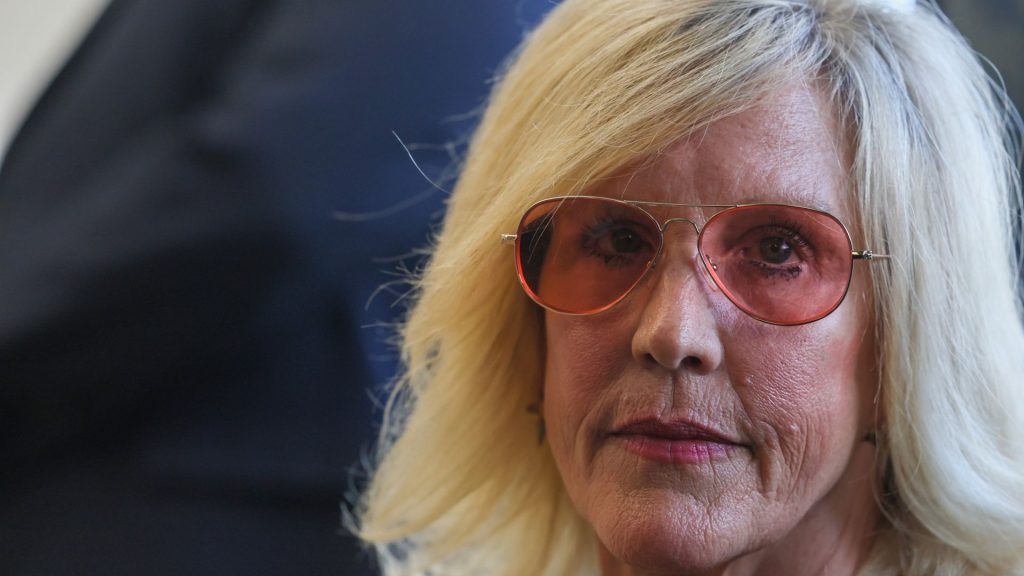
More than a quarter of a century ago, her heroic struggle against a utility giant over groundwater contamination became an Oscar-winning Hollywood movie. Now, Erin Brockovich has turned her attention to the “rapid” and “opaque” expansion of artificial intelligence data centres across the United States.
‘Stubborn and sexy’
“Say the name Erin Brockovich and you think, strong, tough, stubborn and sexy”, says her website. She is, it continues, but definitely so much more – a “modern-day David who loves a good brawl with today’s Goliaths”.
Brockovich was working as a file clerk at a Los Angeles law firm in 1992 when she uncovered evidence linking a rash of illnesses in the town of Hinkley, California, to high levels of hexavalent chromium found in the drinking water.
Her work ultimately led to more than 600 residents of Hinkley filing a lawsuit against utility giant Pacific Gas & Electric. The $333 million settlement they received was the largest of its kind at the time. Her crusade was immortalised in the Academy Award-winning movie “Erin Brockovich” starring Julia Roberts.
At times denounced as “the environmentalist with cleavage,” she “frequently saw her blonde hair and striking looks turned into weapons against her”, said El Pais. But she was “raised by parents who instilled in her an extraordinary sense of resilience and self-confidence”. And, in the wake of the movie, she “did not remain just another heroine fashioned by Hollywood’s capitalist, and often patriarchal, storytelling instincts”.
‘Hinkley on steroids’
Brockovich’s name has become “synonymous with grassroots activism against powerful institutions”, said Time, and this year, she has “turned her attention to a new target” the AI data centres being built by tech giants like Meta, Google, and Microsoft.
In April, she “put a call-out on her website asking for anyone with concerns about one near them to get in touch”, said The Guardian. Within a month, 3,862 people had replied.
She built a “chilling” map of significant AI data centres that are either operational or under construction, plus locations where community members have emailed in concerns. As of June, 33 data centres had been completed and were operational, 68 were under construction, and 41 were proposed. In May, Utah gave approval to a centre twice the size of Manhattan. “This feels like Hinkley on steroids,” Brockovich told the broadsheet.
She says the data centres are being built without proper environmental impact assessments or community input, and have significant impacts on local resources, particularly water usage. She’s concerned they are being built in a secretive manner, bypassing democratic processes, and causing harm to the environment and local communities. She wants a “case-by-case moratorium” on the approval of new data centres until their impacts can be properly assessed and addressed.
She is, she says, “up against forces that have all the money and all the intelligence and all the bandwidth in the world”, but won’t walk away despite “getting too old for this” now that she’s in her “legacy phase” with six grandchildren.
The famous activist is turning her fire against a new target