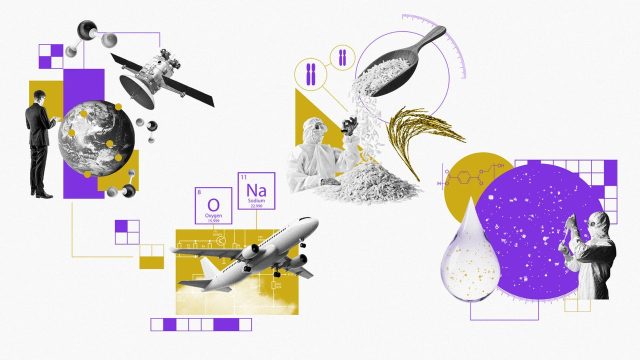
The outgoing year was a mixed one in the fight against global warming. While some countries, including the UK, continued to make positive steps towards net zero, the return of Donald Trump to the White House exacerbated an already fraying international climate consensus. But a series of scientific breakthroughs in 2025 holds out some hope for a greener future. Here are seven of the most promising:
Carbon dioxide satellite tracking
A novel satellite-based method to track fossil fuel CO2 emissions with greater precision than ever before marks a “significant advancement for climate monitoring”, said Open Access Government. “Traditional methods” such as “ground-based measurements and bottom-up inventories, are often resource-intensive and prone to inaccuracies”.
Researchers at Tsinghua University used nitrogen dioxide – which has a shorter atmospheric lifetime and enhanced detectability – as a “proxy” for CO2, to successfully trial a “more reliable and scalable solution for monitoring emissions”.
Automated food waste upcycling
AI-powered food waste management uses real-time data and predictive analytics to monitor, categorise, and reduce food waste. Food scraps can effectively be upcycled into resources for “composting and biogas systems”, said The Sweaty Penguin environmental podcast.
One of the 10 environmental tech breakthroughs for 2025 compiled by the World Economic Forum and published in science journal Frontiers, this technology can also support “nutrient cycling” by enabling food waste to be returned to soil systems. Automated waste sorting can also “separate food waste from plastic waste, reducing plastics and organics going into landfills, producing quality compost for agriculture, while helping slash methane, CO2 and nitrous oxide emissions”.
Gene variant protects rice from rising temperatures
After more than 10 years, Chinese researchers led by plant geneticist Yibo Li of Huazhong Agricultural University, have discovered a naturally occurring gene variant that can preserve both the yield and quality of rice from excessive heat. Rising temperatures are a “major and growing threat to rice production”, said Science, citing a 2004 study that found yields fell by 10% for every degree Celsius average night-time air temperature rose.
The impact of this “major breakthrough,” could “ultimately be even broader than rice” as the same gene variant can be found in other cereals, such as wheat and corn, that are at a similar risk from heat, said Argelia Lorence, a plant biochemist at Arkansas State University.
Sodium batteries make electric flight possible
The sodium-air fuel cell – designed by a team led by Yet-Ming Chiang, a professor of materials science and engineering at MIT – works by combining liquid sodium with oxygen drawn from the air in a continuous reaction. The device is “based on well-established electrochemical principles”, said The Times, but “unlike conventional batteries, which must be recharged, it is designed to be refuelled, with its energy-rich material being replaced as it is consumed”.
While still in the experimental stage, sodium batteries could eventually lead to electric-powered flight which is more sustainable and much cheaper even than non-petroleum aviation fuel. In laboratory tests, the MIT sodium-air fuel cell prototype delivered more than five times as much energy per kilogram as the lithium-ion batteries currently used in electric cars. It also produces sodium hydroxide as a by-product which could be used to absorb CO2 from the atmosphere or turned into sodium bicarbonate which could help de-acidify the ocean, a problem caused by carbon emissions. It is an “essentially free” by-product, “producing environmental benefits at no cost”, said Chiang.
Microplastic referencing
The dangers of microplastics to the environment and human health are well documented, but tracking microplastic pollution remains complicated. Now, in a world first, the European Commission’s Joint Research Centre has developed reference material to measure polyethylene terephthalate (PET) particles, commonly found in packaging and textiles, in water.
Already being used to update key EU regulations such as the revised EU Drinking Water Directive, the JRC’s reference material “lays the groundwork for coordinated global action” on microplastics, said Open Access Government.
Clean energy from toxic waste
Bio-tar – the thick liquid by-product produced when heating biomass and organic matter – has long been viewed as toxic to the environment and an unavoidable cost of renewable energy production. But new research by scientists at the Chinese Academy of Agricultural Sciences has found that instead of being treated as waste, bio-tar can be converted into “bio-carbon”, a “novel material with applications ranging from water purification to clean energy storage”, said Science Daily.
“Turning bio-tar into bio-carbon not only solves a technical problem for the bio-energy industry, but also opens the door to producing advanced carbon materials with high economic value,” said senior author Dr Zonglu Yao.
Green concrete
Manufacturing Portland cement, the key binding ingredient in concrete, currently contributes around 8% of global CO2 emissions. The development of “novel cement-free green concrete technologies” offer an “alternative by eliminating Portland cement altogether and instead using binders derived from industrial byproducts or construction and demolition waste”, according to a World Economic Forum report.
This process “not only eliminates emissions from traditional cement production but also creates a permanent storage route for captured CO2”. Together, these advances “cut demand for extracted raw materials and ease pressure on planetary boundaries related to climate change, land-system change, and biogeochemical flows”.
Progress was made this year on carbon dioxide tracking, food waste upcycling, sodium batteries, microplastic monitoring and green concrete