
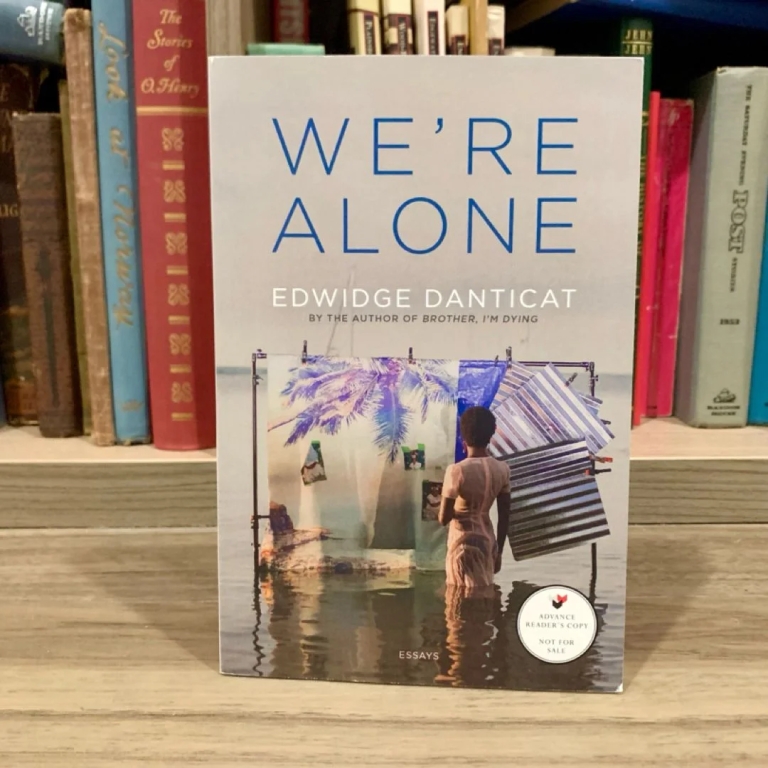

In “We’re Alone,” the acclaimed novelist writes about her native Haiti and the storytellers who have influenced her.
A review by Becca Rothfeld for The Washington Post.
“We’re Alone,” a new collection of essays by the acclaimed novelist and short-story writer Edwidge Danticat, opens with an English translation of lines by the Haitian poet Roland Chassagne. Danticat first encountered the lines in an English anthology of Haitian poets, and she recalls that she “spent many years” trying to track down the French original. Eventually, she contacted the poet’s granddaughter and obtained a copy, which first appeared in the 1933 collection “Le tambourin voilé” (“The Veiled Tambourine”). But by the time Danticat read the work in French, it had been irrevocably refracted through the lens of its English rendering.
This anecdote is a fitting beginning for a collection about the many ways that Haiti has been distorted by its translation into the idioms of global power. The original Haiti — the one that existed before France colonized the country in 1697, before the subsequent centuries of economic exploitation, before a series of devastating hurricanes exacerbated by climate change — is no longer accessible. “I am from a place that constantly evokes nostalgia in the people who have seen, lived, and loved it ‘before,’” writes Danticat, who emigrated to America when she was 12. Years later, when the writer and her children were driving through a flooded street full of floating trash in the capital city, Port-au-Prince, she suppressed her desire to shout, “The land might never be pristine again.”
But as “We’re Alone” demonstrates, pristine purity is not always a virtue. Danticat’s essays are collages of associations and resonances, and they are richer for it. The novelist credits the storytellers in her family — the “kitchen poets,” she calls them — with inspiring her exuberantly choral tone, full of references and echoes. Most of the women who were her “best writing teachers,” as she explains in the first essay in the book, “never went to school and never learned to read and write, but they carried stories like treasures inside them.”
Funnily enough, then, Danticat is never really alone in “We’re Alone.” Instead, she is always in the company of her forebears — and thereby in conversation with a tradition packed with folk tales and lore. Indeed, the phrase “kitchen poets” is itself an allusion to the American novelist Paule Marshall, whose essay “From the Poets in the Kitchen” is a lodestar for Danticat. Even the line “we’re alone,” which comes from Chassagne’s poem, belies its nominal claim. How can Danticat be alone if she is speaking to so many of the writers and raconteurs who preceded her?
Like the informal but spirited orators she grew up idolizing, Danticat cultivates a style that is diverting and digressive. Her essays are not linear artifacts but webs that spin around ideas or turns of phrase. As such, they are never about only one thing.
An essay about the assassination of Haitian President Jovenel Moïse in 2021, for instance, is also about political corruption in Hispaniola, a “forty-three-year-old self-proclaimed prophetess” who warned Moïse of his impending death, the cottage industry of fortune tellers in Haiti and Gabriel García Márquez’s novella “Chronicle of a Death Foretold.”
In another essay, “Children of the Sea,” Danticat circles around the notion of salt. “According to Haitian folklore,” she writes, “eating salt can liberate zombies from their living death.” She recalls that when she emigrated to New York, in 1981, she was “shocked that salt was white. In markets in Haiti, we often bought rock sea salt that looked like little crystals or small pebbles, which were unevenly shaped, and had dark streaks either on the surface or inside.” This one substance gives rise to an abundance of conflicting imagery: The American novelist Zora Neale Hurston wrote that “the sea is salt,” while the Saint Lucian poet Derek Walcott wrote, “The sea is history.” The sea is all this and more.
Although Danticat’s reflections sometimes give way to clichés at the level of sentences (“being human means having to keep beginning again”), their poly-vocal profusion is fresh and gripping. They imagine a form of authorship that is both distinctive and communal.
Appropriately, “we’re alone” is an ambivalent declaration. It is “the persistent chorus of the deserted,” Danticat writes, but it is also “a promise writers make to their readers, a reminder of this singular intimacy between us.” A writer and a reader are “alone together.”
Haiti, too, has often been abandoned (or worse) by the rest of the world, but its inhabitants are alone together, and they have managed to transform even the language of their colonizers into something colorfully new — Haitian Creole. This tongue, which bears remnants of its rudiments, is no more “pristine” than the streets strewn with detritus, but perhaps there is something to be said, Danticat suggests, for the inventiveness required to transform disaster into something brighter.
A couple of pages after she recounts her drive through streets filled with trash, Danticat notes that resilient life forms can, after all, take root in rubble. Scientists recently discovered “close to five hundred invertebrate species growing on the soupy plastic debris of the Great Pacific Garbage Patch,” a collection of underwater trash in the North Pacific. “These coastal creatures have adapted to their new circumstances,” she writes. Some of them have even flourished.
We’re Alone
Essays
By Edwidge Danticat
Graywolf. 137 pp. $26
In “We’re Alone,” the acclaimed novelist writes about her native Haiti and the storytellers who have influenced her. A review by Becca Rothfeld for The Washington Post. “We’re Alone,” a new collection of essays by the acclaimed novelist and short-story writer Edwidge Danticat, opens with an English translation of lines by the Haitian poet Roland Chassagne.