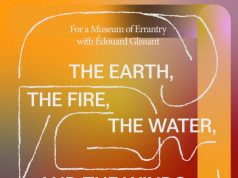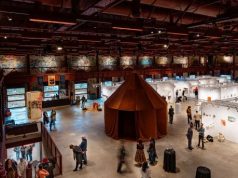
“An exhibition of his collection finds provisional alliances between artists, rather than reiterating established hierarchies.” We enjoyed this review of “The Earth, the Fire, the Water, and the Winds: For a Museum of Errantry with Édouard Glissant” by John Yao. Curated by Manuela Moscoso with Marian Chudnovsky (in collaboration with Paulo Miyada and Ana Roman) the exhibition is on view at the Center for Art, Research and Alliances (225 West 13th Street, New York, New York) through May 10, 2026. The exhibition was co-conceived with Mémorial ACTe, the Édouard Glissant Art Fund, and the Institut du Tout-Monde. Here we share excerpts; read the full review at Hyperallergic.
In the fall of 2018, Hans Ulrich Obrist, Gabriela Rangel, and Asad Raza curated the exhibition Lydia Cabrera and Édouard Glissant: Trembling Thinking for the Americas Society, which I reviewed for this publication. Focusing on artists who made work addressing Martinician writer and philosopher Glissant and Cuban writer and activist Cabrera’s meditations on identity, the exhibition deepened my knowledge of the former’s inspirational thinking. It also made me aware of his friendships with artists from Europe, Africa, and the Americas, including Roberto Matta, Wifredo Lam, Etel Adnan, Irving Petlin, Antonio Seguí, Öyvind Fahlström, and Jack Whitten. When I learned of the current exhibition The Earth, the Fire, the Water, and the Winds: For a Museum of Errantry with Édouard Glissant, at the Center for Art, Research and Alliances (CARA), the first United States showing of works from his personal collection, I knew that by visiting I would gain a broader perspective on Glissant’s relationship with artists and what their work had in common.
According to the press release, Glissant, who passed away in 2011, “gathered these works not for ownership, but in the spirit of the commons, imagining them as the beginnings of a living archive attentive to relation and difference.” Drawing upon Caribbean geography — its many islands — and his fervent desire to undo colonialist narratives, he conceived of his collection as a museum-as-archipelago, a non-hierarchical cluster of distinct but connected islands. Such a museum finds and exhibits “provisional alliances”; it does not reiterate established hierarchies nor replicate colonialist narratives. Glissant’s counter-narrative of the museum as a responsive, non-stable archive is crucial if any real change to Western art-world thinking is going to take place.
Glissant’s view of the non-hierarchical and local extended beyond art into the social dynamics of the Caribbean, its long interaction with the West, and the trade in enslaved people. Rejecting the idea of a Pan-African or essentialist identity that did not account for children of mixed marriages, he came up with the term “Creolisation” to define a non-hierarchical, local environment in which individuals could construct their own identities. [. . .] He had no interest in art associated with personality, entrepreneurship, style, or auction records. Instead, as the curators of the 2018 exhibition stated in their catalog essay, Glissant believed “there was always something unknowable, something opaque, inside each person, which, rather than being what divides us, is what links us.” [. . .]
Another revelation is a group of small drawings in a single frame by Lam, whose landmark painting, “The Jungle” (1942–43), Glissant wrote about in Poetics of Relation (1990). Lam is mostly associated with Aimé Césaire because he notably illustrated his revolutionary masterpiece, Notebook of a Return to the Native Land(1939), in which the word “negritude” first appears. The relationship between Glissant and Lam is less known and written about; this exhibition offers an opening for further exploration.
Other artists in Glissant’s collection include his wife, Sylvie Sema Glissant, Fahlström, Petlin, Brauner, Edwards, and Tania Bruguera (not included in this exhibition). Each of the artists in this collection is an island in an archipelago of relation; they undo colonialist narratives, rationalism, and logical thinking, often with a caustic humor, sense of absurdity, and a wild imagination. [. . .]
For full review, see https://hyperallergic.com/edouard-glissants-museum-as-archipelago/
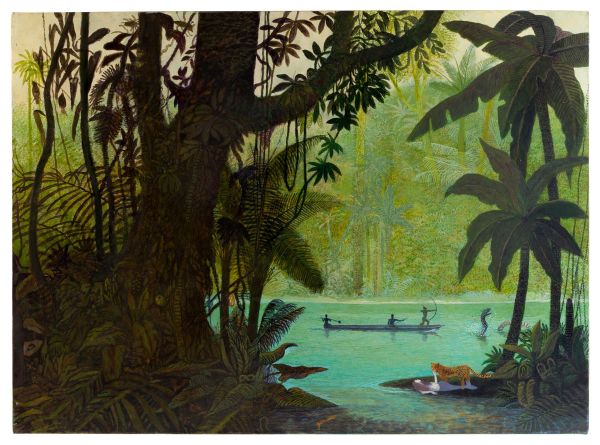
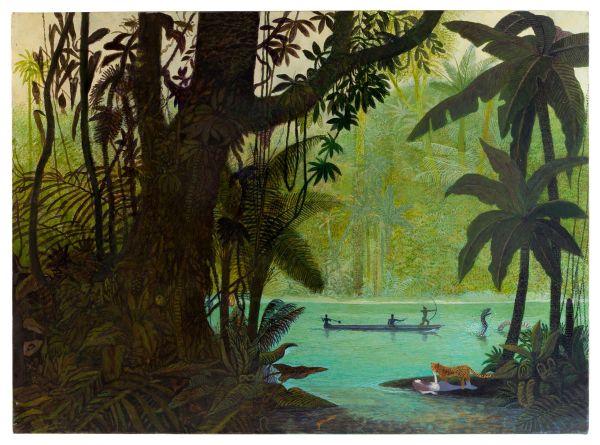
[Shown above, photo courtesy Mémorial ACTe, fonds Région Guadeloupe): José Gamarra. “L’inaccessible… (The inaccessible…)” (1986–87), oil on canvas.]
“An exhibition of his collection finds provisional alliances between artists, rather than reiterating established hierarchies.” We enjoyed this review of “The Earth, the Fire, the Water, and the Winds: For a Museum of Errantry with Édouard Glissant” by John Yao. Curated by Manuela Moscoso with Marian Chudnovsky (in collaboration with Paulo Miyada and Ana Roman) the