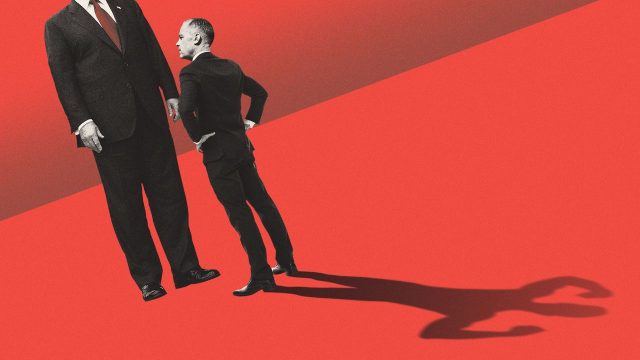
World leaders have long wondered how best to deal with Donald Trump. Cosy up to him and feel the wrath of those more moderate voices back home, or take a stand and feel the wrath of the US president himself.
Canada’s Prime Minister Mark Carney made waves at Davos this month with a speech attacking “coercion from global superpowers, including the use of tariffs”, without mentioning Trump by name, said Bloomberg. “The middle powers must act together because if we’re not at the table, we’re on the menu,” Carney said.
But in recent days he has had phone calls with the US president and taken a more nuanced stance, assuring Trump that a free trade deal with China was not on the table.
Perhaps this hokey-cokeying was in fact for the benefit of voters at home. There is no doubt Trump’s “hostile reaction will likely only help Carney domestically”.
What did the commentators say?
Carney’s domestic approval rating “soared to record highs” after his Davos speech, said The Telegraph.
His authoritative stance against Trump’s desired acquisition of Greenland – “widely interpreted as a rallying cry” against the president – “enchanted much of the Davos elite”, and gained “unsparing recognition of the new reality in a way most European leaders had not”.
He has never been more popular as Canadian leader. Carney has jumped eight points to a 60% approval rating, according to the Angus Reid Institute, a Canadian research group. His “declarative, elbows-up moment at Davos is something that Canadians appreciated”, said Shachi Kurl, president of the institute.
Carney and Trump have enjoyed contrasting fortunes recently. Support for the Canadian prime minister has “swelled” while Trump’s “already-underwater approval has further declined”, said Time.
The picture on the home front, however, is more complicated. While Carney’s “personal brand” has received a clear “boost”, the same poll shows his Liberal Party maintaining only a “narrow lead” over the Conservatives. Even so, this momentum, and Carney’s “hardline” anti-Trump stance, “could play into voters’ decisions moving forward”.
After being “dismissed as a lame duck” recent months, France’s President Emmanuel Macron has “clawed back some influence” after his staunch defence of Greenland and Denmark, said The New York Times. As it was for Carney, Davos was a “gift” for Macron. Donning his aviators, and producing a “meme-ready repetition of the phrase ‘for sure’ in his speech”, he managed to gain “rare support” from across France’s “fractured political landscape”.
Things seem to be coming together for Macron. With his PM Sébastien Lecornu “on the brink” of guiding a budget through the National Assembly, his leading role in the “coalition of the willing” and now his verbal retaliation against Trump, he is in the “vanguard of European leaders in defending Denmark and Greenland”.
Giorgia Meloni has taken a different approach, said The Observer. The Italian prime minister has “carefully cultivated” the role of “Trump-whisperer”, being the only European leader to attend his second inauguration, and Trump himself has praised her as a “fantastic woman” and “exceptional leader”. Unlike Carney and many of her EU counterparts, Meloni is “quietly stepping into the diplomatic gap” between Trump and the rest of Europe.
But her “softly-softly approach” with Trump has “exposed her to criticism at home”. One of Meloni’s critics – Angelo Bonelli, from the opposition Green Europe party – believes she “doesn’t have the capacity to move the dial” and is “merely seeking to boost her standing domestically”. There are doubts whether she can “give Europe leverage – or simply accelerate the fragmentation Brussels fears most”.
Spain’s PM Pedro Sánchez rarely utters Trump’s name in public, but he delivers “harsher criticism of the US president’s aggression than any of his fellow European leaders”, said María Ramírez in The Guardian.
Sánchez was one of the first to condemn US intervention in Venezuela, and spoke out about the “sabre-rattling” over Greenland. His approach has proved “popular in Spain”, at the very least with the 600,000 Venezuelans living in the country and the far-left parties present in his government coalition.
Tackling Trump head-on has offered “useful respite from his mounting domestic challenges”, with his party mired in corruption scandals and sexual harassment allegations.
Spaniards respect the “bold” articulation of “what many other European leaders think, but dare not say”, but aren’t fooled by the transparency of using “international crises in terms of domestic political gain”.
What next?
One of Canada’s “hottest exports” right now is Netflix’s “Heated Rivalry”, but Carney is not far behind, said the Financial Times. His “punchy” Davos speech drew much adulation, but underlined a “risky strategy” for the road ahead.
One European official framed the new reality when it comes to relations with Trump as the “post-Davos” world, said Politico. “Now that the trust has gone, it’s not coming back,” another diplomat said. “I feel the world has changed fundamentally.”
Mark Carney’s approval ratings have ‘soared to new highs’ following his Davos speech but other world leaders may not benefit in the same way