
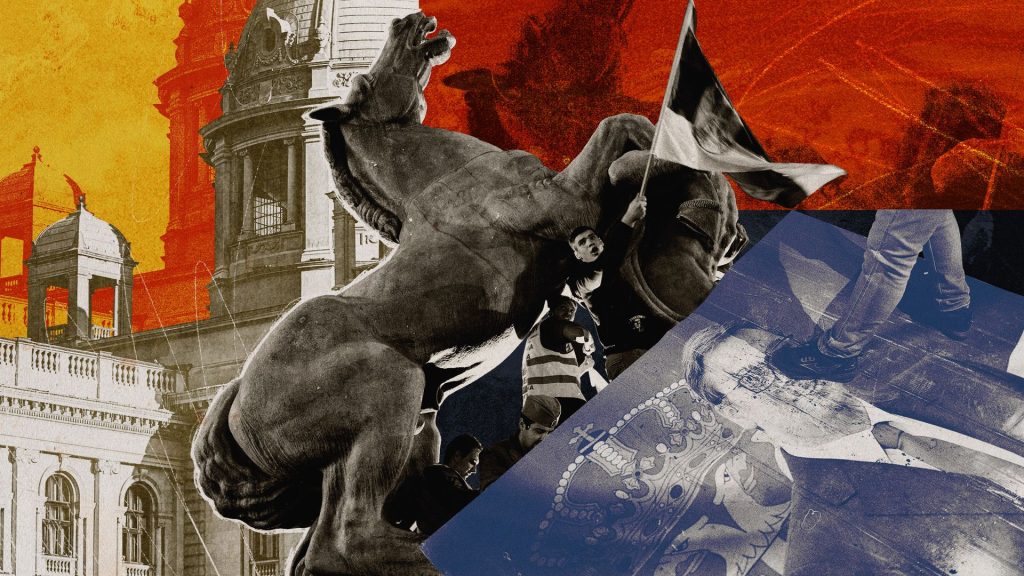
A student-led protest movement has won the Serbian parliamentary elections, defeating Aleksandar Vučić, the strongman who has ruled the country for 14 years. “After toppling governments in Sri Lanka, Bangladesh and Nepal, and rattling others in India, Kenya, and Vietnam,” it seems Gen Z protests “have come for Europe”, said Judah Grunstein in World Politics Review.
The Student List – which has no obvious leaders and whose candidates were not politicians but academics, engineers, farmers and athletes – attracted voters angry at government fraud and corruption with the slogan “Serbia or Mafia?”.
Vučić threw “the kitchen sink at the campaign to skew the result his way”, including taking control of all Serbia’s broadcast channels, “cranking up the nationalist rhetoric” and “cultivating support from Moscow”, said veteran central Europe correspondent Misha Glenny in The Guardian. But he and his once-dominant Serbian Progressive party were beaten, in a result that will reverberate across European countries already rocked by their own student protests.
What did the commentators say?
“Protest movements always respond to local factors,” said Grunstein in World Politics Review. But the student grievances in Serbia “and their underlying causal factors” have “more than a passing similarity” to those in France, Spain and Italy: “educational systems starved of funding, a bleak employment outlook and scarce opportunities for housing”. And corruption “is often the trigger that catalyses anger over the rest”.
In Serbia, the catalyst was the 2024 collapse of newly renovated station roof in Novi Sad, killing 15 people. What started as weekly student protests against the corruption that allegedly lay behind the botched building project “soon became a national movement” that “encompassed far more sections of Serbian society, including farmers, actors and judges”, said the BBC’s Europe editor Paul Kirby.
When Vučić, “clearly shaken” by the scale of the protests, announced snap elections last month, the students made a “calculated decision” not to stand as candidates themselves “as the electorate would probably not voted for a list of candidates with little life experience”.
Instead, they “turned months of university sit-ins” and “anti-corruption marches into a serious parliamentary challenge” by hopping on bicycles, walking across the countryside and knocking on doors to build a 250-candidate campaign slate “unlike anything Serbia has seen”, said Noah Sanders on Geosirius.
The Student List successfully “transformed itself” from “social revolt into electoral legitimacy”, said Ljubiša Ivanović on Euronews. They were vilified by pro-government media but used their energy to attract voters across the country who were disillusioned with their local politicians. Their message, said The Associated Press, was “focused on a non-partisan effort to rebuild Serbia’s economy and restore its democracy”. This youth-led victory over an authoritarian leader echoes the recent defeat of Viktor Orbán, once Vučić’s staunch ally in Hungary.
What next?
“Winning an election is one thing; governing a country is another,” said Euronews’ Ivanović. Student List must now “formulate policies on the economy, foreign affairs, the European integration process, social policy and the rule of law”. Its newly elected parliamentarians, with little to no experience of governing, will be tasked with implementing an 11-point programme that includes purging ministries of officials linked to organised crime, “freeing” Serbia’s media and restoring transparency to public procurement.
“For years, Serbian politics revolved around one dominant question: whether a political force could challenge Vučić. The answer has now been given. It can.” But “the force that did it was not one of the established opposition parties, but a student movement” that’s only two years old. It’s a “political earthquake”.
Turning ‘social revolt’ into ‘electoral legitimacy’ could be blueprint for other youth movements