
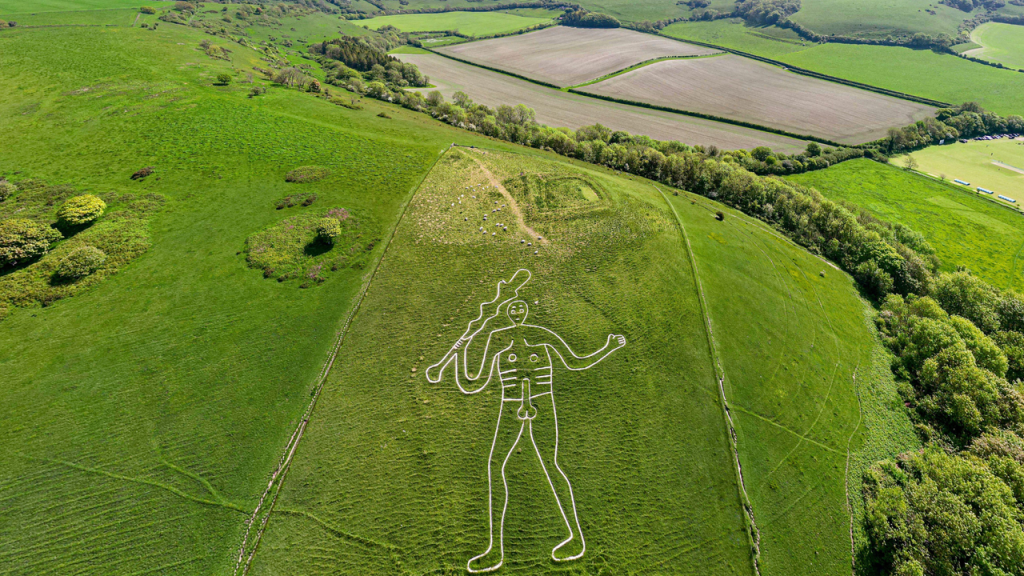
“For centuries, the Cerne Abbas Giant has been hard to miss,” said the BBC. The 55-foot chalk outline of a “naked, club-wielding man” cut into a hillside in the Dorset countryside is “one of the UK’s most instantly recognisable historic landmarks”.
Following recent fundraising efforts, the National Trust purchased the land surrounding the figure to help preserve it for future generations. Its origins are unknown but scientific analysis of sediments published in 2021 revealed the giant was probably first cut in the late Saxon period, between 700 and 1100 AD. Every eight to 10 years, volunteers visit the hillside to restore the figure by packing fresh white chalk into his outline.
Britain is “seared” with chalk figures like this one, said Dr Matthew Green in The Telegraph. From “fantastical beasts” to “beguiling symbols”, the “unsettling and beautiful” shapes are “cut into the bedrock of chalky hills”. In the “absence of detailed written evidence”, their roots remain a mystery.
Among the most “striking” is the Uffington White Horse in Oxfordshire. Best seen from the car park above Dragon Hill, it’s “more of a spectral echo of a horse than a horse”: the chalky outline doesn’t have hooves, its mouth looks like a beak, and it has a “ghastly, ghostly eye”.
Archaeology has dated the horse’s creation to 3,000 years ago in “the late Bronze Age” which is an “extraordinary survival”, said Jon Woolcott in The Guardian. “Generation after generation” have cared for it, “somehow keeping it bound to its wind-blown hill”.
Just over the border in Wiltshire, the rolling green hills are peppered with eight other chalk horses. Following the Ridgeway trail, you can walk to the Alton Barnes White Horse which is carved into Milk Hill, and another gleaming white horse cut into Cherhill Down near Oldbury Castle.
Drive for around two-and-a-half hours into East Sussex and on a “steep scarp of the South Downs” you’ll find the Long Man of Wilmington trekking over the hill, a “stave clasped in each hand”. Possibly Anglo-Saxon in origin, the “mysterious” carving has “fascinated” artists and writers for hundreds of years. Like the 40 or so other chalk figures that mark the British landscape, “their appearance enlivens walks and invites conjecture” to this day.
Ancient carvings cut into hilly grasslands make a captivating backdrop for a hike