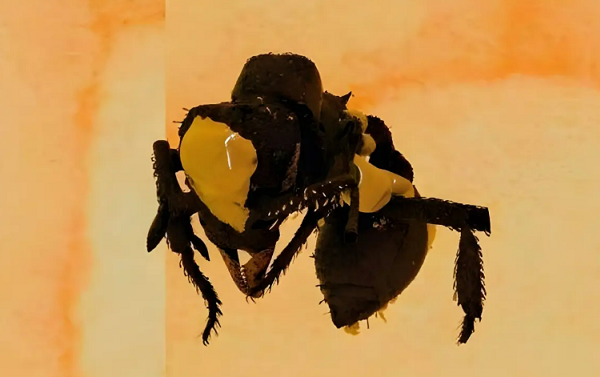

Andrei Ionescu (Earth.com) writes about the implications of the discovery of a fossilized dirt ant (Basiceros) in the Dominican Republic; specifically, a previously unknown species named Basiceros enana. [Also see our previous post Dominican Republic: Discovery of a Long-extinct Species Encased in Amber.]
An exceptionally well-preserved ant fossil encased in 16-million-year-old Dominican amber is offering scientists surprising new insights into the evolutionary journey of a rare group known as dirt ants, or Basiceros.
The fossilized ant – a previously unknown species named Basiceros enana – is the first of its kind ever uncovered in the Caribbean. The discovery suggests that these elusive ants once inhabited the islands before vanishing during the Miocene epoch, which spanned from roughly 23 to 5.3 million years ago. “Dirt ants are rare finds in the wild. Finding one today is exciting given how well they stay hidden, but captured in amber, it’s like finding a diamond,” said Gianpiero Fiorentino, the study’s lead author and a PhD candidate at the New Jersey Institute of Technology (NJIT). “This fossil is singularly distinct from all its modern relatives and reshapes the evolutionary history of Basiceros.”
Discovery of a dirt ant species
Previously, all known members of this ant genus were limited to neotropical rainforests stretching from Costa Rica down to Southern Brazil. Currently, nine living Basiceros species are documented.
The discovery of B. enana, however, raises new questions about how these ants once dispersed and colonized parts of the Caribbean. “Often lineages will have what appear to be fairly straightforward biogeographic histories. If you find a group of animals that only live in South America up to Costa Rica today, you really have no reason to expect that their early relatives lived in the Caribbean,” said Phil Barden, senior author of the study and associate professor of biology at NJIT. “A fossil like this underscores how the distribution of living species can belie the complex evolutionary history of life on our planet.”
Tracing the dirt ant’s ancestry
To analyze the ancient ant, the team employed cutting-edge imaging methods, including Micro-CT scanning at NJIT and the Okinawa Institute of Science and Technology Graduate University. These techniques enabled them to reconstruct the fossil in 3D and examine intricate anatomical details otherwise invisible. [. . .]
Ancient camouflage already in play
Yet despite its smaller size, B. enana already displayed some of the key adaptations that help modern dirt ants remain nearly invisible in their environment – a form of camouflage known as crypsis. These include two layers of specialized hairs designed to trap dirt and debris: long brush-like setae that lift particles and shorter, tighter hairs that hold them close to the body’s surface. [. . .]
The fossil also shares other recognizable features with today’s dirt ants, such as curved propodeal spines, a distinctive trapezoidal head, and sharp mandibles lined with a dozen triangular teeth – traits suggesting a predatory lifestyle.
A piece of a larger puzzle
Despite these survival advantages, Basiceros ants eventually disappeared from the Caribbean, likely due to dramatic environmental shifts during the Miocene. The team suggests that ancient land bridges might have allowed the ants to migrate from mainland South America to the islands.
“The presence of Basiceros in Dominican amber suggests ancient land bridges may have provided pathways for these ants to traverse from the mainland to the Caribbean,” Barden said. “This fossil is a piece of a larger puzzle that will help us understand why some groups of organisms undergo extinction and others stick it out for millions of years.” [. . .]
For full article, see https://www.earth.com/news/dirt-ants-were-once-masters-of-disguise-in-the-caribbean/
Andrei Ionescu (Earth.com) writes about the implications of the discovery of a fossilized dirt ant (Basiceros) in the Dominican Republic; specifically, a previously unknown species named Basiceros enana. [Also see our previous post Dominican Republic: Discovery of a Long-extinct Species Encased in Amber.] An exceptionally well-preserved ant fossil encased in 16-million-year-old Dominican amber is offering scientists