
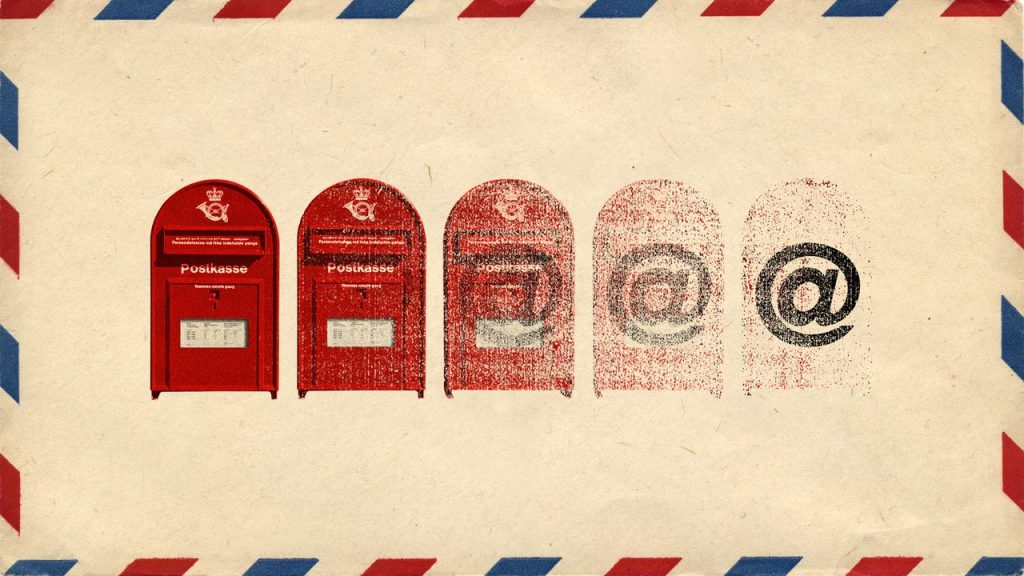
Danes are sending their last Christmas cards through the post. PostNord, Denmark’s state-owned postal service, will stop delivering letters at the end of this year, bringing to an end the 400-year-old tradition.
The country’s 1,500 remaining red postboxes have been “vanishing” since June, said The Times. A “handful” will be saved and end up on display in museums.
The news has “rattled” postal services around the world. Could this be a sign of things to come for Britain’s “beleaguered” Royal Mail?
‘Digital by default’
PostNord has seen a “steep decline in letter volumes” in recent years, said the BBC. Since 2000, the number has plummeted from 1.4 billion to 110 million last year.
The sharp downward trend is being driven by a shift towards digitalisation – Denmark is one of the world’s most digitalised nations, behind only South Korea, according to the OECD’s 2023 Digital Government Index. A “digital by default” policy has been “embraced” by the Danish government, with all correspondence carried out electronically for more than a decade.
The rising cost of sending a letter in Denmark hasn’t helped. A law introduced in 2024 that opened up the postal market to private competition saw the cost of a PostNord stamp jump to 29 Danish krone, or £3.35, for a single letter. Unable to justify keeping the service, PostNord has shuttered several of its “enormous letter-sorting facilities” and is slashing a third of its workforce (2,200 roles) from its “loss-making letter arm”. Instead, its attention will be turned to its profitable parcel business, where 700 new positions will be created.
But this doesn’t mean the death of letters. A private delivery firm, DAO, will “step into the gap with its own nationwide service”, collecting post from mailboxes inside affiliated shops instead of from postboxes or, for an extra fee, from people’s doorsteps. Without the traditional postal infrastructure, though, sending a letter may become more difficult – especially among elderly people unfamiliar with the new system.
Writing on the wall?
Post offices around the world have seen “letter volumes collapse over the past two decades” as emails and texts continue to replace paper, said The Economist. The trend was “exacerbated” by the pandemic, as housebound people communicated online while the demand for parcels skyrocketed.
In response, some postal services are “reinventing” themselves. Germany’s Deutsche Post, for example, pivoted into a logistics company after privatisation in 1995, also providing freight and supply chain management services.
With Royal Mail – now owned by Czech billionaire Daniel Křetínský – hiking the price of a first-class stamp to an “eye-popping” £1.70 (up 5p), and Saturday deliveries of second-class post due to be “scrapped” from next year, it looks as if the fate of Denmark’s post could be “the shape of things to come” in Britain, said James Moore in The Independent.
It’s hard not to imagine the UK entering a “doom loop”, as higher prices for a lesser service will “inevitably lead people to consider whether they actually need to send that card or whether an email greeting will suffice”, especially in the midst of the cost-of-living crisis.
For now, Royal Mail would be wise to “watch and learn” from how things play out in Denmark. The volume of letters being sent in the UK has dropped from 20 billion in 2004-25 to 6.6 billion in 2023-24, but that’s still a lot of letters. “So you can breathe easy. For now.”
Danish posties say ‘farvel’ to 400 years of tradition but can Royal Mail weather the storm?