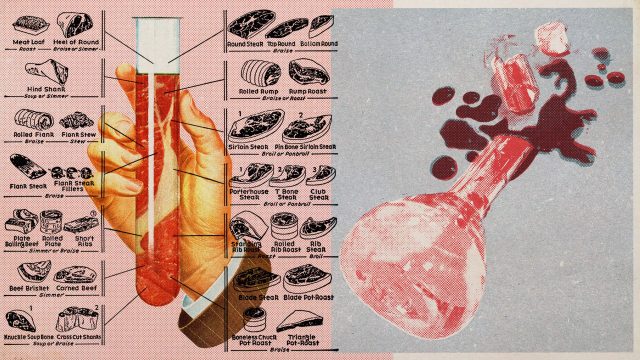
When lab-grown meat “first captured investors’ attention, the promise was simple: steak without cattle, chicken without poultry – a carnivorous diet stripped of its moral baggage”, said the Financial Times.
A decade later a combination of “high costs, slow regulation, consumer scepticism and the difficulty of scaling laboratory processes into industrial production” has skewered a sector that once threatened to upend the very way the world produces its food.
Gold rush
The first artificial meat burger was unveiled to much fanfare in 2013. Made from cattle cells grown in a laboratory by Mark Post, a professor of vascular physiology at Maastricht University in the Netherlands, it took two years to develop and cost €250,000 (about £210,000 at the time), funded in large part by Google co-founder Sergey Brin.
It “triggered a kind of gold rush”, said The Guardian. Alternative protein companies focusing on beef, pork, chicken and fish sprang up across the world, and the think tank RethinkX predicted the food industry was “on the cusp of the deepest, fastest, most consequential disruption in food and agricultural production since the first domestication of plants and animals 10,000 years ago”.
Theory vs practice
The technology “remains compelling”, said AgFunderNews. Unlike plant-based options, it has the appeal of “real” meat and “promises a consistent, local supply of meat made to order”, but “without the disease risks, supply chain vulnerabilities, environmental damage, and ethical baggage” that comes with the farming of animals.
“In practice, however, there’s no playbook for biomanufacturing meat at scale, funding has almost dried up, and the political environment has become increasingly hostile in key markets.”
At its peak in 2021, alternative protein companies raised more than $5 billion, according to the Good Food Institute. Last year this had dropped to $881 million, with cultivated meat and seafood companies attracting just $74 million in investment, said the FT.
In late 2025, two of the sector’s most prominent companies ceased operations within days of each other. Dutch start-up Meatable had been named one of Time magazine’s best inventions of 2024, while Believer Meats had built the world’s largest cultivated meat factory.
Better sausages not brand new steaks
Perhaps the only solution is to consolidate. “I don’t think as standalone companies they will survive,” Jeff Tripician, Meatable’s former CEO, told Food Ingredients First.
“They need to become part of – as in sell to – meat companies, so that it’s almost like an R&D investment they can manage over time. I don’t think there’s external funds that are going to come in to prop up the small companies the way they’re constituted today.”
As the early promise of “a rapid shift from farms to factories has receded”, the new pitch has become “more focused: cultured cells will work first in corners of the food system where the price is easier to bear or the advantages are simpler to explain”, said the FT.
“The technology is there but it’s technology to make better sausages, not brand new premium steaks,” said Max Jamilly, chief executive of Hoxton Farms, a London-based company growing cultivated pork fat.
High costs, slow regulation, consumer scepticism and difficulty scaling has seen investment dry up in recent years