
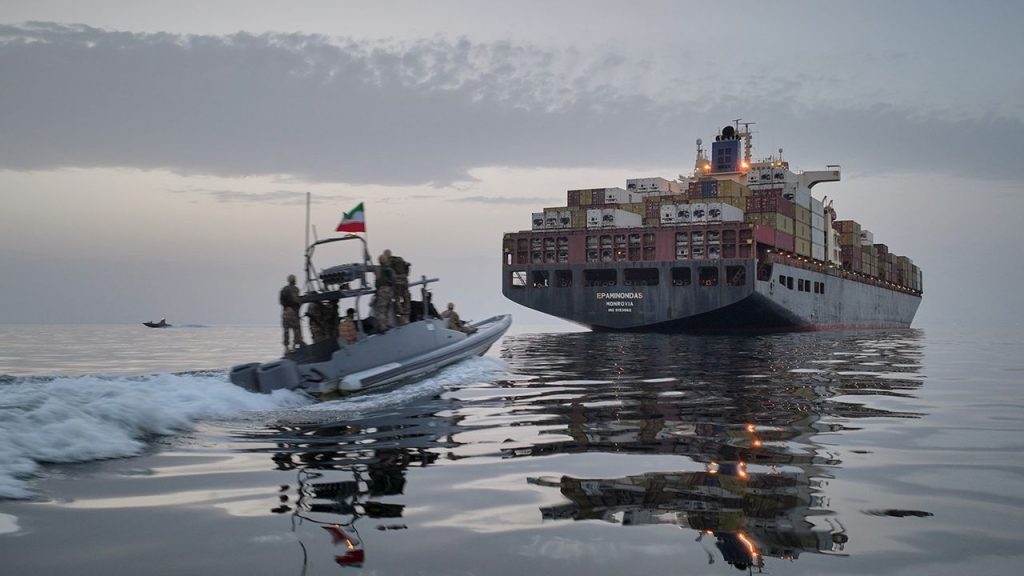
The war with Iran has hit a “toxic stalemate,” said Janna Brancolini in the Daily Beast. American officials poured cold water on a proposal from Tehran to end the two-month conflict, under which the U.S. would end its naval blockade of Iranian ports and Iran would reopen the Strait of Hormuz, a crucial oil-shipping route whose closure is choking the global economy. The regime’s nuclear program, meanwhile, would be discussed at a later date. A U.S. official said the nuclear punt was a nonstarter because it “would deny Trump a victory,” and in a 4 a.m. social media post—accompanied by an image of Trump as a gun-toting action hero and the caption “NO MORE MR. NICE GUY”—the president made his feelings clear on Tehran’s offer. “They better get smart soon!” he wrote, saying the regime’s only hope is to go “nonnuclear.” For now, Trump is set on “an extended blockade of Iran,” said Alexander Ward in The Wall Street Journal. He’s decided his other options, walking away or resuming bombing, carry more risk than targeting “the regime’s coffers in a high-risk bid to compel a nuclear capitulation Tehran has long refused.”
“Time is on America’s side,” said Mark Dubowitz and Miad Maleki in the New York Post. While U.S. motorists grumble about gas topping $4.20 a gallon, the remnants of Iran’s regime are battling triple-digit inflation, mass unemployment, a currency in “free fall,” and a U.S. blockade that has them “bleeding cash.” Worse, said Amit Segal in The Free Press, Iran is now “drowning in its own oil.” Within a few weeks, Iran will run out of storage for the crude it pumps out of the ground, leaving the regime no option but to halt production and see extraction systems clog up, a “death sentence” for its oil industry.
Don’t underestimate “Iran’s pain threshold,” said Ben Geman in Axios. The country has alternate storage facilities, including a fleet of floating crude carriers, and continues to sneak tankers past the U.S. Navy. And experts say the regime has other revenue sources, including oil exported overland, “to keep its troops paid and its position in Iran secure.” Iran believes it can hold out for at least another two or three months, said Ali Vaez in The New Yorker, and that “the American timeline” is more like two to three weeks. With Trump’s approval rating hitting a record low of 34% in a new Reuters poll, the regime thinks cost-of-living pressures will force him to back down and save Republicans from a wipeout in the midterms. Trump also doesn’t want the war to dominate his mid-May visit with Chinese President Xi Jinping, let alone for jet-fuel shortages to ruin this summer’s World Cup, which the U.S. is co-hosting with Mexico and Canada.
Trump might still be able to reach a deal with Iran, said Katrin Bennhold in The New York Times, but it won’t be as good as the Obama-era pact he ripped up in 2018. That deal barred Iran from enriching uranium above 3.67% purity; its current stockpile is at 60% and with further processing could be used to build 100 nuclear bombs. And Tehran now has better cards to play than during the negotiations for the 2015 deal, including control of the Strait of Hormuz. For future talks to have any chance, Trump will “have to abandon his ‘I win, you lose’ approach to diplomacy,” said Trudy Rubin in The Philadelphia Inquirer. As gas prices climb higher, perhaps he’ll accept a compromise that lets both Iran and the U.S. save face. But based on everything we’ve learned about our president, “this hope requires a suspension of disbelief.”
Both sides think they can hold out longer than the other