
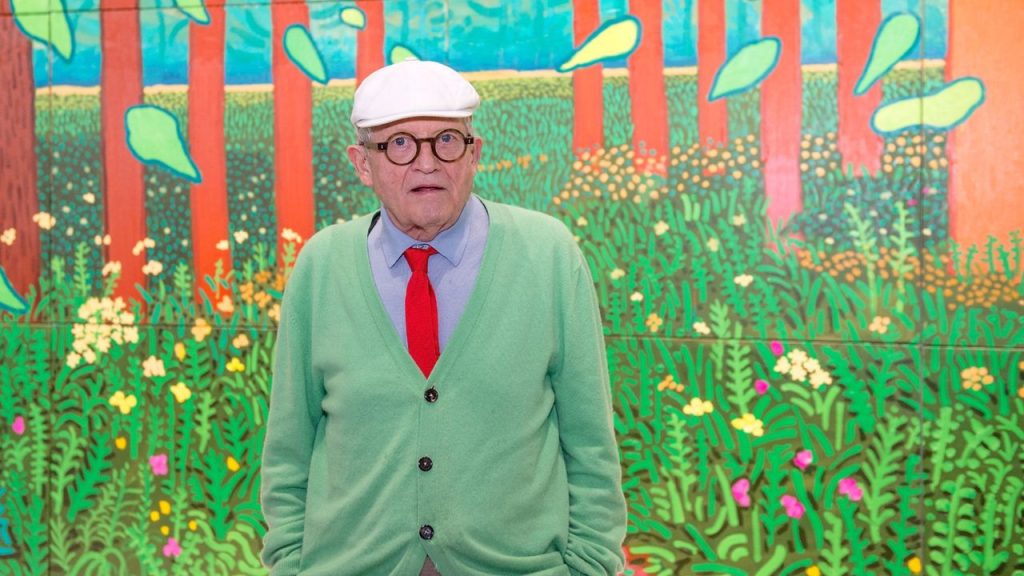
David Hockney, who has died aged 88, was widely considered to have been Britain’s greatest living artist, said The Daily Telegraph. Instantly recognisable, with his bleached-blond hair, round glasses, impish smile and “ever-smouldering cigarette”, he was for decades a subject of fascination to the world’s media, as Picasso had been a generation earlier. And just as Picasso once commented that he never produced a painting as a work of art – it was all research – Hockney was a man of restless curiosity, who for more than 60 years never stopped the process of experimentation and reinvention.
What drove him was an intense need to understand “the way the world works, how the eye sees it and how the brush sets it down”, said Laura Freeman in The Times. “What happens when raindrops strike still water? Or a body breaks the surface of a swimming pool? How do you capture a glass of water, transparency on transparency, or shafts of sunlight on a polished parquet floor?”
He was a superb draughtsman, but there was no medium he would not try in his effort to depict the world as it is seen. He worked in oils, acrylics, watercolours, charcoal, pen and ink, pencil, felt-tips, crayons; he produced etchings and drypoints; and made use Polaroid cameras, Xerox photocopiers, inkjet printers and the iPad. His inspirations ranged from Monet to Chinese scrolls to the Bayeux Tapestry, and he found inspiration in everything California’s epic landscapes to the graffiti in public lavatories.
Accessible superstar
He was fascinated by the mechanics of image-making, said Kelsey Ables in The Atlantic – and, as he put it, “any technology that is about pictures”. In 2001, he published an art historical book in which he laid out his carefully researched but hotly debated theory that the likes of Caravaggio and van Eyck had used devices such as concave mirrors and projecting lenses to achieve realism.
Hockney’s work was not always universally admired by the critics; but his aim, he said, had never been to please a room full of art-world insiders, but to make pictures that were appreciated by a lot of people. And he did. People flocked to his exhibitions; their posters became collectors’ items. In 2018, one of the sun-drenched paintings he produced in California – 1972’s “Portrait of an Artist (Pool with Two Figures)” – became the most expensive artwork by a living artist ever sold at auction, at $90 million.
Yet neither his enormous success, nor the glamorous circles in which he moved – in Los Angeles, Paris and London – seemed fundamentally to change him. “The moment I first sold pictures to earn a living, I felt rich,” he said. “I’ve been rich ever since… You are a rich man if you do the things you want to do.” He retained a deep-seated seriousness about his work and a ferocious dedication to it; he was not a regular on any party circuit. And he never ceased to be a Yorkshireman (nor did he lose his accent, which he said might have been partly due to his inherited deafness: he started losing his hearing in his 40s).
He was an art-world superstar, who somehow conveyed a sense of being personally accessible. Modest, direct and down to earth, he remained close to his family (he spent every Christmas with his parents until their deaths) and for a period in the latter part of his life, he lived in the seaside town of Bridlington, in east Yorkshire. Over the years, he attained a level of popularity “that has eluded younger British artists”, said Jonathan Jones in The Guardian, “and has more in common with that of David Attenborough” or Queen Elizabeth II.
Grammar school boy
David Hockney was born in Bradford in 1937, the fourth of five children. His mother, Laura, was a devout Methodist and a vegetarian, while his father, Kenneth, who worked as an accounts clerk and also restored prams and bicycles, had been a conscientious objector, and was a militant anti-smoker.
Hockney inherited a propensity for strongly held views, but he famously campaigned for the right of smokers to smoke, said Zoe Williams in The Guardian. He loved tobacco, he said. He kept 2,000 cigarettes at home “for emergencies”, and liked to point out that he had outlived four doctors who’d advised him to kick the habit. He held a sign reading “DEATH awaits you all even if you do not smoke” at a Labour Party conference in 2005, and from 2012 he sported a badge saying: “End bossiness soon”.
Hockney grew up during the War, and money was tight, but from the age of three, he drew where he could – even on the kitchen floor. Years later, he said that being gay in that era had not been as hard for him as it might have been, because he had always felt set apart by his talent. To his parents’ delight, he won a scholarship to Bradford Grammar School, but the boys in the top stream were not given much time in the art room, so he determinedly dropped down the divisions. In one science paper, he left the answers blank, and wrote “am no good at science but I can draw” above a sketch of the invigilator.
At 16, he was awarded a grant to attend Bradford School of Art. On his first day, he turned up in a suit, bowler hat and red scarf, but while his dress sense was outlandish, his work ethic was even then decidedly Protestant, said Sam Woodhouse on BBC News: he was at his easel for 12 hours a day. Later, he kept by his bed a sign reading: “GET UP AND WORK IMMEDIATELY”.
Extraordinary talent
He sold his first painting, a portrait of his father, in 1957, for £10. By then, the themes that would preoccupy him were already evident, said The Daily Telegraph: “a cool self-interest, a strong sense of pattern, the contrast between stillness and movement, surface and depth”. He refused to do National Service, and spent two years scrubbing floors as a hospital orderly instead. In 1959, he moved to London to study at the Royal College of Art, where his contemporaries included Allen Jones and R.B. Kitaj.
Figurative art was regarded as over in the early 1960s. Hockney gave the fashionable abstract expressionism a try, but found it unsatisfying. Eventually, he took Kitaj’s advice – to paint the things that he loved, that interested him and mattered to him. In his second year at the RCA, he produced “We Two Boys Together Clinging” – the title refers to a Walt Whitman poem. It depicts two blob-like figures locked in an embrace. Numbered codes indicate that they represent the artist and his unrequited crush, Cliff Richard. Homosexual acts would not be decriminalised for another six years, but Hockney did not stay long in the closet. “Never worry about what the neighbours think,” had been his father’s advice.
To graduate, he was required to write a thesis. He refused to comply, stubbornly insisting that he be judged on his art alone. Recognising the extraordinary nature of his talent, the RCA not only made an exception for him, it awarded him a gold medal. He turned up to the ceremony wearing a gold lamé jacket. His sartorial style evolved over the years but was never less than eye-catching. “Yellow galoshes,” exclaimed King Charles delightedly, when he spotted the Crocs that Hockney had paired with a Savile Row checked suit for a lunch at Buckingham Palace in 2022. “Beautifully chosen!”
Out west
A star straight from art school, he was taken on by the dealer John Kasmin, who oversaw his production of “A Rake’s Progress”, a series of etchings inspired by a visit to New York in 1961. He’d relished the energy of the city and its more permissive attitudes, and these semi-abstract etchings depicted the rake cruising in Central Park, dying his hair and drinking in gay bars. Kasmin marketed them at £250 a set. With the proceeds, Hockney flew back to New York in 1963, and then on to Los Angeles. Other artists were drawn to Manhattan, said The Times, but he told interviewers that he found its lines too vertical.
As the plane made its descent, he was struck by the sight of hundreds of swimming pools twinkling blue in the sunshine. “My God,” he recalled thinking. “This place needs its Piranesi… so here I am.” Los Angelinos would later tell him, he said, that they had not really noticed the palm trees until he started painting them. As well as California’s sunlight and blue skies, he embraced its sense of freedom, and its open gay culture. He rented a flat in Santa Monica, and within a few months he had flown his parents out from Bradford to visit him. En route from the airport, his mother gazed out of the window, apparently rapt by these strange surroundings. “I don’t understand it,” she eventually remarked. “Such lovely drying weather and no one’s got their washing out.”
His first California picture was 1964’s “Plastic Tree Plus City Hall”, said The Guardian, which celebrated the flat artificiality of LA, what the critic Robert Hughes called its role as a “glaring, over-lit, antiseptic madhouse”. To paint it, he had swapped his oils for acrylics. Doing away with surface texture, these plastic-based paints were perfect for capturing the bright colours and – “that signifier of a shallow”, more hedonistic world – “the dappled surface of a chlorinated pool”. The same year, he produced “Picture of a Hollywood Swimming Pool”. It is “poster-like” but – like the artist who painted it – its “frivolity is deceptive”. This is a “polished, late-modernist work”, with an “interplay of surface and depth” that draws “on its maker’s knowledge of Matisse and Cézanne”. A voracious reader, Hockney was highly learned.
He followed it up with the pool paintings that remain among his most famous, including “Peter Getting Out of Nick’s Pool”, featuring the tan-lined bottom of Peter Schlesinger, his muse and lover, and 1967’s “A Bigger Splash”. In 1973 that work lent its name to a semi-fictionalised documentary about the artist. Shot over three years, it was focused on Hockney’s painful break-up Schlesinger, his partner from 1966. Hockney repeatedly painted his partners, his friends and the other people around him, while refusing most commissions. The art critic Waldemar Januszczak once asked why he had never painted the late Queen. “Because I didn’t know her,” he replied.
Artistic evolution
In the 1970s, he produced a series of double portraits. One was of Christopher Isherwood (an avid collector of his work) and his partner Don Bachardy. “Mr and Mrs Clark and Percy” shows the fashion designer Ossie Clark, his wife, the textile designer Celia Birtwell (Hockney’s muse for several decades), and their cat (actually Blanche), in their flat in Notting Hill. The painting was a wedding present; but the conventions of wedding portraiture are overturned (she stands, he sits) and the portrait hints at the complexities of the couple’s relationship. He also painted his parents. In “My Parents”, his mother sits upright, staring lovingly at her son, her face illuminated by light from an unseen window; his father looks restless, as he sits hunched over a book. There is a space between them. “It is a tender picture about the failure of communication,” said The New York Times, “and the loving acceptance of that.”
The 1980s were a difficult period. As HIV-Aids ravaged LA’s gay community, Hockney saw countless friends and acquaintances fall sick and die. That his hearing was starting to deteriorate left him further isolated. Professionally, he moved away from painting and started to work on his “joiners” – hundreds of photographs (initially Polaroids) that he stitched together in an effort to create images that encompassed multiple viewpoints. He called this new cubism. Later on in the decade, he began experimenting with photocopies, and also distributed his drawings to friends via fax machines. Having produced evocative set and costume designs for “The Rake’s Progress” at Glyndebourne in the mid-1970s, he embarked on major projects for the Metropolitan Opera in New York. More intimately, he painted and drew his beloved dachshunds, Stanley and Boodgie, over and over again.
Meanwhile, he had continued to paint his mother, on his many visits home. She died in 1999, aged 98. A few years later, he left LA and settled in the Edwardian villa overlooking the sea that he had bought for her, in Bridlington. From his studio nearby, he produced a series of monumental paintings of the Wolds landscape. These formed the basis of “A Bigger Picture” – a record-breaking exhibition at the RA in 2012. The following year tragedy struck when his 23-year-old studio assistant, Dominic Elliott, was found dead in his house after a drink and drugs bender. Hockney – who had been asleep at the time – was devastated. Soon after, he moved to Normandy with his partner of two decades, Jean-Pierre Gonçalves de Lima, where he captured the shifting landscape on an iPad. During the March 2020 lockdown, he sent out a new iPad drawing of yellow daffodils against a grey field, with the message: “Do remember they can’t cancel spring.” He was at heart an optimist, who signed off emails to friends with the words: “Love life.”
Over the years, Hockney was offered countless honours and turned most down – including a knighthood. He did, however, accept the Order of Merit. It was a personal gift from the then-Queen, and he reasoned that it would be ungracious to reject it. Arguably, the honour he most appreciated came in 2007, said Sam Woodhouse. At a dinner at Tate Britain to mark his 70th birthday, it was announced that the smoke alarms would be turned off for ten minutes at the end, so that Hockney could have a cigarette with his coffee.
David Hockney obituary: titan of British art who never stopped seeing