Paulina Kubiak (UN News) reports on the ongoing fear and tensions as the United States threatens to impose tariffs on any country providing oil to Cuba. Cuba has also been relisted by the United States as a state sponsor of terrorism. The country is already seeing the effects as countries like Canada decide to put a halt of their services to and from Cuba (see “Air Canada suspends its Cuba service in response to the aviation fuel shortage”). The island is now facing greater shortages and infrastructure challenges.
The United States has threatened to impose tariffs on any country providing oil to Cuba, increasing pressure on the island nation following a decades-long trade embargo and the US seizure of Venezuela’s leader Nicolás Maduro last month.
Venezuela had been the main supplier of oil to Havana but Washington has been ratcheting up pressure on Cuba in recent weeks, including an executive order last Thursday threatening to impose additional tariffs on countries that sell oil to Cuba, including Mexico.
“I can tell you that the Secretary-General is extremely concerned about the humanitarian situation in Cuba, which will worsen, and if not collapse, if its oil needs go unmet,” said UN Spokesperson Stéphane Dujarric.
The UN chief noted that the General Assembly has been calling for an end to the US embargo for more than three decades: “The Secretary-General urges all parties to pursue dialogue and respect for international law.”
Fuel crisis
The fuel crisis has pushed up food prices for Cubans, led to severe fuel shortages and major power cuts throughout the country. “Clearly what we see now, especially after the recent events in Venezuela, is a combination of emotions,” said Francisco Pichon, the most senior United Nations official in Cuba, describing “a mix of resilience, but also grief, sorrow and indignation, and some concern about the regional developments.”
Thirty-two Cubans were killed in Venezuela on 3 January in the US operation to capture Mr. Maduro.
The UN’s humanitarian work in Cuba
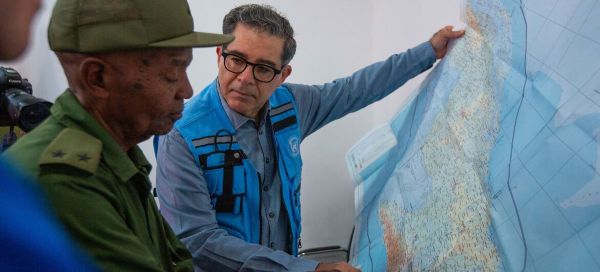
Mr. Pichon spoke to UN News from Havana last month, where the power had just gone out in his office. The UN team said that the vast majority of Cubans are being hit by rolling blackouts, at a time when the number of people in vulnerable situations has increased significantly.
Even before the latest regional developments, the UN has been working with the Cuban Government to incubate ideas and support development, including ways to diversify the Cuban economy.
“The energy transition is a major priority due to reduced access to fuel and infrastructure challenges,” Mr. Pichon said, noting that investment needs remain a bottleneck.
Urgent changes needed
“The last two years have been quite tough,” he added, stressing that urgent changes are needed to sustain Cuba’s social model “in the midst of the severe economic, financial and trade sanctions”.
Cuba’s economy, which has historically relied on tourism as a key source of hard currency, was severely disrupted in the COVID pandemic and remains well under 2018 levels. As the Cuban economy has deteriorated, the country’s social indicators – such as universal healthcare, universal education, and extensive social safety nets like subsidised healthcare and food rations – are under strain.
“All of this is happening in the context of the US embargo against Cuba,” said Mr. Pichon, noting that Cuba has also been relisted by the United States as a state sponsor of terrorism.
“From the UN perspective, our guiding principles remain unchanged: To be present. To support. To act based on cooperation, respected for international law, and the UN values.” Mr. Pichon, as UN Resident Coordinator, oversees the work of 23 UN agencies, funds and programmes. Here is a snapshot of some of the work underway. [. . .]
For full article, see Cuba: UN warns of possible humanitarian ‘collapse’, as oil supplies dwindle | UN News
Also see Air Canada Suspends Service to Cuba Amid Fuel Shortage
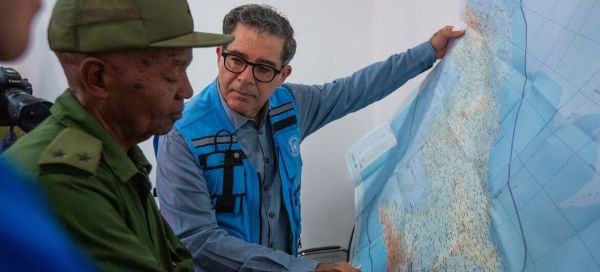
[Shown above: “UN Resident Coordinator Francisco Pichón speaks with civil defence authorities in Santiago de Cuba.”]
Paulina Kubiak (UN News) reports on the ongoing fear and tensions as the United States threatens to impose tariffs on any country providing oil to Cuba. Cuba has also been relisted by the United States as a state sponsor of terrorism. The country is already seeing the effects as countries like Canada decide to put