

Daniel Delgado and Ellen von zur Muehlen (People’s World) write about Cuba’s vulnerabilities, resistance, and the “rational and creative measures actively undertaken by the Cuban government and people to not only mitigate the effects of the crisis but also build toward a more independent and sustainable future.” [Many thanks to Peter Jordens for bringing this item to our attention.]
Trump’s recent escalation against Cuba, threatening to tariff nations that trade oil with Cuba, is compounding hardships in the island nation and motivating the international solidarity community to help.
Since the kidnapping of Venezuela’s sitting President, Nicolás Maduro, on January 3rd, the MAGA administration has set its sights more intensely on Cuba, with Marco Rubio leading an all-out siege on the sovereignty of not only the Caribbean island nation, but all of Latin America.
While Cuba has endured a blockade for over 60 years, in recent years it has had to withstand redoubled pressure from the colossus to its north, from being placed on the spurious State Sponsors of Terrorism List to the now virtual oil blockade. The effects of this pressure are palpable on the island: long gas lines, severe power outages, delays in trash collection, and scarcity of necessary medical equipment and supplies.
Yet, tuning in to the U.S. media gives the impression that Cuba is facing such challenges with crossed arms, waiting for the final blow to bring it to its knees. Corporate journalists spin the narrative with seemingly no evidence that the Cuban population is on the verge of mass starvation, all public services have ceased to function, and the nation awaits an external hero to relieve them of their suffering.
This is far from the truth.
Not only does this exaggerate the conditions on the ground, but it also obscures the rational and creative measures actively undertaken by the Cuban government and people to not only mitigate the effects of the crisis but also build toward a more independent and sustainable future.
Solidarity activists should be wary of reproducing the tropes of the corporate media, which paint the island as a hopeless vestige of a past era now in total decline. As the Cuba solidarity movement mobilizes to meet the moment and bring assistance in support of the Cuban people, it is crucial that activists have correct and accurate information, as well as a longer-term vision.
A few shipments of food or medical goods will provide short-term relief and be a welcome contribution, but a deeper horizon is required. Humanitarian aid may be helpful, but it will not solve the larger economic issues Cuba faces as a result of the blockade that shackles their capacity for autonomous development and international trade. [. . .]
What is Cuba doing?
Dependence on imported petroleum makes Cuba vulnerable to attacks of the kind Trump, egged on by Rubio, is waging. This is why the national focus is on building an autonomous energy grid sustained by renewable energy and nationally produced oil.
With cooperation from both Russia and China, Cuba is building out its solar and wind energy capacities, as well as renovating its thermoelectric plants. Not only is the government developing large solar parks to supply the national grid, but it is also installing panels to electrify homes in remote rural areas, aiming to achieve full electrical access for the whole population. Additionally, the government is offering favorable financing options for individuals in critical sectors such as health and education to acquire solar panels for their homes.
While the expertise and solar panels themselves are supplied by China, Cuba is also developing an expert workforce trained in various aspects of renewable energy development. This is a further step toward energy sovereignty and constitutes an investment in human resources that will one day allow Cuba to aid other nations in developing their renewable energy sectors.
In a recent national press conference, Cuba’s President Miguel Díaz-Canel remarked that in addition to the over 1,000 megawatts added to the national electrical system in 2025, “we aim to add a similar number this year, so we will be achieving levels above 15 or close to 20 percent of our electrical generation with renewable sources.”
At the rate Cuba is going, they will reach their original goal of 25 percent renewable energy by 2030 a few years early. Cuba also boasts significant reserves of cobalt and nickel, empowering it to potentially produce its own solar panels, electric vehicle and battery technology with further development of its industrial capacities.
Another forward-looking policy, Cuba is incentivizing homes and businesses that have acquired their own solar and wind energy generation systems to engage in cogeneration. This means that private citizens and businesses would use their surplus energy (generated by solar panels or wind turbines) to share with their neighbors or sell back to the national grid. [. . .]
A sign of the changing times, throughout Havana—a city known for its vintage American cars—the collective taxis people use on their everyday commutes are rapidly changing. Whereas these were usually old, gas-guzzling 1950s Chevrolets, increasingly Cubans are using new, electric Chinese tricycle wagons.
Imperialism vs Internationalism
Highlighting Cuba’s modes of resistance and future-oriented planning is not to negate the real material effects of the intensified blockade in Cuban’s lives. Currently, Cuba is still far from achieving its planned goals of energy independence, and the toll of fuel shortages on people’s lives is real and heavy; Cubans are dealing with difficult realities no one should have to endure. [. . .]
For full article, see https://peoplesworld.org/article/cuba-resists-sovereignty-under-the-boot-of-u-s-imperialism
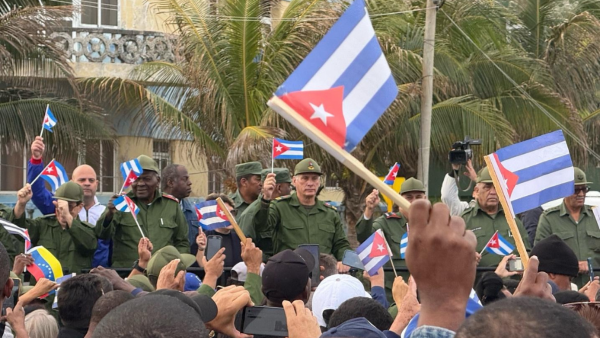
[Photo by Daniel Delgado/People’s World: Havana, Cuba, January 16, 2026. “Cuban President Miguel Díaz-Canel and other top officials wave to protesters as they march past the U.S. embassy.”]
Daniel Delgado and Ellen von zur Muehlen (People’s World) write about Cuba’s vulnerabilities, resistance, and the “rational and creative measures actively undertaken by the Cuban government and people to not only mitigate the effects of the crisis but also build toward a more independent and sustainable future.” [Many thanks to Peter Jordens for bringing this item


