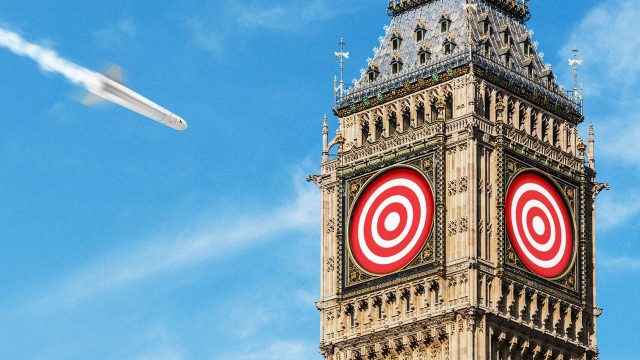
The targeting of Iranian missiles at the Diego Garcia UK-US military base on Friday has sent alarm bells ringing in Europe. Diego Garcia is over 2,500 miles (4,000km) from Iran and, if a missile from Tehran can reach there, it could also reach Paris, Berlin or even London.
“Previously, we thought Iran’s missiles had a range of 2,000km (1,245 miles),” General Sir Richard Barrons, former commander of Joint Forces Command, told BBC Radio 4 on Saturday.
One of the missiles fell well short of its target and the other was shot down, said Defence Secretary John Healey. But “the launch, however unsuccessful” has “fuelled fears” about the range of Iran’s ballistic missile programme, said the BBC’s defence correspondent Jonathan Beale.
What did the commentators say?
Israel has claimed Iran is developing weapons capable of travelling 2,500 miles (4,000km). “We have been saying it,” the Israel Defence Forces posted on social media. “The Iranian terrorist regime poses a global threat. Now, with missiles that can reach London, Paris or Berlin.”
This could “put continental Europe and possibly even Britain under threat”, defence analysts told The Telegraph’s Paul Nuki. Every European capital “now lies within credible Iranian reach”, Ran Kochav, former commander of the Israeli air and missile force told the paper.
Yes, it’s “conceivable” that an Iranian rocket “could reach London”, Sidharth Kaushal, of the Royal United Services Institute think tank, told the BBC’s Beale. But “so what?” We’re talking about “a small number” of conventional missiles over “well-defended airspace”, and they are “quite inaccurate at very long ranges”. The risk to London is “pretty low”, research analyst Decker Eveleth of the CNA Corporation told Beale. A missile could travel the distance but it wouldn’t be “particularly aim-able”. It would also be spotted quickly. Using a network of satellites and powerful radars, the US Space Force can track the trajectory of “any missile fired across the globe”.
“Various sources” agreed that it was unlikely that missiles launched from Iran would be able to hit London, said Jamie Grierson in The Guardian. Britain is protected by Nato’s ballistic missile defence, a shield “designed to detect, track and intercept” weapons in flight, bolstered by two Aegis Ashore defence sites in Poland and Romania.
The UK government is “not aware of any assessment at all” that Iran is “even trying to target Europe, let alone that they could if they tried”, said Communities Secretary Steve Reed on the BBC’s “Sunday with Laura Kuenssberg”. And “even if they did, we have the necessary military capability” to defend ourselves. “The UK is not going to be dragged into this war.”
What next?
Britain has “very little in the way of” independent “ballistic missile defences”, said the BBC’s Beale: “a glaring gap” acknowledged by the government’s recent Strategic Defence Review. But it’s “unlikely” that Iran has “large numbers of intermediate or even long-range ballistic missiles”. The fact that it only fired two towards Diego Garcia “suggests its long-range missile capability is limited”. For now, “the threat seems remote”.
Even if it were able, Iran is unlikely to single out the UK for a missile attack, according to a recent paper from the European Centre for Counterterrorism and Intelligence Studies. More likely would be “precision strikes on Nato logistics hubs, and economic disruption” through attacks on Mediterranean ports or liquefied natural gas terminals in Italy, Greece and Romania.
“Nato does have what it takes to defend alliance territory, to defend our one billion inhabitants,” said Colonel Martin O’Donnell, spokesperson for Supreme Headquarters Allied Powers Europe. Europeans “should rest easy at night”.
Attempted missile attack on Diego Garcia suggests Tehran has weapons with range to reach Europe