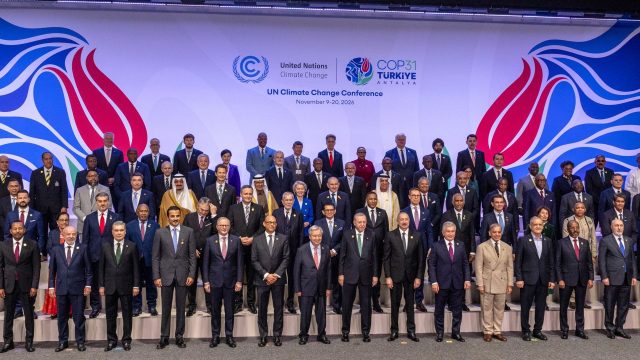
The annual two-week UN climate conference got under way in Antalya, Turkey, on Monday. Progress is likely to be difficult.
Remind me, how do the Cops work?
Cop stands for Conference of the Parties: the countries that are parties to the UN Framework Convention on Climate Change. In theory, that means every nation on Earth is involved – though not all send delegations. Afghanistan and Myanmar, for instance, didn’t attend Cop30 in Belém, Brazil, last year; and nor did the US, which was pulled out of the landmark Paris Agreement of 2015 (made at Cop21) by President Trump.
In the Paris Agreement, all nations committed to keeping global warming “well below 2°C above pre-industrial levels”, with “efforts to limit them to 1.5°C”, which the UN Intergovernmental Panel on Climate Change found would “significantly reduce the risks”.
Subsequent meetings have been focused primarily on making national pledges on reducing emissions to meet these targets, refining rules and assessing progress. The main Cop agreements have to be agreed by consensus: unanimously.
How is the fight against global warming going?
Not well. Global average surface temperatures for January to September 2026 were already around 1.47°C above the preindustrial average, according to the World Meteorological Organisation. The chance of holding global warming to 1.5°C is “now gone”, the Emissions Gap Report 2026 from the UN Environment Programme (Unep) concludes.
The question now is how far we “overshoot”, and how damaging that will be. Greenhouse gas emissions are still increasing. In 2025, Unep estimated that 58.4 billion tonnes of greenhouse gases were emitted – possibly a record, though not much higher than in 2024.
Is it all doom and gloom?
No: much progress has been made. Global emissions have levelled off while the world population and the demand for energy are still growing. In the ten years before the Paris Agreement, emissions rose by 18%. In the ten years after, they rose by 1.2%. A decade ago, the world was heading for around 4°C of heating by 2100 (instead of 2.5-3°C).
“This shift reflects an extraordinary surge in clean energy deployment, stronger policy frameworks and the mainstreaming of net zero as a common global goal to tackle climate change,” according to the Energy & Climate Intelligence Unit. EU emissions have dropped by 17% since Paris, and the UK’s by 25%. China’s fast-growing renewable capacity now outstrips coal. Solar energy is booming across the developing world.
Why is the process in difficulties?
Cop30 in Brazil was seen as a failure, because the final agreement omitted even to mention fossil fuels. A coalition of around 80 countries (including the UK and the EU) had pushed hard for a commitment to plan a “transition away” from fossil fuels. But a similar-sized bloc, including major oil-producing nations led by Saudi Arabia and Russia, alongside nations such as India, strongly opposed this, citing the need to protect their economic development.
Wealthy nations officially agreed to (at least) triple finance to allow poorer nations to adapt to climate change, but this was heavily undermined by a series of omissions and loopholes. The absence of the US, the second-largest emitter – on the grounds that the Paris Agreement imposed an “unfair economic burden” – also undermined credibility.
How are the prospects for Cop31?
It is facing heavy headwinds. The cost of living, and of fossil fuels, are at the top of most nations’ list of concerns; the climate and foreign aid are much further down. Wars in Iran and Ukraine have increased geopolitical tensions.
The negotiating process looks likely to be even more complex than usual, since the presidency will be shared between the host, Turkey, and Australia. Both have poor environmental records. Australia is one of the world’s top coal exporters, and has recently approved dozens of new fossil fuel projects, including major coal mine expansions. It is also thought likely to miss its binding 2030 emissions-reduction goals. Turkey, for its part, is a major coal burner: about a third of its electricity is coal-derived, and emissions are rising fast.
What’s on the agenda in Antalya?
Australia will take charge of formal negotiations. These will focus on converting past promises on emissions into verifiable national policies; around 50 nations are lagging. The other major sticking point is the delivery of climate finance to developing nations, to help them adapt. Such nations want a large increase on the current minimum promise of $300 billion per year by 2035; developed nations, under great fiscal pressure, are unlikely to agree.
Turkey will lead the “Action Agenda”, the Cop’s non-negotiated “track”, where real-world solutions are discussed. A major theme will be electrification. The target is “35 by 35”: the hosts want nations to commit to derive 35% of final energy use from electricity by 2035, up from a global average of 23% (by electrifying cars, heating and factories, for instance). Electricity is much more efficient than fossil fuels: this will reduce emissions considerably, however the electricity is generated.
Are the Cops fit for purpose?
Arguably, these mega-meetings are no longer doing their job. Perhaps 90,000 people will attend Cop31, and critics argue that, now that it covers a plethora of environmental issues, from plastics to biodiversity, it has lost its focus. “The result is intense horse trading, diluted outcomes and a negotiation agenda that no team of diplomats, however skilled, can realistically handle,” says the former UN climate adviser David Carlin. “When everything is a priority, nothing is.”
The process is clearly failing in its central purpose of reducing global warming, agrees Johan Rockström of the Potsdam Institute for Climate Impact Research. On the other hand, it “is all we have”: climate change can only be addressed if all nations move together to reduce emissions heavily.
Annual climate conference comes as cost of living concerns have pushed the environment down the agenda in many participating countries